When I first published my article, The Circus of Roman Emperor Nero: Were Saint Peter Was Martyred in 2016, my intention was to simply present that the Christians were not martyred in the Colosseum, as tradition has it, but rather at another location, the Circus of Nero. However, my title caused a few readers to argue that Peter the Apostle was never in Rome. They state that there’s no historical or biblical proof that he was ever there. Again, my intention at that time wasn’t to get into a theological debate.

But those comments got me thinking; how did this tradition get started if there wasn’t any historical or biblical reference? And if he were indeed in Rome, as tradition says, then why is there no proof? After a little armchair researching, I found some interesting bits of information that may help to shed some light on this question: Was Saint Peter ever in Rome?
Saint Peter in Rome and the New Testament
One of the main arguments used against Peter being in Rome is the New Testament of the Bible. Those using this argument point to the fact that the New Testament doesn’t mention Peter being there. However, when you compare the dates of when the books of the New Testament were written with those of the Christian persecutions, it becomes relatively straightforward why Peter’s presence in Rome isn’t mentioned.
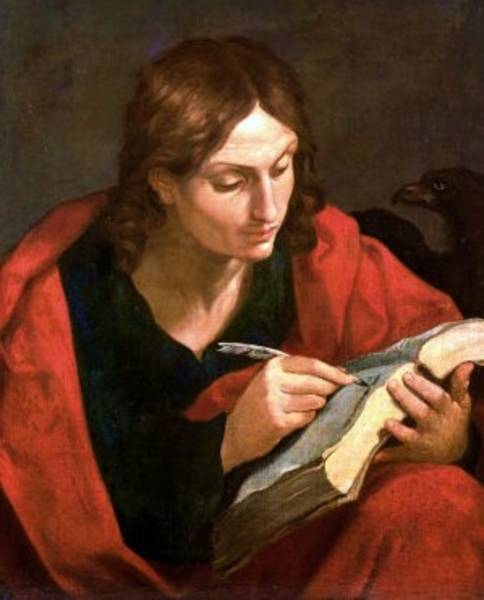
Most historians and theologians agree that the first three Gospels were written between 50 and 60 AD, and the Epistles of the Apostles were written around 44 to 70 AD. Also, the only book of the New Testament that directly tells the history of the early Christian church and the Apostles is the Book of Acts, which was written around 62 AD. Now compare those dates with the accepted time of Nero’s persecutions and Peter’s arrest and martyrdom, which was between 64 and 68 AD. So, it would be tough for the writers of the New Testament to include an event that hadn’t happened yet.
But some theologians believe that one gospel writer knew of Peter’s crucifixion and death and wrote about it. The last gospel, the Gospel of John, was written between 80 and 90 AD, which was long after Peter’s death in Rome. In John 21:18 and 19 the author has Jesus saying to Peter, “Truly, truly, I say to you, when you were younger, you used to gird yourself and walk wherever you wished; but when you grow old, you will stretch out your hands and someone else will gird you, and bring you where you do not wish to go. Now this, He said, signifying by what kind of death he would glorify God.” Was the writer then describing Peter’s martyrdom by crucifixion in Rome?
Saint Peter in Rome and Historical Accounts

Modern statue outside the Austrian Parliament.
The second question, why there are no historical records of Peter being in Rome, is also straightforward to understand. At the time of Nero’s reign, Christianity had only been in existence for less than thirty years. Roman historians, such as Titus Flavius Josephus and Publius Cornelius Tacitus, do mention Christians, but only in the context of a small movement within the Jewish faith. Additionally, during that time period, Christians worshiped privately and secretly. They did this not so much because of the Romans, but rather because of persecution by Jewish leaders. Therefore, it’s not surprising that ancient historians had no knowledge of the names of the leaders in this new, emerging religion.
If Saint Peter’s presence in Rome isn’t mentioned in the New Testament or in historical writings, then how did the tradition of his being crucified upside down in Rome originate? To answer this, we need to turn to the writings of Christian leaders of that time.
Saint Peter in Rome and Early Christian Accounts
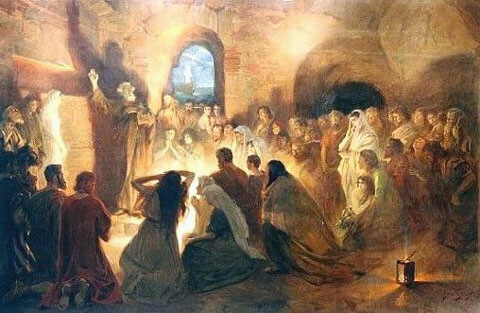
In the first three centuries AD, it was universally accepted among Christians that Saint Peter and Saint Paul had ministered in Rome and were subsequently martyred there by Emperor Nero. One of the earliest recorded accounts of Peter’s martyrdom is the first-century apocryphal work, Ascension of Isaiah. In chapter 4:2f, the author writes, “…the king of wickedness who murdered his mother…,” the king being referred to here is Nero, who was the only Roman emperor accused of killing his mother. It goes on to say that one of the 12 apostles will be “delivered into his hands.” The apostle mentioned here couldn’t be Paul, because he wasn’t one of the original twelve apostles.
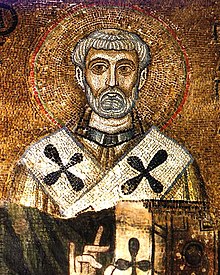
The most referred to early Christian leader who writes of Peter being in Rome is Clement I of Rome. Clement lived in Rome at the same time that Peter was supposed to have been there; this would have made him a firsthand witness. In addition, church tradition has Peter, shortly before he was crucified in the Circus of Nero, ordaining Clement as the overseer of the church in Rome. In his first century work, the Epistle of Clement to James, Clement writes to Saint James, one of the original twelve apostles. Clement writes of Peter’s death, “He himself (meaning Peter), by reason of his immense love toward men, having come as far as Rome, clearly and publicly testifying, in opposition to the wicked one… by saving men by his God-inspired doctrine, himself, by violence, exchanged this present existence for life.” Clement also tells of Peter’s death in his Letter to the Corinthians.
Besides the many documented letters by Christian leaders of the first centuries AD, there is another primary source supporting Peter in Rome. The Eastern Orthodox Church, which has had a sometimes contentious relationship with the Church in Rome over theological matters, has never questioned that the Apostle Peter was indeed in Rome. Because of their differences, it’s believed that if the Orthodox Church had any doubt whatsoever of Peter being there, they would have disputed it.
With such an abundance of early Christian documentation supporting Peter’s ministering and then crucifixion in Rome, why is it so wildly disputed by some? To answer that question, we need to look at the time period known as the Protestant Reformation.
Saint Peter in Rome and the Protestant Reformation
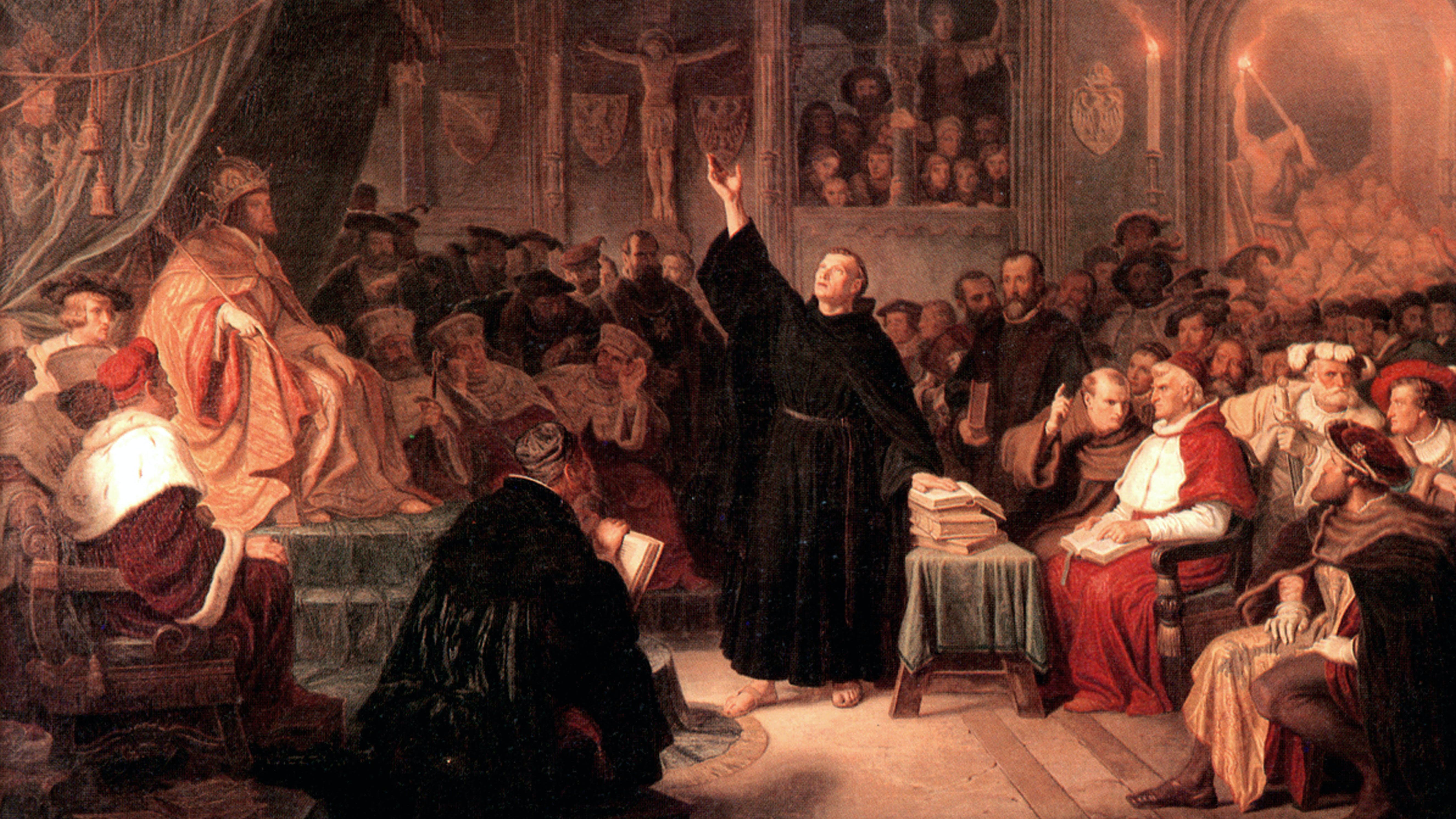
It never ceases to amaze me when I come across little tidbits of historical information, which outwardly seem totally unrelated to the subject I’m writing about, but end up adding tremendously to the completion of my story. And that’s what happened when I found the unlikely connection between Saint Peter in Rome and the 16th-century European Protestant Reformation.
Historians point to October 31, 1517, as the beginning of the Protestant Reformation movement. That’s when the Augustinian monk Martin Luther (1483-1546) nailed his “95 Theses” onto the door of the All Saints Church in Wittenberg, Germany. The Protestant Reformation grew from there, with other reformers, as John Calvin and even King Henry VIII of England, adding their own insights to this Christian movement.
By the time of the Reformation, the Holy Roman Catholic Church had become the controlling voice of Christianity in Europe. So powerful was the Church over its members that it was inconceivable to ever question the Church’s doctrines. The Protestant Reformation marked the first significant challenge to doctrines that the reformers believed were based more on church traditions than on the Bible.
For the purpose of this article, I’ll focus on the two Catholic doctrines that involve Saint Peter being in Rome: the Apostolic Succession and the Primacy of the Bishop of Rome. These two doctrines upset the reformers so much that it would lead to the Protestants’ denial of Saint Peter ever having been in the Eternal City.
Saint Peter in Rome, Apostolic Succession and
The Primacy of the Bishop of Rome
So, what is the doctrine of Apostolic Succession? Apostolic Succession comes from the tradition that while in Rome, the Apostle Peter founded what would become the Holy Roman Catholic Church. Additionally, this tradition states that Saint Peter was the first bishop, or pope, of that church. The Apostolic Succession doctrine states that from Saint Peter, all subsequent popes are his successors. And as his successors, they have the Apostle Peter’s authority through the doctrine of “the Primacy of the Bishop of Rome.”

So now what’s the Primacy of the Bishop of Rome? This doctrine does have a somewhat biblical foundation. It’s linked to what is known as “the Primacy of Saint Peter.” The Primacy of Saint Peter is based on verse 16:18 of the Gospel of Matthew. In this verse, it’s believed that Jesus Christ gave primacy, or authority, over His church to Simon Peter. Catholic doctrine states that since Saint Peter was given authority over the church by Christ, and Peter being the first pope, that authority is then passed to each Pope through the apostolic succession. This authority is the doctrine of the Primacy of the Bishop of Rome.
It’s the Primacy of the Bishop of Rome that gives the popes their unquestionable and absolute authority over all doctrine of the Catholic Church, and so dictates how Christians practice their faith. Although the Protestant Reformers disavowed these doctrines as non-scriptural and rejected the pope’s primacy, the connection between the pope’s authority and one of the twelve apostles was quite bothersome. For the reformers, it would have been better if Saint Peter had never been in Rome at all. So they tried to make that happen.
Saint Peter in Rome and Protestant Prejudice
From the sources I found, in their attempt to separate Saint Peter from these two Catholic doctrines, Protestant leaders initiated a centuries-long campaign of aggressively disavowing all writings and documentation that associated Saint Peter with Rome, or even Italy itself. But was all their rejection of historical records of Saint Peter being in Rome really necessary?
No, not so much. They seemed to have missed the fact that Simon Peter and the other apostles, including Saint Paul, were actually traveling evangelists. This is supported both historically and scripturally. There’s also another simple reason why Saint Peter couldn’t start a church while he was in Rome. For that reason, he wasn’t there long enough. All accounts have him in Rome for just a couple of years, four at the very most, before he was martyred. Not long enough to organize and head a church.

While many Protestants still argue that the Apostle Peter was never in Rome, one protestant theologian and historian disagrees with their attacks and denials. German Lutheran theologian Adolph von Harnack (May 7, 1851 – June 10, 1930) wrote, “To deny the Roman stay of Peter is an error which today is clear to every scholar who is not blind. The martyr death of Peter at Rome was once contested because of Protestant prejudice.”
So, if the Protestant denial of Peter being in Rome was to disprove Catholic doctrine, then where did the Catholic Church get these traditions that it was the Apostle Peter who founded their church and was also its first pope? Neither of these traditions is supported in either scripture or by historians.
Pastor John D. Keyer presents an intriguing theory on this conflict. In his article “Did the Apostle Peter Ever Visit Rome?” he proposes that there were possibly two Simon Peters in Rome at that time: one, the Apostle, and the other, Simon Magus. He suggests that it was actually Simon Magus, not the Apostle, who founded the Church of Rome and became its first pope. He believes that over time, these two Peters may have been confused as being the same person. It’s a fascinating article to read.
So, Was Saint Peter in Rome or Not?
What an interesting and revealing journey I’ve been on, trying to determine if the Apostle Peter was martyred in the Circus of Nero, or even if he was ever in Rome at all. I’ve explored the most frequently cited reasons given for his absence. Those reasons being that it’s not mentioned in the New Testament or even in ancient Roman records that he was ever in that city. But I also found evidence of abundant documentation, written by early church leaders in the first, second, and third centuries, telling of Saint Peter’s visit to Rome, and then being put to death there.
But my most amazing discovery was that this whole “Peter in Rome” controversy may be rooted in the Protestant Reformation of the 16th century. Could the rejection of Saint Peter in Rome actually have been fueled by Protestant leaders, just to disavow Catholic doctrine? And add to that Pastor John D. Keyer’s theory, that perhaps there were two Simon Peters in Rome. All of this provides much food for thought.
So, my personal conclusion is yes, it’s very possible, and very likely, that Peter the Apostle was indeed in Rome and martyred there. However, I’d also like to point out that I’m not a theologian, and I consider myself an armchair historian. Most of my research was conducted using online sources, and I’ve cited those sources below to assist you in your own quest to determine whether Saint Peter was martyred in the Circus of Nero.
Sources used:
“Apostolic succession.” Wikipedia, Wikipedia, 18 Jan. 2021, en.m.wikipedia.org/wiki/Apostolic_succession.
Catholic Answers. “What the Early Church Believed: Peters Primacy.” Catholic Answers, Catholic Aswers, http://www.catholic.com/tract/peters-primacy. Dec. 2020.
Encyclopedia Britannica. “Treatise on the Power and Primacy of the Pope.” Britannica, Encyclopedia Britanncia, http://www.britannica.com/topic/Treatise-on-the-Power-and-Primacy-of-the-Pope. Nov. 2020.
History Channel . “The Reformation.” History.com, History Channel, http://www.history.com/topics/reformation/reformation. Nov. 2020.
“HISTORY OF THE BIBLE-NEW TESTAMENT.” History World, History World, historyworld.net/wrldhis/PlanTextHistoriesResponsive.asp?historyid=aa11. Nov. 2020.
Keyser, John Keyser. “Did the Apostle Peter EVER Visit Rome?” Hope of Israel Ministries (Ecclesia of YEHOVAH, Hope of Israel Ministries, hope-of-israel.org/petrome.htm. Nov. 2020.
Lewis, Nicola Denzey. “The Apostle Peter in Rome.” BIBLE HISTORY DAILY, Biblical archaeology Society, 25 Apr. 2020, http://www.biblicalarchaeology.org/daily/pople-cultures-in-the-bible/people-in-the-bible/the-apostle-peter-in-rome/.
Nathan, Peter. “Was Peter Ever in Rome?” VISION, VISION, 2008, http://www.vision.org/was-peter-ever-in-rome-952.
Oakes, John. “What is the evidence that Peter was crucified upside down in Rome?” EVIDENCE FOR CHRISTIANITY, EVIDENCE FOR CHRISTIANITY, 20 Mar. 2010, evidenceforchristianity.org/what-is-the-evidence-that-peter-was-crucified-upside-down-in-rome/.
Petersen, Jonathan. “When Was Each Book of the Bible Written?” BibleGateway Blog, Bible Gateway Blog, 1 Feb. 2016, http://www.biblegateway.com/blog/2016/02/when-was-each-book-of-the-bible-written/.
“Primacy of Peter.” Wikipedia, Wikipedia, Dec. 2020, en.m.wikipedia.org/wiki/Primacy_of_Peter.
“Primacy Of The Pope.” Encyclopedia.com, Encyclopedia.com, http://www.encyclopedia.com/religion/encyclopedias-almanacs-transcript-and-maps/primacy-pope. Dec. 2020.
“Saint Clement I.” Britannica , Britannica Encyclopedia , http://www.britannica.com/place/Vatican-City. Dec. 2020.
Slick, Matt. “When were the gospels written and by whom.” CARM, Christian Apologetics & Research Ministry, 8 Dec. 2008, carm.org/about-the-bible/when-were-the-gospels-written-and-by-whom/.
“Tradition Of Peter In Rome.” Britannica, Encyclopedia Britannica, http://www.britannica.com/topic/letters-of-Peter. Nov. 2020.
Wasson, Donald L. “Tacitus.” Ancient History Encyclopedia, Ancient History Encyclopedia, 2 June 2020, www,ancient.eu/tacitus.
“When were the Bible books written?” Grace to You, Grace to You, http://www.gty.org/library/questions/QA176/when-were-the-bible-books-written. Nov. 2020.
“When were the Gospels written?” Compelling Truth, Compelling Truth, http://www.compellingtruth.org/when-gospels-written.html. Oct. 2020.


Very well researched, solid article. I too believe Peter was in, and was martyred in, Rome. There is biblical proof though that he did not start the Church in Rome, as the book of Romans–written in the AD 50s, makes no mention of Peter, yet, Paul is writing to an established church. It would be unthinkable for Paul to be writing a church…with Peter being there…besides, the timeline doesn’t match. The traditions you mention have Peter dying by Nero in AD 64, and you mention he’d only been there maybe 2 years. Acts 2 (AD 33) makes clear that there were Jews at Pentecost from all over the Empire. Surely some of those converted then, made their way back to the capital city–and founded a church there, some 30 years before Peter came. That’s the church Paul wrote to in AD 57. Clear evidence, from scripture, and tradition….Peter himself did not found the church in Rome.
LikeLike
Thank you so much Ralph for your comment. I tried to address some of what you stated in my follow up article. I’m sure you’ll enjoy the theory presented by John Keyser, of there being two Simon Peters in Rome.
LikeLike
Greetings,
When I visited Rome, I visited St. Peters Basilica. I also was able to go on the Scavi tour, which is a tour of a 1st-century street under St. Peters. While there, our guide showed us the burial place of St.Peter. I viewed this gravesite with much skepticism. While Peter certainly could have visited Rome. I don’t believe that Peter was the first pope and the head of the Catholic Church. No scripture for that one. Also, I understand that a good portion of the funding for the church was from indulgences. Which is money paid to get souls out of purgatory. This I find scripturally abhorrent.
Thanks,
Robert
LikeLike
Thank you so much for your comment Robert. When I visited Rome in 2015 I was surprised to learn that Christians weren’t killed in the Colosseum but rather in the Circus of Nero. This caused me to write this post in 2016. After the article was published I received comments questioning some of the same things you just addressed. Because of that I rewrote the original, the one you just read, and to write a follow-up post that deals with those questions, like yours, from a historical perspective. I’m sure you’ll enjoy my “WAS SAINT PETER EVER IN ROME? Also, please check out one of the sources I used, “DID THE APOSTLE PETER EVER VISIT ROME” by John Keyser. I’d be interested to hear back from you after you’ve read them. Once again, thank you.
LikeLike
Thank you for an interesting and informative article, Ron. You might want to review the birthyear of Harnack, though. A lifespan of 115 years seems a bit excessive in our modern age, even for the most healthconscious of germans. More in the style OT patriarchs.
Born 1851, not 1815. Interesting guy – seems to have been level-headed and had some sound ideas. First time I´ve heard of him and glad you brought him up. Again – Thanks!
LikeLike
Thankyou. I’m glad you enjoyed may article. And thank you for catching my typo.
LikeLike
there are no eye witness accounts of the Apoatke Peter in Rome, except the Peter imposter, there are no Biblical records of the Apostle Peter in Rome
there is catholic prejudice by legend to place Peter in Rome, mistakenly it was the imposter Simon Magnus, there is catholic motivation to perpetuate the myth to support the many catholoc false dictrines
LikeLike