By the time 1960 rolled around, I had long stopped watching the Howdy Doody Show. I had outgrown it, and now had other interests for my twelve-year-old mind, like the Mickey Mouse Club with Annette Funicello.

It was September 24th, 1960; I remember that day well. It was a Saturday, and since I didn’t have anything going on, I decided to turn on the TV and watch my old Howdy Doody friends. There was good old Buffalo Bob in his mustard colored suit. But something was wrong. He wasn’t standing in front of the Peanut Gallery asking that familiar question he’d asked for the last thirteen years, “Say, Kids, what time is it?” Instead, he was rummaging around in what looked like a storeroom. He picked up an object and said to himself, “TV Forecast Award.” Then, as if he just noticed we were there, he said, “Ah, Hi Boys and Girls. Well kids. This is our two-thousand-three-hundred and forty-third Howdy Doody Show. And kids, it’s also our last Howdy Doody Show.” At that moment, my heart stopped. Buffalo Bob went on to say, “You know, after almost thirteen years, the Howdy Doody Show will end today.” I was in shock!

It just couldn’t be, not Howdy Doody. Even as the different characters were packing up, and Buffalo Bob sang the “Goodbye Song,” and didn’t say “see you next Saturday,” I still didn’t believe it was the end. It wasn’t until the ever-mute Clarabell the Clown, in a tight close-up, looking straight into the camera, with tears in his eyes, said, “Goodbye, kids,” that I knew it was really over.
Perhaps you could say that I was a little too self-centered, but I actually blamed myself for the show’s ending because I hadn’t been watching. However, the fact was that it wasn’t just me; it was also my fellow Baby Boomers who had stopped watching. In addition, this simple program that we grew up with wasn’t attracting the new generation; they had many more options to watch.
The truth was that the Howdy Doody Show had already been in a slow decline, well before that fateful Saturday in 1960. It was on Friday, June 15, 1956, that Howdy ended its hallmark five-day-a-week programming, reducing it to just once a week, on Saturday mornings at 10 o’clock. So it shouldn’t have been much of a surprise to the cast when they were told that the show was being canceled.

In an interview, Bob Smith stated that although he was disappointed about being canceled, he concluded, “It was a pretty good run.” Smith also added, ”How many can say they were on a TV show that had lasted thirteen years?”
And it was a pretty good run indeed; when the Howdy Doody Show made its final broadcast on Saturday, September 24, 1960, it had been the longest-running show on TV at that time. It would also hold the record as the longest-running children’s program until it was eclipsed by former cast member Bob Keeshan’s Captain Kangaroo.
Over its thirteen-year run, the Howdy Doody Show broadcast 2,343 episodes, was the first show to be regularly broadcast in color, the first television show to be seen nationwide, had an accompanying radio show, and was one of the first programs to market the show’s characters, earning an estimated two hundred million dollars in those days’ money. In the history of American television, Howdy Doody sits right up there with the other greats of the “Golden Age of Television,” like Milton Berle and Sid Caesar.
In this post and the next, I’ll cover what happened to Howdy and the cast after the original show ended.
(This post was updated on August 31, 2025)
Time to get on with our lives
When the taping had ended on that final show in 1960 and the lights and cameras had been turned off, the cast and crew said their tearful goodbyes. They were sad that their thirteen-year run had come to an end, but they knew it was time to move on. The Howdy Doody Show had been fun, but it was, however, just a job.

William LeCornec (Chief Thunderthud) decided to go back to his home state of California, and Puppeteer Lee Carney would eventually also settle in California. Lew Anderson (Clarabell) put away his clown makeup and suit and returned to his music career. Anderson began working in New York as an arranger and musician. Bobby Nicholson (Clarabell #2 and Corny Cobb) partnered with Howdy producer Roger Muir to form a TV production company. One of their most popular and well-known shows was The Newly Wed Game.
Rufus and Margo Rose, the head puppeteers on the show, returned to their pre-Howdy Doody work. On TV, they were the puppeteers for the syndicated television program “The Blue Fairy,” for which they won a Peabody Award. In 1961, Rufus was elected to the Connecticut State Legislature, where he served for twelve years. Margo taught at the Institute of Professional Puppetry, as well as conducting puppetry workshops.
When asked about their involvement with the Howdy Doody Show, they said that it wasn’t their best work. However, even though they didn’t consider Howdy Doody as their best, they would become very important in the future of Howdy and the other puppets from the show.
What to do with Howdy and the other marionettes?
As the sets were dismantled and the studio cleaned of the show’s props, some of the cast members took souvenirs. As an example, Anderson took his Clarabell suit, box, and seltzer bottle. But the biggest question: what was to become of Howdy Doody and the other Doodyville marionettes?
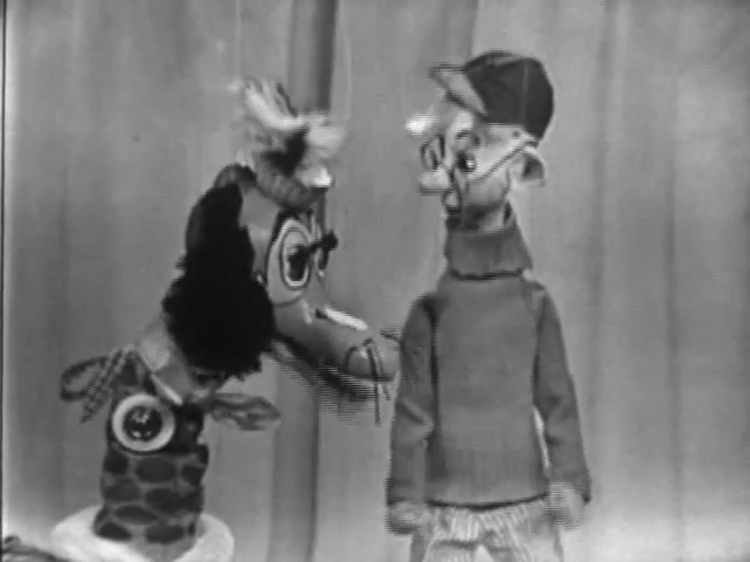
That was a significant concern for both Roger Muir and Rufus Rose. It seemed that NBC, which legally owned them, really didn’t have a plan. Since they couldn’t get a firm answer from the network, they made an executive decision. During the run of the show, the Roses had stored the puppets at their workshop in Connecticut when they weren’t being used. Therefore, it was logical for them to keep the marionettes until NBC decided what to do with them.
Rufus Rose packed up all the puppets, from both the US and Canadian shows, including the Canadian Howdys, Double Doody, and the original Dawson Howdy. The only marionette not taken by Rose was the original Photo Doody. Which was owned by Muir personally.
In a later post, I’ll go into greater detail on what happened next between Rufus Rose and NBC, and how their agreement would set the stage for the future custody battle over Dawson’s original Howdy Doody.
Besides Howdy, there was the other key personality on the show, Buffalo Bob.
Back to just Mr. Bob Smith
On that fateful Saturday morning in 1960, there was another person, sitting at home with his five-year-old son, watching more sadly than most, as Clarabell said, “Goodbye.” Since 1959, the Howdy Doody Show had been videotaped, so watching that final broadcast was Buffalo Bob himself. After the credits had rolled for the last time, Smith later told a reporter that he quickly ran out of the house, going to his favorite golf course. Smith went on to say, “I didn’t play very well that day.”
After the show went off the air, Bob Smith left New York City and show business, retiring to his home in New Rochelle, New York. Now, simply, Robert Smith believed that his “Buffalo Bob” days were over.
Smith spent his time playing golf and running his little liquor store in Wykagyl, a small suburb of New Rochelle. Smith had purchased this small business to take up some of his free time after the Howdy Doody Show began being videotaped. But this leisurely life didn’t last too long for the workaholic Smith. Soon, he purchased an apartment house in Fort Lauderdale, Florida, and then later moved to that state.

Smith also owned a cottage on a remote lake in northern Maine, near the Canadian border. This is where he and his wife, Mildred, would spend their summers. In 1964, Smith purchased the radio station WQDY FM in nearby Calais. Three years later, he would buy two more radio stations: WHOU and WMKR. Besides owning these stations, Smith would also take a turn behind the mic. As I mentioned in an earlier post, the man who helped pioneer early television had never shed his radio roots.
Smith was also very active in the community and regularly attended Rotary Club meetings when in town. Smith enjoyed going fishing with the locals, as well as entertaining them with his skills on the piano, organ, and ukulele. He had a lot of friends. In that little Maine town, Bob Smith, not Buffalo Bob, was the local celebrity.
All but forgotten in the 60s
Throughout the 1960s, the Howdy Doody Show was pretty much forgotten by both former cast members and fans alike. The only remaining reference to the show was the surfers’ cry of “Kowabonga;” with most not knowing its origin.

The assassinations of John and Bobby Kennedy, Martin Luther King Jr., and the escalation of the war in Vietnam had turned the late 60s into a turmoil of lost innocence for us Baby Boomers. We, the children of the 1950s, who grew up and were shaped by the Howdy Doody Show, were now young adults, desperately looking for something to remind us of that gentler time in our lives. That something was Howdy Doody.
It was in January of 1970 when Bob Smith got the call. A senior at the University of Pennsylvania wanted to know if “Buffalo Bob” would visit the University and perform a Howdy Doody Show.
So it would seem that Smith’s life with his wooden buddy wasn’t quite over yet.
My next post will cover Howdy Doody’s rediscovery
Sources used:
Archibald, John J. “Doody Bound.” The Howdy Doody Times, vol. 1, no. 79, The Doddyville Historical Society, Aug. 1985.
The Associated Press. “Former ‘Howdy Doody’ host dies ‘Buffalo Bob’ had Maine ties.” Bangor Daily News, The Bangor Daily News, 31 July 1998, archive.bdnblogs.com/1998/07/31/former-howdy-doody-host-dies-buffalo-bob-maine-ties/.
Davis, Stephen. Say Kids! What Time Is It? Notes from the Peanut Gallery. Frist Edition, Little, Brown and Company, 1987.
Ellerbee, Boddy. “The Early History Of Howdy Doody…Television’s First Hit.” Eyes Of A Generation…Television’s Living History, Bobby Ellerbee , 4 July 2016, eyesofageneration.com/wp-content/uploads/2016/11/The-Early-History-Howdy-Doody…Televisions-First-Hit-Show-Revised.pdf.
“Howdy Doody Show-September 24, 1960 Full Last Episode.” The Howdy Doody Show, the last episode of the 1950s Howdy Doody Show, YouTube, 24 Sept. 1960.
McIntire, Mike. “Say, Kids, What Time Is It?” Hartford Courant , Hartford Courant, 6 May 2000, http://www.courant.com/news/connecticut/hc-xpm-2000-05-06-0005060455-story-html.
“Robert “Buffalo Bob” Smith.” Find A Grave, Find A Grave, http://www.findagrave.com/memorial/7294174/robert-smith. Accessed 10 Nov. 2019.
Saturday Morning Archives . “Here he comes again: The New Howdy Doody Show (1976).” Saturday Morning Archives , Saturday Morning Archives, 28 Oct. 2018, saturdaymorningarchives.blogspot.com/2018/10/here-he-comes-again-new-howdy-doody.html.
Smith, Bob. “I Remember Howdy.” People, People, 30 Nov. 1987, people.com/archive/i-remember-howdy-vol-28-22/.
Wikipedia. “Buffalo Bob Smith.” Wikipedia, Wikipedia , en.m.wikipedia.org/wiki/Buffalo_Bob_Smith. Accessed 16 Feb. 2019.
Wikipedia. “Howdy Doody.” Wikipedia, wikipedia, JJMC89 bot III.
“WQDY-FM.” Wikipedia, Wikipedia, en.m.wikipedia.org/wiki/WQDY-FM. Sept. 2020.
 Still Current
One thought on “FROM DOODYVILLE TO DETROIT: THE HISTORY OF HOWDY DOODY, PART 7: GOODBYE KIDS”