With great anticipation, my wife and I entered the Detroit Institute of Arts (DIA) through its Woodward Avenue entrance. Perhaps because I looked the right age or others like me had also come to the DIA on this quest, the greeter knew precisely what I meant when I asked, “Where is he?” With a smile, she said, “He’s down the stairs, then take the last opening on the left. You can’t miss him,” pointing the way.

Hurriedly, I took the winding stairs down to the Kresge Court, heading to the last opening on the left when my wife called, “Slow down, Ron, he’s not going anywhere!” But that was hard to do, because I was about to meet a significant figure from my childhood that I never thought I’d ever see.
As we came into the room off the court, I heard that long past but still familiar question, “Say, kids, what time is it?” And in my mind, I responded, “It’s Howdy Doody time!” That question I heard came from a replica of an old 1950s black and white TV. It was playing a video of one of those long-passed shows I remember.
And there he was, in a glass case, wearing his well-known plaid shirt, western jeans, gloves, boots, and bandanna, with his dimpled, freckled, ever-smiling face. Howdy Doody. I must admit, I did get a little teary.
For us Baby Boomers, the thirteen-year run of “The Howdy Doody Show” covered our childhood like no other TV show. Although many, if not most, of us who sat in front of the TV, spellbound by all the characters of “Doodyville” and dreaming of being a part of the “Peanut Gallery,” we really didn’t know much about this iconic children’s program.
Initially, I had planned for this to be a single post, but as I delved deeper into the story of Howdy Doody, his origins became increasingly complex. To accurately tell his story, from television to Detroit, I found that I needed to make this a multi-part series. Also, as I was digging for information on this iconic program, I came upon some very surprising connections with Howdy Doody, a Detroit suburb, and a somewhat forgotten California puppeteer, without whom there would not have been the Howdy Doody we know.
Also, I’d like to thank my fellow members of the Facebook groups “The History of American Television” and “The Doodyville Historical Society” for clearing up some of my Howdy Doody questions.
So take your place in the Peanut Gallery because “It’s Howdy Doody Time!”
This Post was updated on October 23, 2021.
It All Began With Bob Smith
Howdy’s story began in the mid-1940s, when the popular Buffalo, New York, radio host Robert Schmidt came to NBC in New York and was hired as a disc jockey on their flagship AM radio station, WNBC.
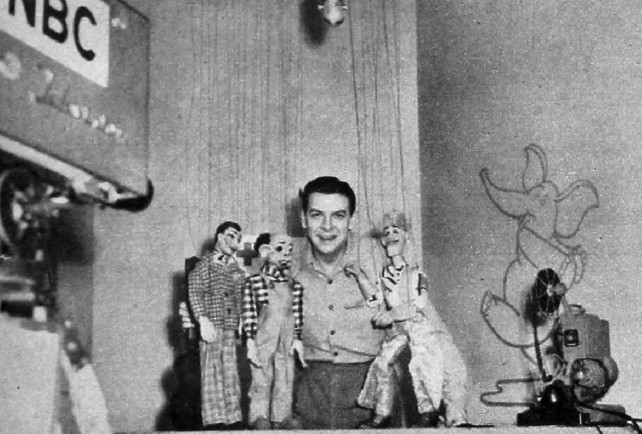
Besides being a DJ, NBC allowed Schmidt to create a children’s radio show in March 1947 called the Triple B Ranch Show (which stood for Big Brother Bob). By then, Schmidt had changed his name to Robert Smith.
On his Triple B Ranch radio show, Smith created a character called Elmer. Elmer was kind of a country bumpkin. Smith voiced Elmer as being sort of dimwitted. Whenever Elmer was introduced during the show, he’d start by saying, “Well, uh, howdy doody, Mr. Smith.” Elmer’s greeting, “howdy doody,” was actually a take on the western expression, “howdy do.” Since it was radio, the children listening only heard Elmer say, “howdy doody,” so they began thinking that was his name. When children visited the Triple B Ranch studio, they’d first ask, “Where’s Howdy Doody?” Hearing this enough times, Smith changed the character’s name to Howdy Doody. Soon, Howdy Doody became as popular as Bob Smith on the show.
In the late 1940s, television was in its early stages of development. The National Broadcasting Company (NBC), which desperately needed programming to fill its time slots, believed a program for children would be the answer. With Bob Smith’s already popular Triple B Ranch radio show, Warren Wade, the head of NBC Television, figured it would be easy to adapt it for TV. But Wade wanted to make a slight change to the show’s format; he wanted the show to have puppets.
To explain the concept of his new show, Wade called a meeting with Smith. At that meeting, Smith brought along his young head writer, Eddie Kean.
Edward George “Eddie” Kean
In his book Hey Kids! What Time Is It? Notes from the Peanut Gallery, Stephen Davis refers to Eddie Kean as the “chief writer, philosopher, and theoretician” for the show. While that sounds impressive, the basic fact is that without Eddie Kean, there wouldn’t have been the Howdy Doody Show we all grew up with.
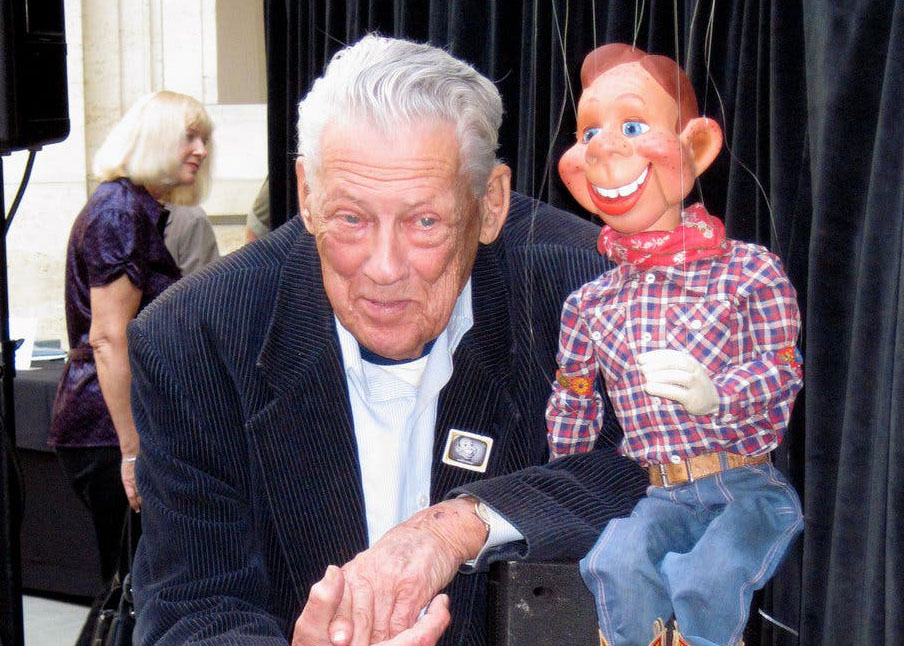
Some sources credit Bob Smith with creating the show. That’s true to a point; he did create the Howdy Doody character. However, Eddie Kean came up with continuing stories and exciting characters that appeared on the show daily. In short, Kean created the Doodyville we all came to love.
Kean came to Bob Smith’s attention from a song he had written called “Where’s Sam.” Smith, an accomplished musician with perfect pitch, appreciated the twenty-three-year-old Kean’s talent. Smith hired Kean to write jingles and copy for his early morning radio show and later for the Triple B Ranch program.
When Smith and Kean met with Warren Wade, he told them he liked Smith’s Triple B Ranch radio show but wanted something more for TV. He was looking for a show with “puppets with strings.” After brainstorming ideas for this new program, Wade came up with the name Puppet Playhouse. Some sources have Kean as the one who named the show. However, in his Howdy Doody Marionette Registry, Dave Little writes that Kean and Roger Muir, the Howdy Doody Show’s producer, credits Wade as the one who created the show’s name. Although Kean may not have named the show, he was hired as its chief writer.
Over the next eight years, between 1947 and 1954, Eddie Kean would create the many continuing stories that unfolded throughout the week, including the nationally famous “Howdy Doody for President” campaigns. When asked to explain his thoughts about his stories, Kean said he was writing ” a soap opera for kids.”
When asked, Eddie would say that his time as a counselor at Camp Paradox, a music camp in New York, inspired his work on the Howdy Doody Show. While there, he learned of the local Indian legends, which he would weave into the show’s stories and characters.
In the eight years Kean was with Howdy Doody, he wrote most of the songs we heard, including the show’s theme song, “It’s Howdy Doody Time,” and the “Clarabell” song. Kean also created the famous word “Kowabonga.” Eddie kept prop and puppet maker Scott Brinker busy, constructing the puppet characters he dreamed up: Double Doody, Phineas T. Bluster, Inspector John J. Fadoozie, Dilly Dally, and Flub-a-Dub.
In addition to working on the American Howdy Doody Show, Kean, who was also head of new show development, was sent to Toronto, Canada (1954) and Havana, Cuba (1956) to launch their licensed versions of the Howdy Doody Show.
In addition to the show’s puppets, Kean created the live characters of Clarabell Hornblow, J. Cornelius Cobb, Chiefs Thunderthud, and Featherman. He also created another character, which became the actor’s persona for the rest of his life.
Mr. Smith Becomes “Buffalo Bob”
From his Triple B Ranch radio show and on to the Puppet Playhouse, Bob Smith was simply addressed as “Mr. Smith.” In 1949, Kean began making changes to the show, notably with Smith’s on-air name.
The theme and sets for Puppet Playhouse were designed around a traveling circus. This was based on the show’s first master puppeteer, Frank Paris’s “Toby Tyler at the Circus” segment. After Paris left the show (I write about this later in this post), Kean began transitioning from the circus to the town of Doodyville. Also, he changed the show’s name from Puppet Playhouse to the Howdy Doody Show.
Kean felt that calling the second most important character on the show Mr. Smith didn’t fit. So, how did Eddie make Mr. Smith into “Buffalo Bob?” According to Bob Smith, in Davis’s book, Kean’s storyline had Mr. Smith being the great-great-grandson of the Sigafoose Indian tribe’s “Great White Leader, Buffalo Tom.” When Tom went to the “happy hunting ground,” the title went to Bob.
Chief Featherman (Bob Keeshan) assisted the magical transition using special effects; Mr. Smith, in his shirt and slacks, rematerialized in his well-known fringed costume as Buffalo Bob. Kean would again use this process to transform Princess Summerfall Winterspring.
As Davis states, Kean scripted “almost every line spoken and every note sung.” You can also add that almost every character that appeared on Howdy Doody came from Eddie Kean’s mind.
But after eight years of creating characters, songs, and stories five days a week on live TV, Eddie Kean ran out of gas; he just couldn’t handle the grind any longer.
After Kean left Howdy Doody, he worked in public relations as a stockbroker and columnist for the Consumer Madvocate newspaper. He also authored stories for Doody Dell comics and other non-Doody books. His last career was as a lounge pianist in Miami and Detroit. Seeing Detroit listed caused me to perk up. Living in the Detroit area, I was interested in knowing how deep Kean’s Detroit connections really were. And it turned out to be quite a lot.

Eddie Kean, the creator of Doodyville’s citizenry, had retired to the Detroit, Michigan, suburb of West Bloomfield Township in Oakland County. When the original Howdy Doody marionette arrived at his new home, the Detroit Institute of Arts, Kean was also on hand to welcome his old buddy Howdy Doody to Detroit.
Edward “Eddie” Kean passed away from emphysema on August 13, 2010, at the age of 85. Kean was buried at Congregation Beth Tefilo Cemetery’s Nusach H’ari Cemetery on Woodward Avenue in the City of Ferndale, Michigan. I was so excited; the man behind the creation of the Howdy Doody Show was buried only forty minutes from my house. It was time to go pay my respects.
My wife and I figured that finding Kean’s grave would be easy. The Find-A-Grave listing had really good directions to its location. It had the section, the row, and how many graves in from the path it was. It should have been really easy, but it wasn’t. The listing was completely wrong.
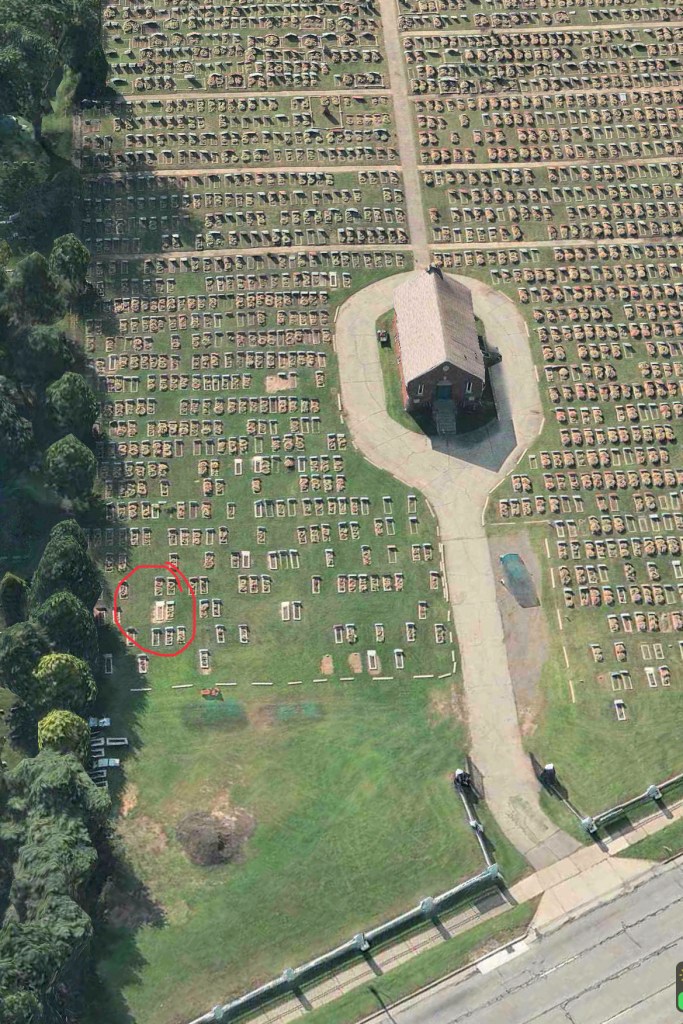
Luckily, the cemetery wasn’t that big. But after an hour of walking around, trying every possible interpretation of the Find-A-Grave directions, we thought we’d failed with no luck. That’s when I noticed the cemetery’s gardener near the back.
He was extremely—I mean extremely—helpful. He retrieved the grave record book. It didn’t list Kean. He dug up (sorry for the pun) another list, this time with Eddie’s grave listed.
Walking to the front, the gardener pointed to the grave of Edward “Eddie” Kean, the only grave in the entire cemetery not marked. The Find-A-Grave listing showed only a temporary grave marker, which is now long gone.
I placed a stone on his grave. Standing there, I thanked him for all the joy and excitement his adventures and characters had given me so many decades ago.
This section was added on June 19, 2021
Eddie Kean Remembered
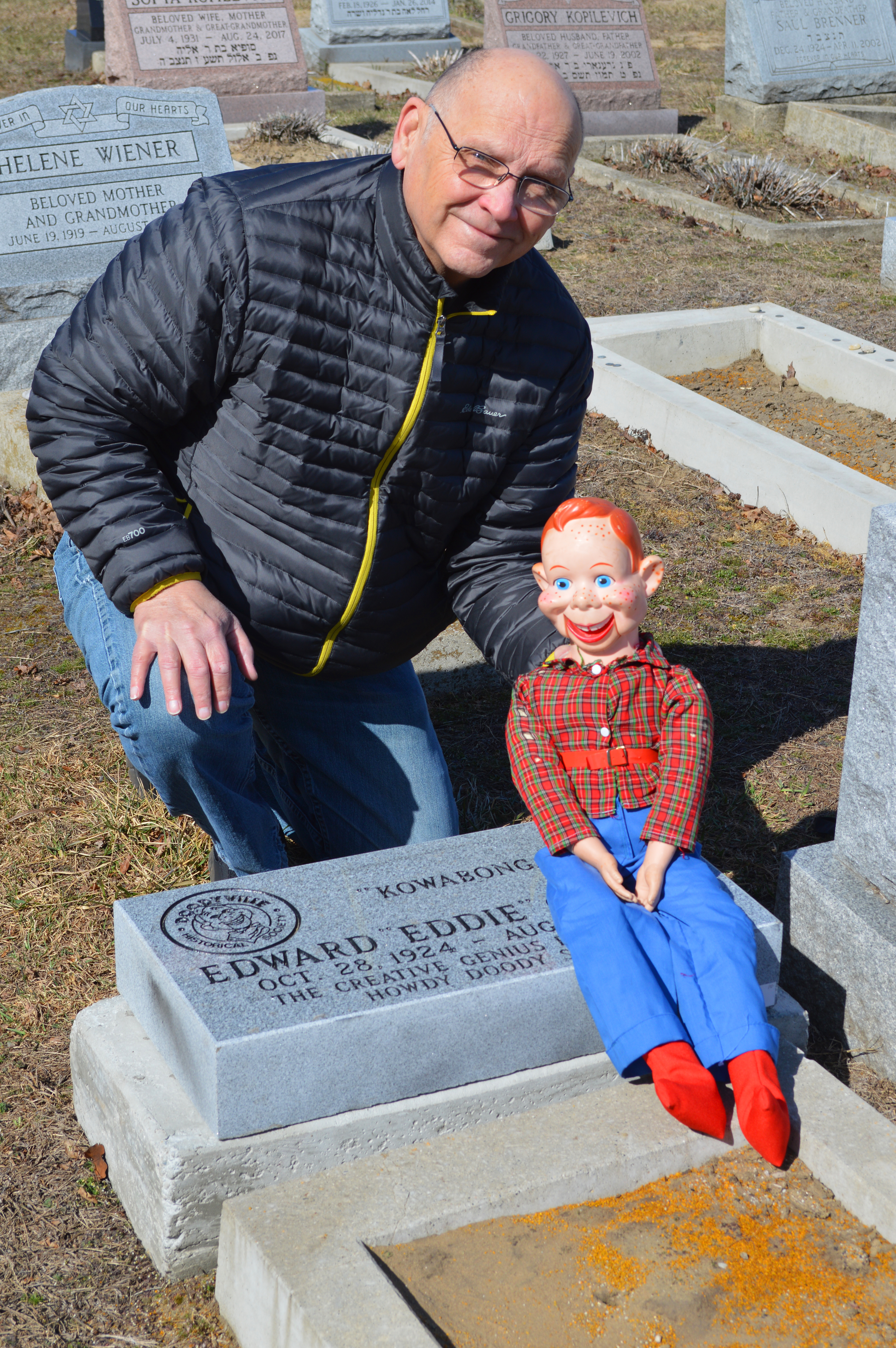
I had no idea in February of 2020, when I first published this article, that my reporting on Eddie Kean’s grave not having a marker would touch so many Howdy Doody fans. It was soon suggested that a fundraising drive be started to purchase a marker for Eddie’s grave.
This effort was spearheaded and coordinated by Jeff Judson, Howdy Doody historian and the founder of the Doodyville Historical Society. Since I live in Michigan, and not far from where Eddie is buried, I became the local contact.
It took over a year to accomplish our loving task between the pandemic and winter. Finally, on March 12, 2021, we were notified that his stone had been installed.
The inscription reads:
“KOWABONGA” (Eddie’s spelling)
EDWARD “EDDIE” G. KEAN
OCT. 28, 1924 – AUG. 13, 2010
THE CREATIVE GENIUS BEHIND THE HOWDY DOODY SHOW
Also prominently displayed is the Doodyville Historical Society’s logo.

This section was updated on October 23, 2021.
The Formal Dedication of Eddie’s Marker
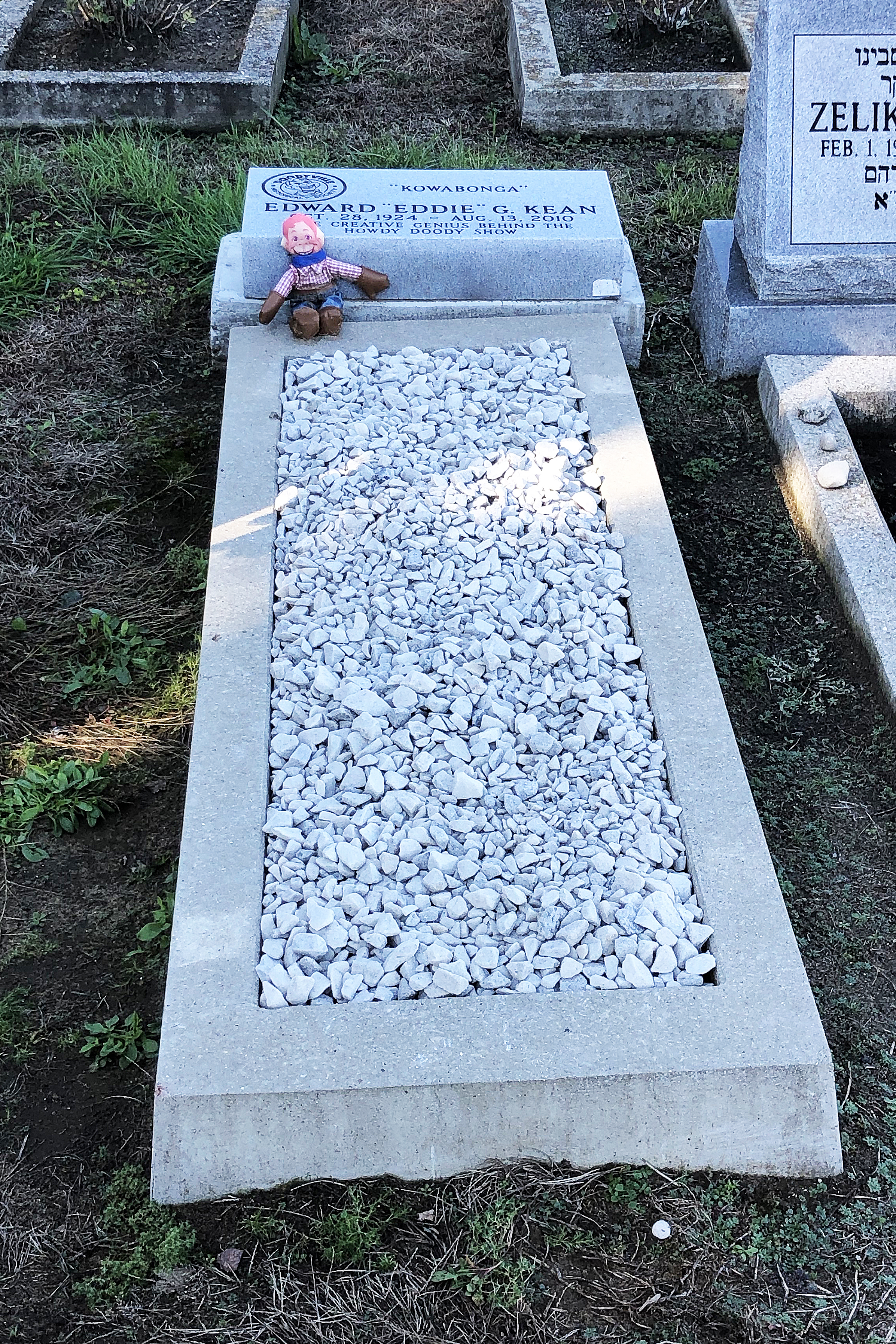
On Friday, August 13, 2021 (the 11th anniversary of Eddie’s passing), I conducted a graveside formal dedication of Eddie Kean’s marker. This ceremony was live-streamed over the Doodyville Historical Society’s Facebook page.
Our project to honor Eddie was completed on October 22, 2021, with my wife and me spreading marble chips on his grave. This was just a few days before what would have been Kean’s 97th birthday on October 28th.
It was an honor to assist Judson and the members of the Doodyville Historical Society in honoring and remembering one of the Howdy Doody Show’s key creators.
Frank Paris, The First Puppeteer
Now that the new show had a name, Puppet Playhouse, and a theme for writer Eddie Kean to work with, they needed a puppeteer to fulfill Wade’s puppet show idea. NBC hired Frank Paris, one of the top puppeteers in the country, to bring his marionettes from his touring puppet show, “Toby Tyler at the Circus,” to NBC and create a Howdy Doody puppet from the radio character.

To help Paris, Smith recorded himself in his Elmer/Howdy Doody voice. Using this, Paris tried to create a Howdy Doody marionette that would match Smith’s character’s voice. But Paris still hadn’t finished the puppet when the show aired on December 27, 1947.
To cover for the lack of a “Howdy Doody,” Kean wrote that Howdy was very shy and wouldn’t come out of Smith’s desk drawer. During the show, Smith continued to try to coax Howdy out, but to no avail. In his Elmer/Howdy voice, Smith would answer, “Gorsh, Mr. Smith, ah’m too darned bashful to come out.” And for that first show, Howdy stayed in the drawer.
Originally, Puppet Playhouse was to be three different productions: the first was Bob Smith’s TV version of his Triple B Ranch, the second was to be hosted by announcer Ed Herlihy, who would later appear on the soap operas As the World Turns, and All My Children, and the third was with Paul Winchell and his dummy Jerry Mahoney. The show that received the best viewer response would be green-lighted as a regular TV program.
However, Mother Nature stepped in and changed history.
There May Not Have Been A Howdy Doody Show
Since Bob’s Puppet Playhouse segment could have been a “one-and-done” program, there wasn’t a big push to get Paris to finish his puppet. However, on that post-Christmas winter afternoon when Puppet Playhouse first aired, the East Coast was hit with a record-breaking snowfall. With everything shut down, there was nothing to do but watch Bob Smith and Howdy Doody on TV. This weather event launched Howdy Doody.
So popular was the show by the response from viewers that NBC canceled the other two programs in the series and made Bob Smith’s production part of their weekly line-up. Now, they really did need a Howdy Doody.

Paris presented his version of Howdy Doody at a staff meeting in January 1948. Paris did his best to match what he thought a country bumpkin looked like from the voice Smith did. His Howdy Doody puppet had a sizeable goofy grin, big ears, and light-colored hair that stood straight up. It’s said that most of the staff and producers loved Paris’s puppet. But one member of the show didn’t, Bob Smith.
Even though Smith called Paris’s puppet “the ugly Doody,” the new show must continue. Kean wrote Howdy out of the desk drawer, and Frank Paris’s Howdy Doody appeared on TV for a time. But that wouldn’t last long.
Exit Paris With His Howdy Doody
At first, Puppet Playhouse was only on Saturdays, but as the program’s popularity grew, it was quickly expanded to three days a week: Tuesday, Thursday, and Saturday. Since Howdy Doody was the most popular character on the show, and Kean’s “It’s Howdy Doody Time” became the show’s theme song, it was only logical that the name was changed to the Howdy Doody Show on August 15, 1948.
It was only after a few months on the air that there became a high demand for Howdy Doody merchandise. Major retailers like Gimbel’s and Macy’s department stores, along with toy manufacturers, contacted NBC, Smith, and Paris for the rights to make Howdy Doody dolls and other items. Although Paris had created the marionette, Bob Smith owned the character of Howdy Doody, and NBC owned the puppet, for which they paid Paris $500.

Paris believed that since he built the Howdy Doody puppet, he owned it, and he was entitled to some of the financial benefits from the merchandising. But Smith and NBC didn’t see it that way. After a heated exchange and seeing he was getting nowhere, Paris stood up, holding his Howdy Doody in a cloth bag, and said, “Well. If you think you own him, just see how you will do your show tonight.” Then he stormed out the door with his puppet. And this was just four hours before the live show aired.
But the story of “Ugly” Howdy doesn’t end there. Soon after he left the Howdy Doody Show, Paris reconfigured the marionette into a more pleasing-looking character, Peter Pixie. This puppet appeared on a competing kids’ program on WPIX-TV-11 in New York. The show wasn’t successful and quickly went off the air.
Paris kept his Ugly Howdy/Peter Pixie marionette until 1955. That year, Paris was awarded a $20,000 settlement in his lawsuit against NBC over leaving the Howdy Doody Show. One of the conditions in the settlement was that his “Ugly” Howdy, along with two other puppets Paris used on the Howdy Doody Show, had to be destroyed. The three marionettes were taken to the law offices of NBC, where they were dismembered and burned. Although there’s a rumor that Paris substituted a copy of his “Ugly” Howdy to be burned and retained the authentic one. However, most experts agree that the original was indeed burned.
Although Paris was no longer part of the Howdy Doody Show, he went on to perform with his other marionettes at Madison Square Garden, Radio City Music Hall, and the Baltimore Bowl in Los Angeles. Frank Paris retired to California, where he died at his home in North Hollywood from lung cancer at the age of 70 on August 14, 1984.
Howdy Doody Goes On The Campaign Trail
With their “star” abruptly gone, Kean had to devise a cover story to explain Howdy’s absence. He decided to capitalize on the already running plot line of Howdy running for “President of the Kids.” Kean had Howdy suddenly leave Doodyville to work the campaign trail across the country.
The TV crew built a large map to track Howdy Doody’s travels. Also, during the show, Smith would receive telephone calls from Howdy. To accomplish this, Smith prerecorded Howdy’s lines before the show. This worked so well that a new technique was developed for when Howdy came back.
On the radio, it was easy for Smith to do his lines and Howdy’s because no one was watching. However, TV was different; everyone could see everything. At first, doing it live worked fine, with Smith being off camera or with his back to it when he delivered Howdy’s lines. But once he got caught, live on-air.
They devised a creative way for Smith and Howdy to talk to each other. Before each broadcast, Smith recorded Howdy’s lines. During the show, when Smith said something to Howdy, the sound director would put his finger on the record, stopping it; when it was Howdy’s turn, he’d lift his finger, and Howdy would respond. This process was used until Smith had his heart attack.
We Need A Howdy Doody!
With Paris and his “ugly Howdy” out of the picture, Smith saw it was time for Howdy to get a real makeover. Smith had already been slowly changing Howdy’s voice from that of the country bumpkin Elmer to that of a quizzical young boy. But how do they sell a different-looking Howdy Doody to the millions of fateful children who watch the show daily? Once again, they turned to Eddie Kean to save the day.
Kean again used the campaign story that while Howdy was on the trail, he had noticed that the other candidates had a better appearance. So, he decided to improve his face using a new surgical procedure called “plastic surgery.” They believed this would cover that when Howdy finally returned to the show, he’d look completely different, and we would all believe it. Now, they had to get another Howdy Doody and do it fast!
In the next post, I will discuss the creation of the Howdy Doody we all know and introduce you to his Mom.
Sources Used:
Davis, Stephen. Say Kids! What Time Is It? Notes from the Peanut Gallery. First Edition, Little, Brown and Company, 1987.
Deep-Fried Hoodsie Cups. “H*O*W*D*Y D*O*O*D*Y.” Deep-Fried Hoodsie Cups, Dee-Fried Hoodsie Cups, 20 Jan. 2011, deepfriedhoodsiecups.wordpress.com/2011/01/20/1202011.
“Eddie Kean.” Find A Grave, Find A Grave, www.findagrave.com/memorial/57513640/eddie-kean. Accessed 15 June 2020.
“Edward Kean.” Wikipedia, Wikipedia, 15 June 2020, en.m.wikipedia.org/wiki/Edward_Kean.
Fletcher, Dan. “A Brief History of NBC.” TIME, TIME USA, 4 Dec. 2009, content.time.com/time/arts/article/0,8599,19408,00.html.
“Frank Paris, 70, Puppeteer of Howdy Doody.” Obituaries, The New York Times, 6 Sept. 1984, www.nytimes.com/1984/09/06/obituaries/frank-paris-70-puppeteer-creator-of-howdy-doody.html.
Hevesi, Dennis. “Edward Kean, Chief Writer of “Howdy Doody,” Dies at 85.” The New York Times, The New York Times, 24 Aug. 2010, http://www.nytimes.com/2010/08/25/arts/25kean.html.
McIntire, Mike. “Say, Kids, What Time Is It?” Hartford Courant, Hartford Courant, 6 May 2000, http://www.courant.com/news/connecticut/hc-xpm-2000-05-06-0005060455-story-html.
The Official Howdy Doody Marionette Registry by Dave Little. Accessed on June 25, 2021
“Robert “Buffalo Bob” Smith.” Find A Grave, Find A Grave, 27 Mar. 2003, http://www.findagrave.com/memorial/7294174/rober-smith.
Severo, Richard. “Buffalo Bob Smith, ‘Howdy Doody’ Creator, Is Dead at 80.” The New York Times, The New York Times, 31 July 1998, http://www.nytimes.com/1998/07/31/arts/buffalo-bob-smith-howdy-doody-creator-is-dead-at-80.html.
Smithfield, Brad. “Howdy Doody: The most celebrated children’s show in television history.” Vintage News, Timera Media, 18 May 2017, http://www.thevintagenews.com/2017/05/18/howdy-doody-the-most-celebrated-childrens-show-in-television-history.
Wikipedia. “Buffalo Bob Smith.” Wikipedia, Wikipedia, en.m.wikipedia.org/wiki/Buffalo_Bob_Smith. Accessed 16 Feb. 2019.
Wikipedia. “Howdy Doody.” Wikipedia, Wikipedia, JJMC89 bot III.
 Still Current
That was so cool Cuz. I had no idea it ran for 13 years!
LikeLike
Thank you so much Cuz
LikeLike
I used to watch that, but not for 13 years!
LikeLike
You’ll see, in the coming posts, that I, and I figure most of our fellow Baby Boomers, were just like you. Thanks for read. And I enjoy your posting too.
LikeLiked by 1 person
Thanks.
LikeLike
Hello! I simply wish to give a huge thumbs up for the great data you might have right here on this post. I will be coming again to your weblog for extra soon.
LikeLike
Born in 1946, I was a faithful viewer of Howdy Doody for many years and was there on the the Saturday morning, Clarabel said good bye. Years ago, from reading Stephen Davis’ book, I learned so many new and interesting details. And thanks to your blog here, I’m learning many more and look forward to future installments.
LikeLike