
On our trip to Rome in 2015, visiting the Roman Forum was high on my bucket list. I was unprepared for what we discovered as we walked its ancient streets.
What we found raised a lot of questions about what we saw. Even though the buildings had identifying plaques, it didn’t help; we were like most visitors, that if you didn’t have a guide or didn’t know the history of the building, it would be just another old ruin.
Luckily, I had taken a lot of photos. When I got home, I researched the history of the temples and public buildings we saw so I could present them to you. However, in a few cases, my photo wasn’t as good as I would have liked. With those photos, I identified where I got them from.
So, walk with me now as we explore the fabulous Forum Romanum.
Here’s where these sites are in the Forum
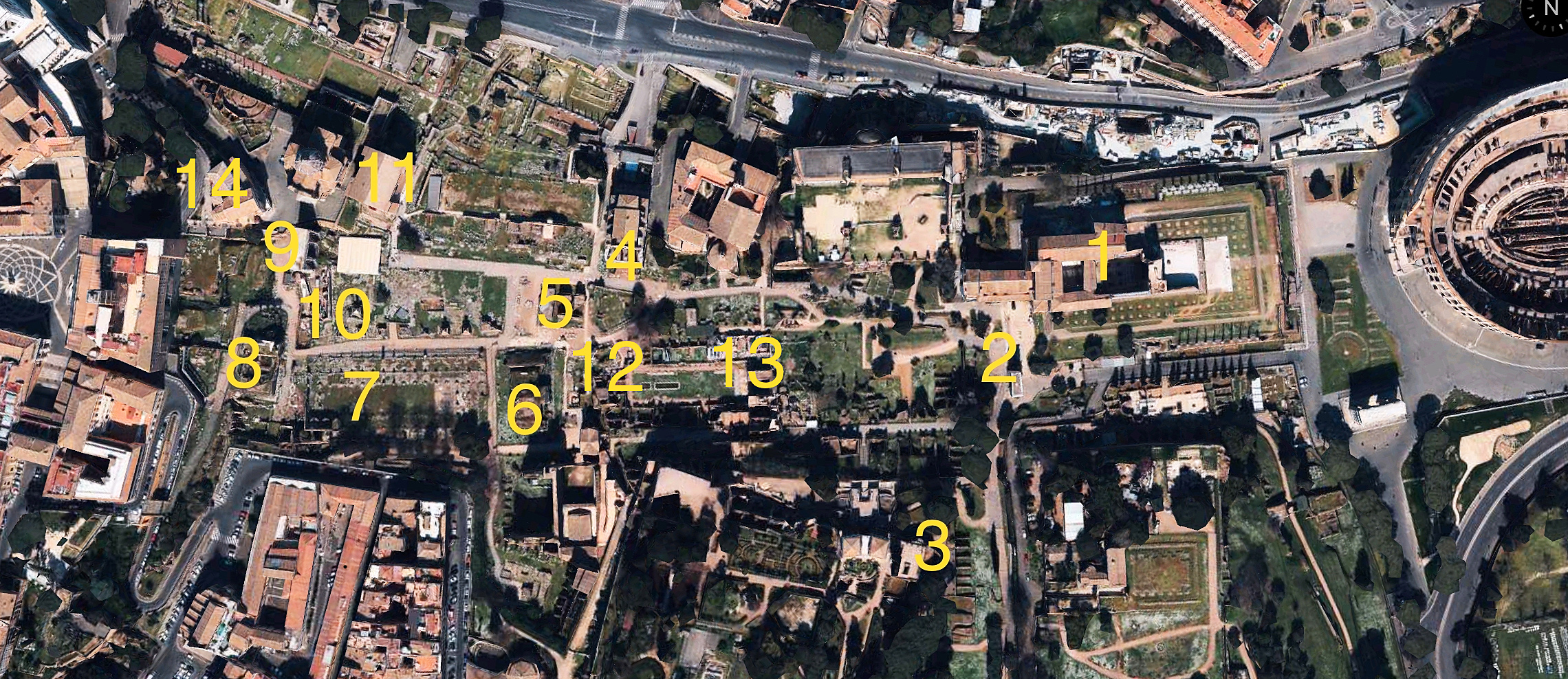
14. The Tullianum, or the Mamertine Prison
1. The Temple of Venus and Rome
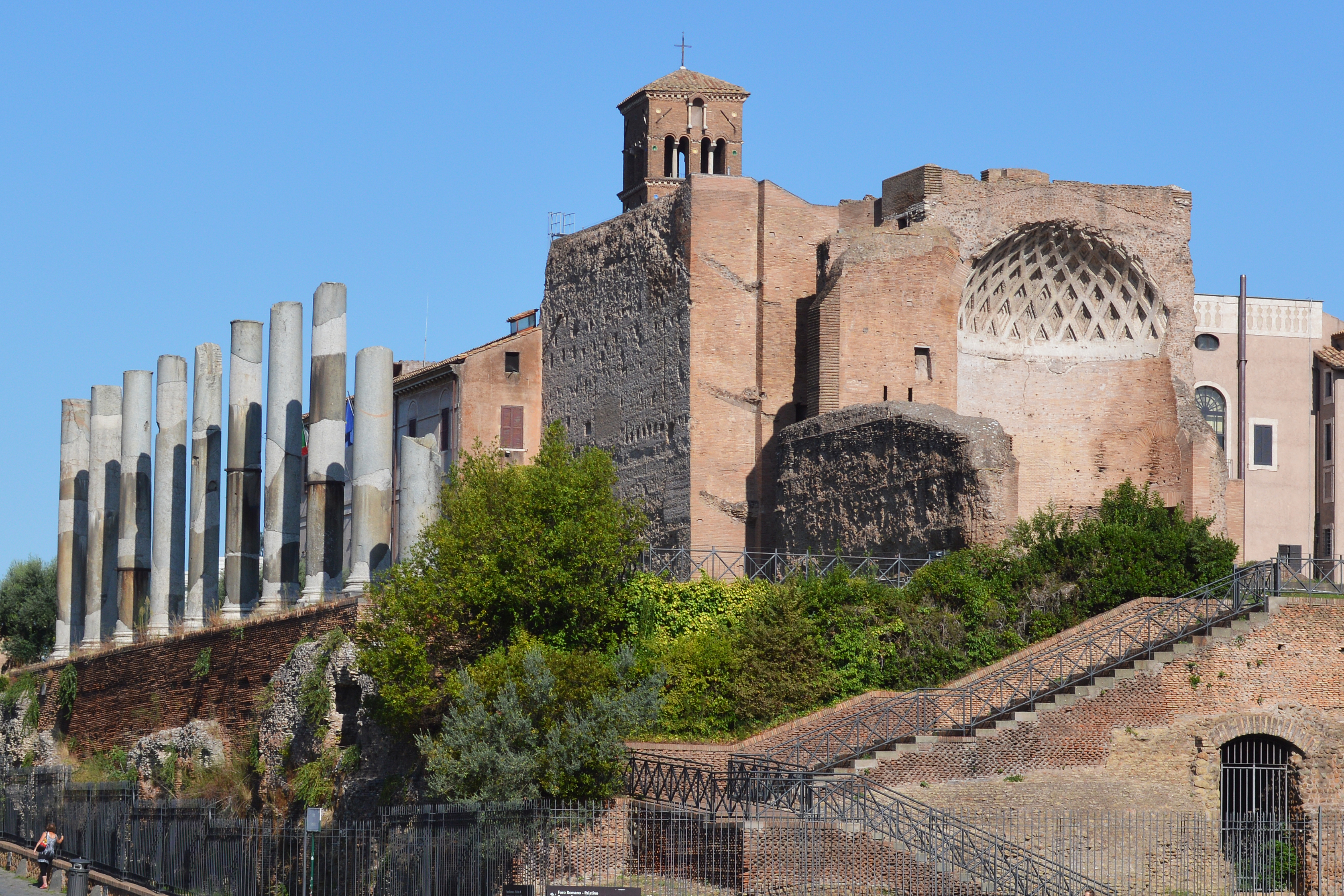
The largest temple in Rome in its time.
Photo by author
At the southern end of the Forum, across from the Colosseum, is a set of columns that rise above the street level. These are all that remain of the Temple of Venus and Rome, believed to have been the largest temple ever built in the ancient city.
It is dedicated to the divine Julian family (the family of Julius Caesar), who believed they were descended from the goddess Venus and could trace their family to the very founding of Rome. Construction on the temple began under Emperor Hadrian in 135 AD and was completed by his successor, Emperor Antonius Pius, in 141 AD.
The temple was built on top of the largest man-made podium of its time. Along its longer sides ran two columned porticos. The temple’s south end faced the Colosseum, while its northern end looked out over the Forum. The north and the south end featured long stairways going down to the streets.
Inside the temple was a statue of Venus facing the Colosseum. At the north end, another statue represented the City of Rome facing the Forum.
To make room for the temple, Hadrian had to first remove what remained of the vestibule of Nero’s Golden House and relocate Nero’s gigantic statue, “The Colossus of Nero.” It was written that it took twenty-four elephants to move the Colossus.
Colossus Square, the impressive Colosseum, the Colossus of Nero, the Temple of Venus, and Rome must have been spectacular to see.
As with many of the buildings in the Forum, the Temple of Venus and Rome suffered from being stripped of its marble and stones. Earthquakes and fire also contributed to its destruction. An earthquake in the ninth century finally destroyed what was left of this temple.
The first Christian church was built on the site in 850 AD. In 1612, the Church Santa Francesca Romana was constructed on that site, using the earlier church’s and the temple’s components.
Today, the temple terrace has been restored and is open to the public.
It’s now time to explore the Roman Forum. To get there from its south end, you enter off the Great Square of the Colosseum. Next to the remains of the Temple of Venus and Rome, you’ll find the Via Sacra. During the height of the Roman Empire, the Via Sacra was the main road of the Forum. Today, this mighty Roman road, where its legions marched, seems to be just a wide walkway.
In the distance, you’ll see our next stop, the Arch of Titus.
2. The Arch of Titus
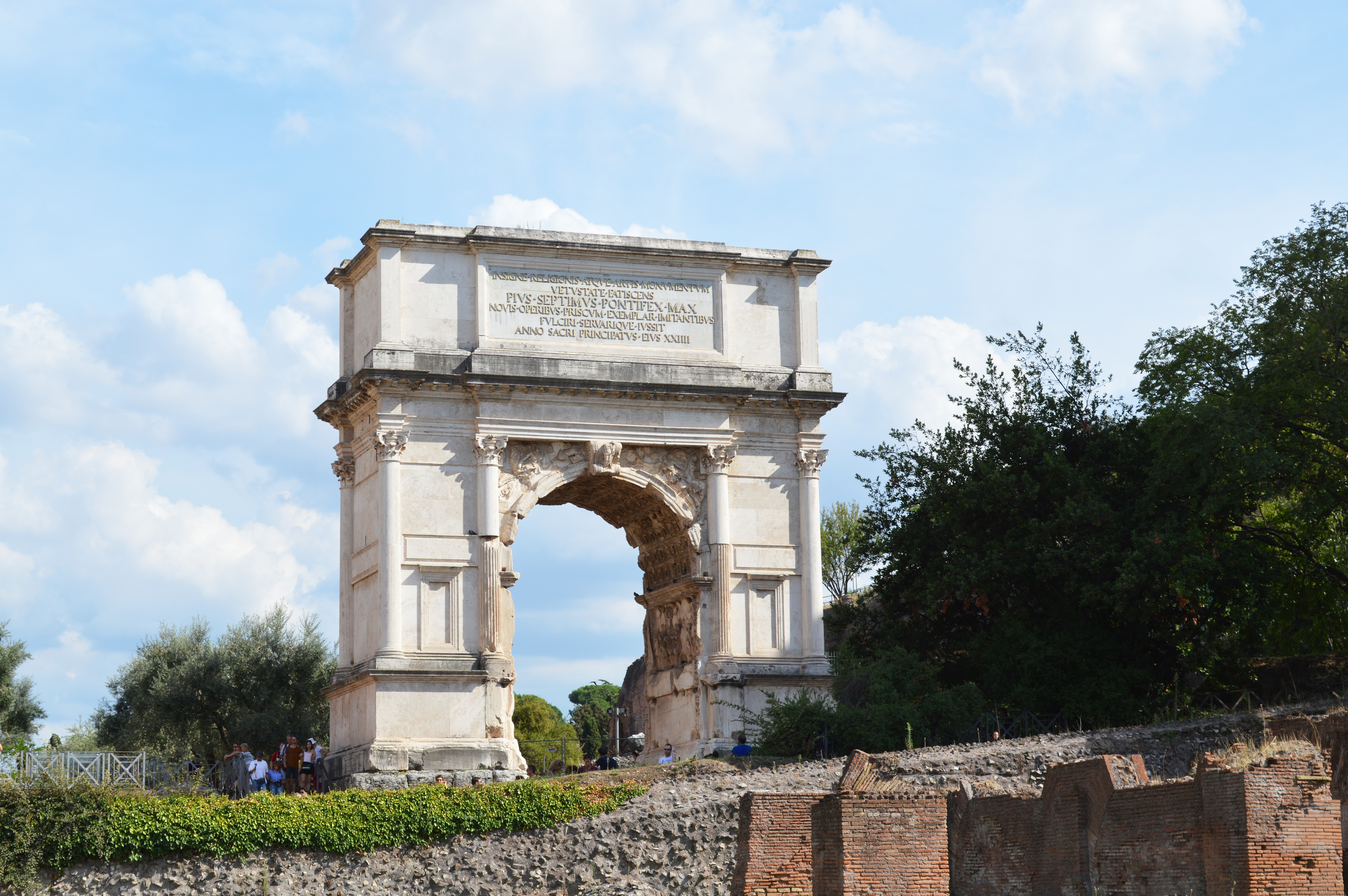
Photo by author
The Arch of Titus is Rome’s oldest of the three surviving triumphal arches. It stands on the highest spot on the Via Sacra, and being over 50 feet in height, it gives a commanding presence to the Roman Forum that stretches out below it.
In 85 AD, Emperor Domitian dedicated this triumphal arch to honor his brother, Emperor Titus, who died in 81 AD. The arch commemorates Titus’s victory in the Jewish Revolt. It was during this war that the revolt by the Jewish nation came to an end when the City of Jerusalem was captured, and Masada fell in 72 AD.
The reliefs on the arch depict the emperor’s triumphal procession into Rome with the spoils of that war. When dedicated, all these reliefs were in color. The arch was also topped with a bronze quadriga.
The Frangipani family incorporated the Arch of Titus into their fortress in the eleventh century, helping to save it. You’ll notice that some of the stones in the arch have differing shades. This is because when architect Giuseppe Valadier restored the arch between 1821 and 1823, he used travertine instead of marble to replace the missing sections. This was to distinguish what was replaced from the original marble.
3. Palatine Hill
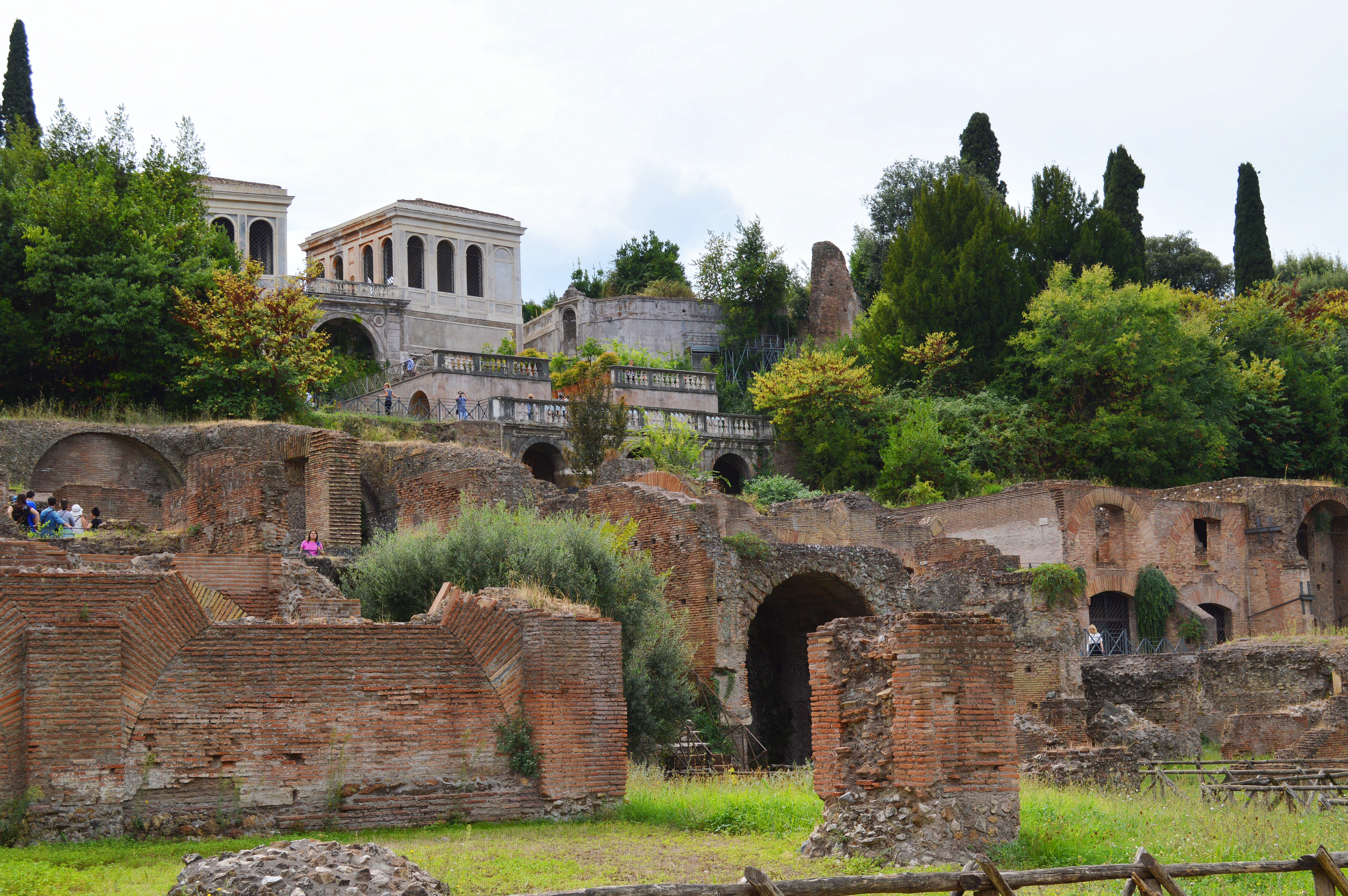
Photo by author
As you pass by the Arch of Titus, look to your left. There, you’ll see ruins on the side of a hill, with restored buildings at its top. This is Palatine Hill, one of the famous Seven Hills of Rome and the legendary birthplace of the city.
When archaeologists excavated Palatine Hill, they discovered more than just items from the ancient Roman period. What was uncovered was the remanence of bronze-age huts, which proves that Palatine Hill was inhabited much earlier than first thought. However, for the tourists who visit this site, it’s mostly known for the palaces of the first Roman emperors.
Augustus Caesar was the first emperor to reside on Palatine Hill in 44 AD. Although Augustus’s palace was impressive, his successor, Emperor Tiberius, would build an actual imperial palace. Following Tiberius’s lead, the emperors Caligula, Claudius, and Nero continued expanding the complex.
If I had done more research before our trip, Palatine Hill would have been a site I would have liked to have explored.
4. The Temple of Antoninus Pius and Faustina
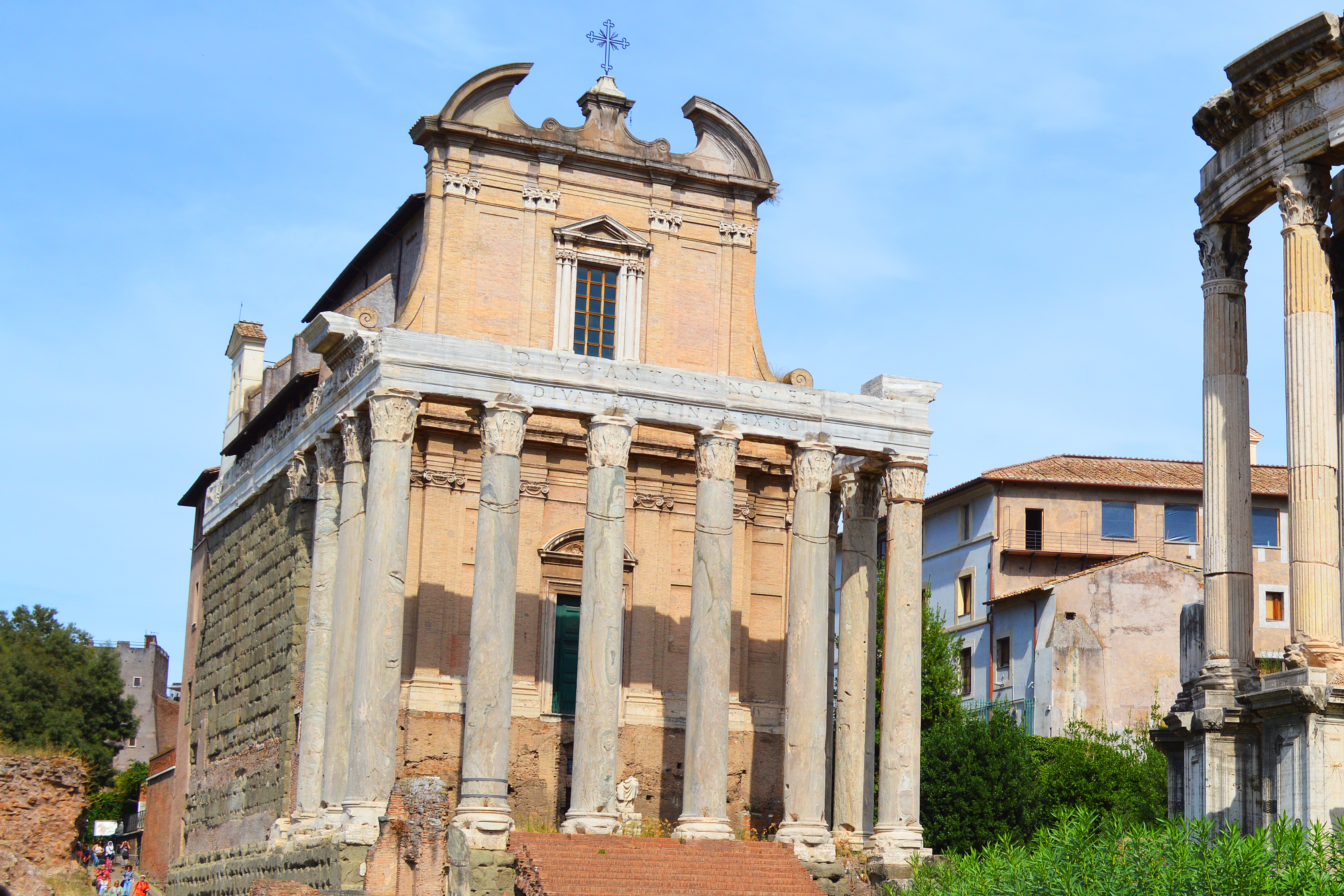
Photo by author
As you follow the winding path down through the weeds and dirt, you descend through time and centuries of buildup. When you reach the bottom of the incline, you’ll be standing on the excavated Imperial level of the Roman Forum. The impressive structure on the right is what remains of the Temple of Antoninus Pius and Faustina.
This temple was built by Emperor Antoninus Pius in 141 AD to honor his deceased wife, Faustina, the Elder. Antoninus had Faustina deified, allowing for a temple to be constructed. Faustina is the only empress to have a temple in the Roman Forum. When Antoninus died in 161 AD, the Roman Senate deified him, and this temple was then re-dedicated to both.
Evidence shows that the temple was initially fenced off from the Via Sacra. In the temple’s cella was a large statue of a seated Faustina. After his death, a statue of Antoninus was added. Pieces of these two statues have been found around the temple.
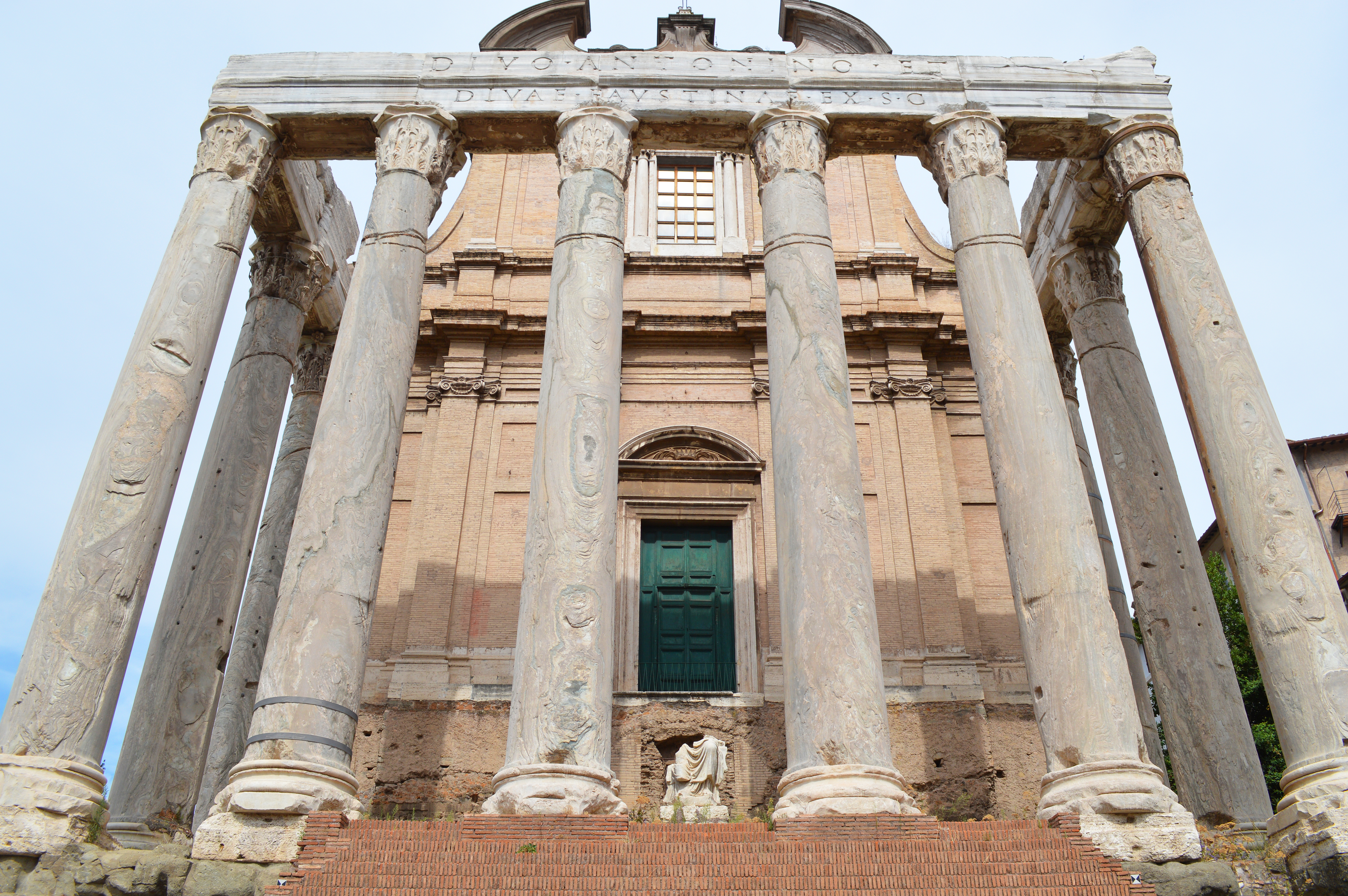
Photo by author
What you’ll notice about this temple from the others in the forum is that it seems to be two buildings in one, which is correct. This is a perfect example of repurposing by medieval builders. They took the foundation of the ruined Roman temple and used it to support a Christian Church. The building that seems to be enveloped by the ancient temple is that of the twelfth-century Church of San Lorenzo in Miranda. The building you see now is from 1601 when the church was rebuilt.
The church’s builders retained the cella and portico of the temple, but they couldn’t keep the scavengers from stripping the marble from the ruin. Looking closely at the temple’s columns, you’ll see grooves in the stone. There are two theories for these grooves: it could be evidence that they were attempts to dismantle the pagan temple or that they could have been used to help attach a roof over the portico.
Notice how high up the bottom of the church’s door is from where you stand. That door was at ground level when San Lorenzo in Miranda was first constructed. After clearing away centuries of dirt and debris from the temple ruin, there’s now a 20-foot difference.
5. The Temple of Caesar
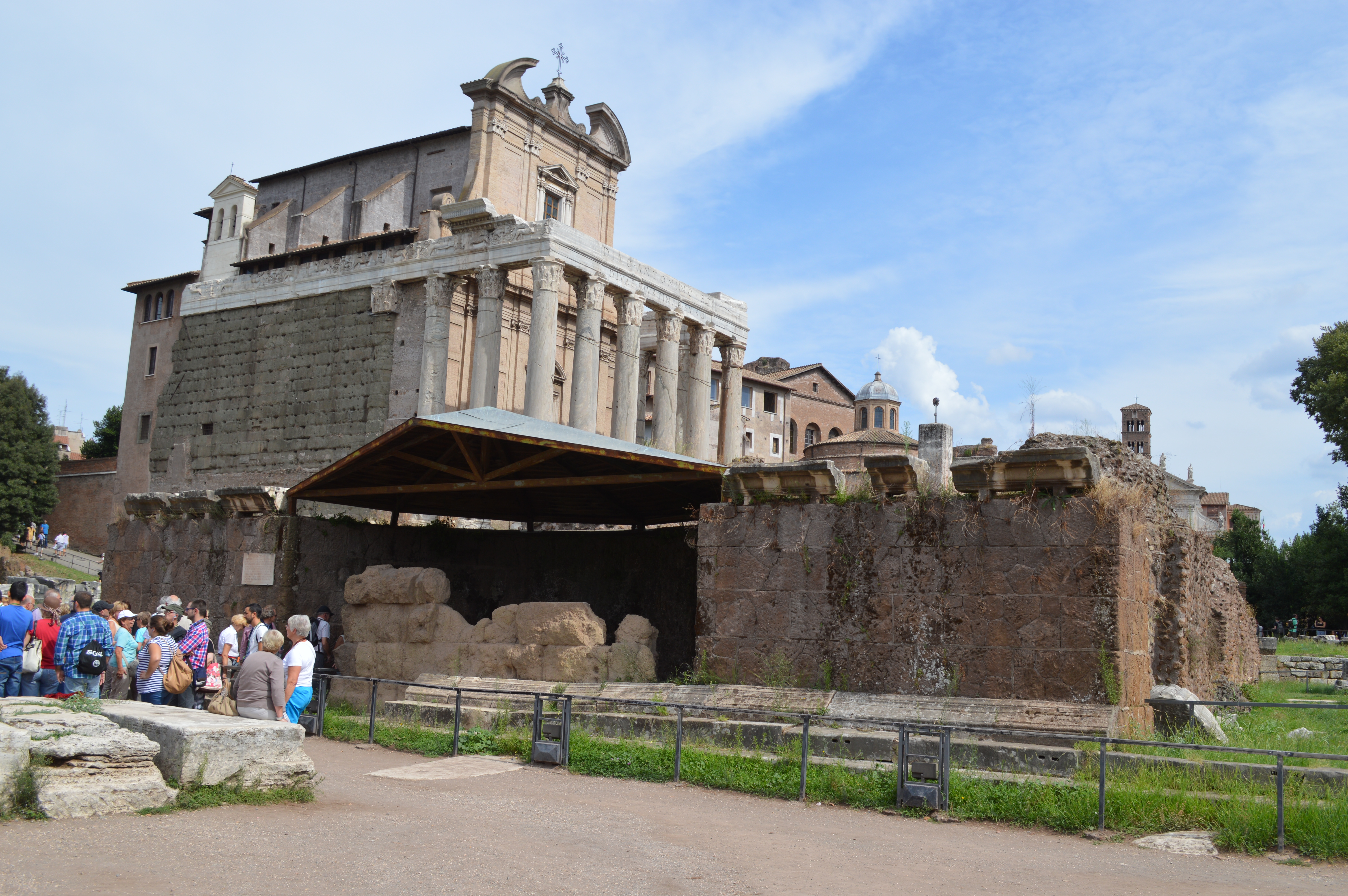
Emperor Augustus promised the people of Rome that he would build a temple for his deified adoptive father, Julius Caesar, which he did in 29 BCE. Once the most impressive temple in the Forum, the Temple of Divus Julius’s ruins are tricky to locate.
Built on the site where Julius Caesar’s body had been cremated in 44 BCE, the Temple of Divus Julius, also known as the Temple of Caesar, was built on the eastern end of the Forum’s main square near the Temple of Castor and Pollux, and the Basilica Aemilia.
It’s believed that the temple was around eighty-eight and a half feet wide by ninety-eight feet in length. But what made the Temple of Caesar fascinating wasn’t the ground area it covered but rather its height. The Temple of Caesar was designed with two levels. The top-level supported the temple building and stood around eighteen feet above the ground. The lower level, which protruded from the higher level, featured the temple’s speaker podium. This level is believed to have been around eleven and a half feet above the Forum’s Square.
The ruins of the Temple of Caesar are across the Via Sacre from the Temple of Antonius and Faustina. They can be identified by a grouping of brown caementivium (Roman concert) walls, the temple’s foundation, and a semicircle niche covered by a modern roof.
To learn more about the Temple of Caesar, click this link: The Roman Forum: Searching For Caesar’s Grave, Part 3: The Temple of Caesar.
6. The Temple of Caster and Pollux
also known as “The Three Sisters”
Photo by author
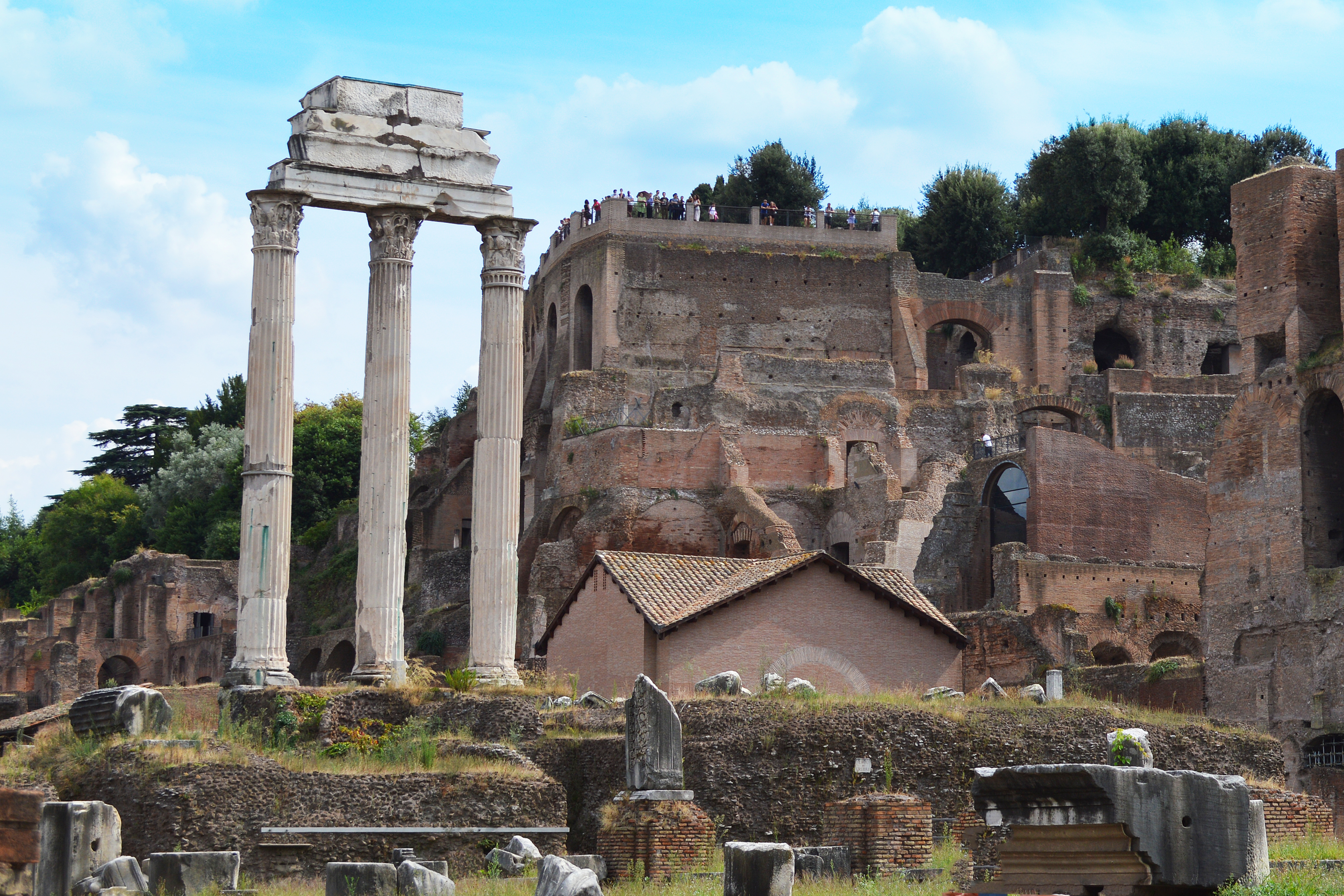
Three columns are on the opposite side of the Via Sacra from the Temple of Antonius and Faustina. These columns are popularly called “The Three Sisters.
These columns are all that remain of the Temple of Caster and Pollux, one of the first temples built on the Forum. The first temple is believed to have been constructed around 484 BC by the pre-republic dictator Postumius.
It’s believed that Postumius built the temple to celebrate his victory in the Battle of Lake Regillus in 495 BC. The temple was dedicated to the mythical twins Caster and Pollux. Castor and Pollux were the sons of the god Jupiter/Zeus and Leda of Sparta. When the temple was built, a large cult was devoted to these twins.
During the Republican era, the temple was used as a meeting place for the Roman Senate, and its podium served as a speaker’s platform. In the Imperial period, it became a government building and the State Treasury.
A fire raged through the Forum in 14 BC, destroying the original temple. The Emperor Tiberius rebuilt the temple in 6 AD, and the ruins you see today are from that temple.
7. The Basilica Julia
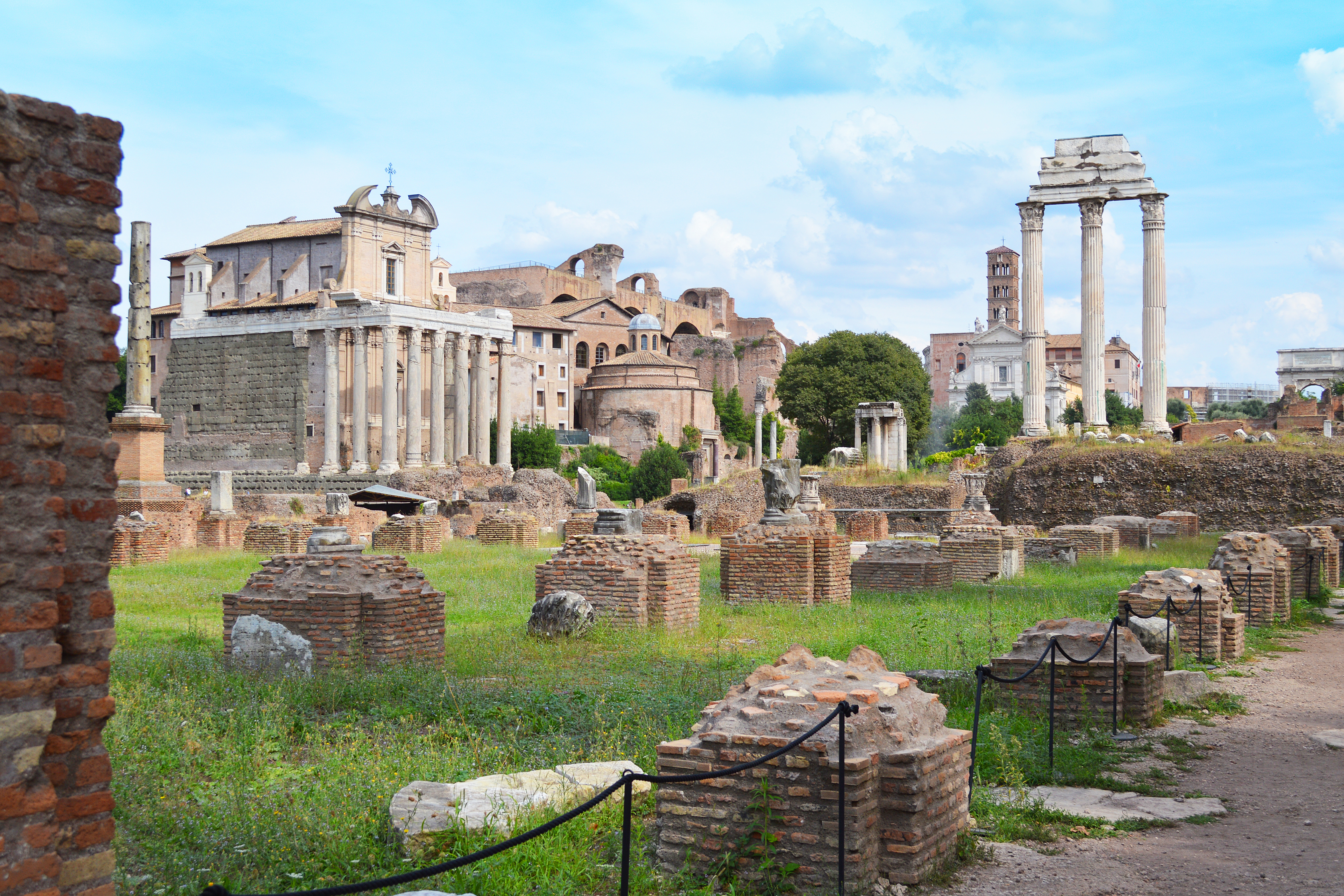
Photo by author
If you turn around and face north from the Temple of Caster and Pollux, you’ll see a large open area littered with rows of column bases and a large ruined brick wall at its north end. This is all that remains of one of the largest buildings of the ancient Roman Forum, the Basilica Julia.
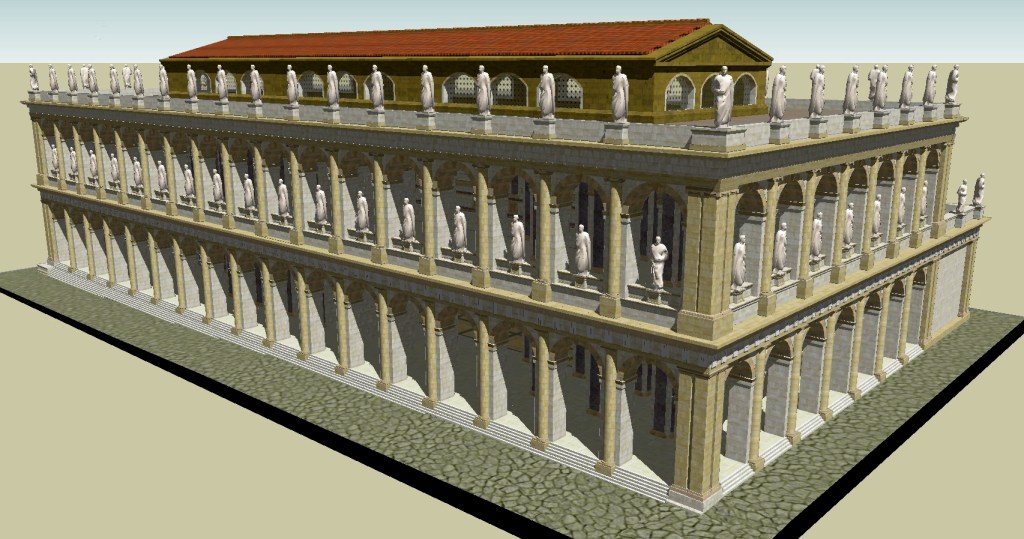
This public building stood 331 feet long and 161 feet wide.
Art by 3D computer model maker Lasha Tskhondia
Constructed by Julius Caesar in 46 BC, the Basilica Julia was the city’s main government building. During the Imperial period, this grand building housed the seat for the Centumviri, the people’s court.
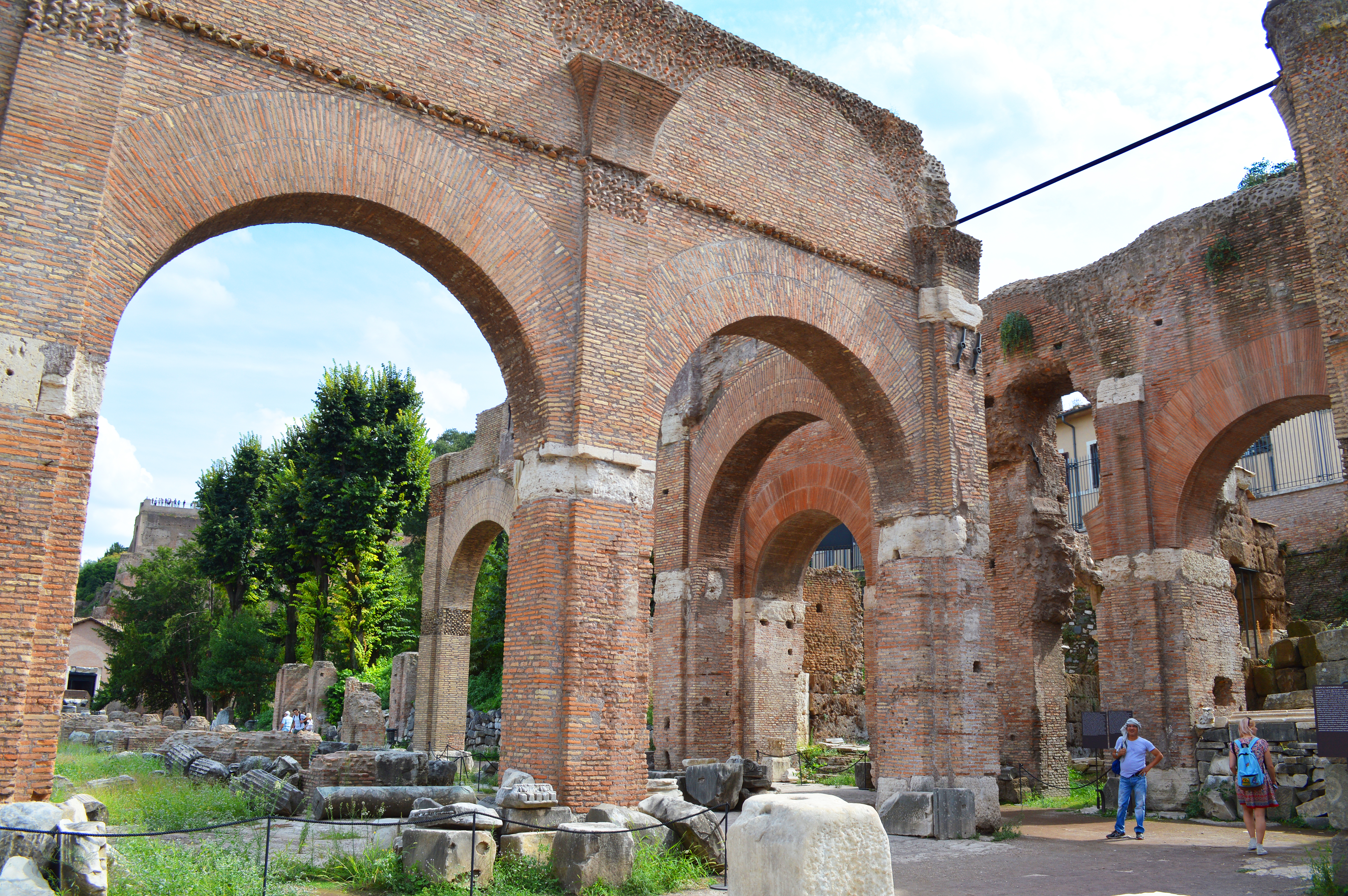
Photo by author
The original building was destroyed by fire in 9 BC and rebuilt in 2 AD. In its day, it measured over 331 feet long and almost 161 feet wide. Today, this once great public building of ancient Rome is a field of rubble.
8. The Temple of Saturn
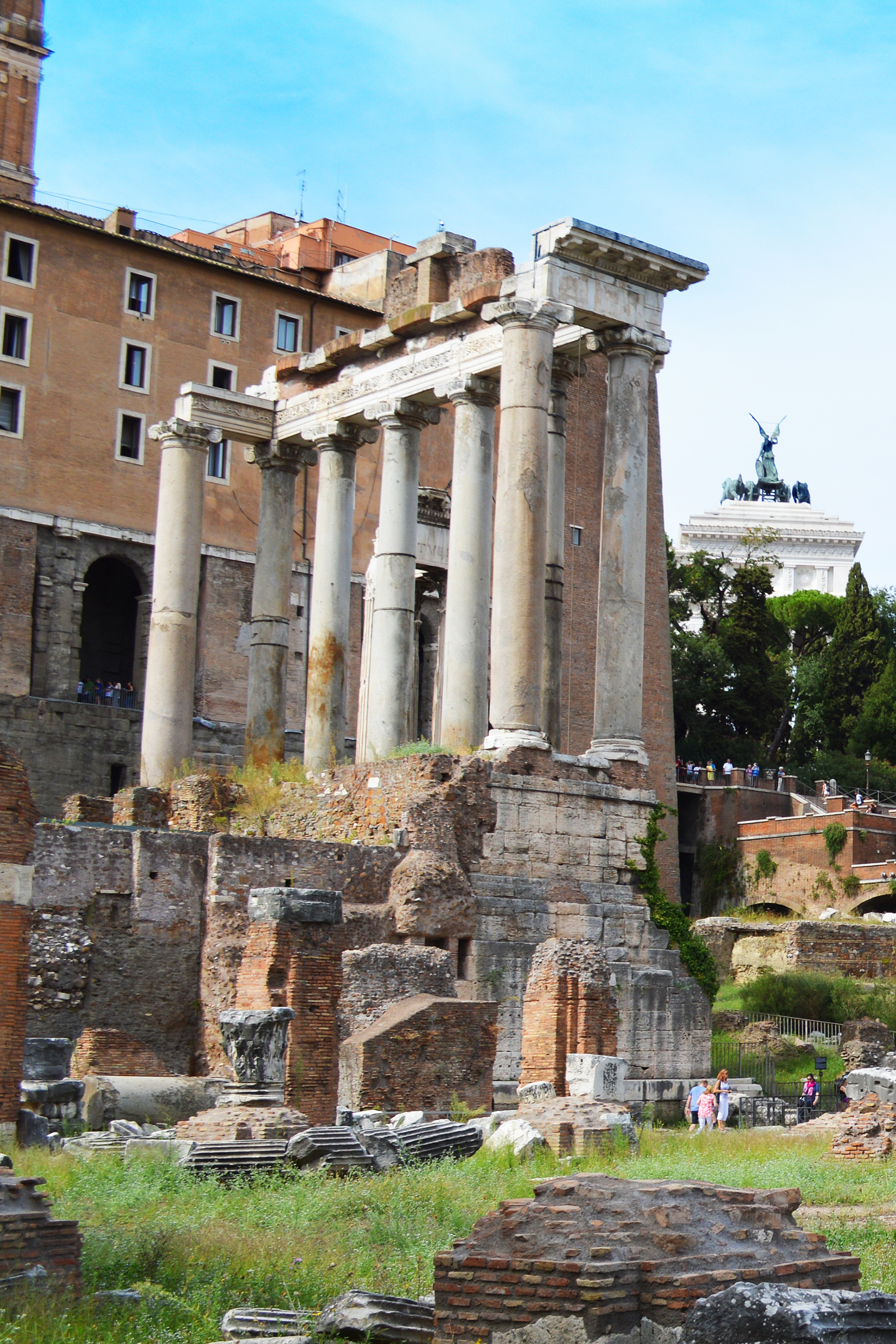
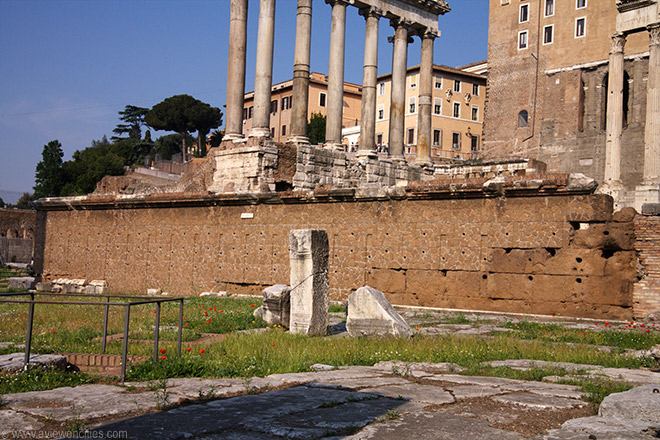
Photo by author
When you see travel brochures of the Roman Forum, they’ll most likely feature the columns of the Temple of Saturn. It is the most recognizable and photographed of all the Forum ruins.
It’s believed that the first temple to the Roman god Saturn on this site was begun in the latter part of the Kingdom of Rome and inaugurated during the first part of the Republican period, around 497 BC. However, it’s thought that the altar, which stood at the front of the temple, is much older than the temple itself.
In 42 BC, Roman Consul Lucius Munatius Plancus completed the reconstruction of the entire temple. Today’s ruins are those of another reconstruction after a fire in 360 AD.
The base of the Temple of Saturn was designed to house the State Treasury, or the Aerarium, of the Roman Republic. The standards of the Roman legions were also kept in this temple.
You’ll find the ruined base of a column at the foot of the stairs leading up to the temple. This is what remains of Emperor Augustus’s Miliarium Aureum, or Golden Milestone. The Miliarium Aureum marked the center of the City of Rome, from which all roads lead.
9. The Arch of Septimius Severus
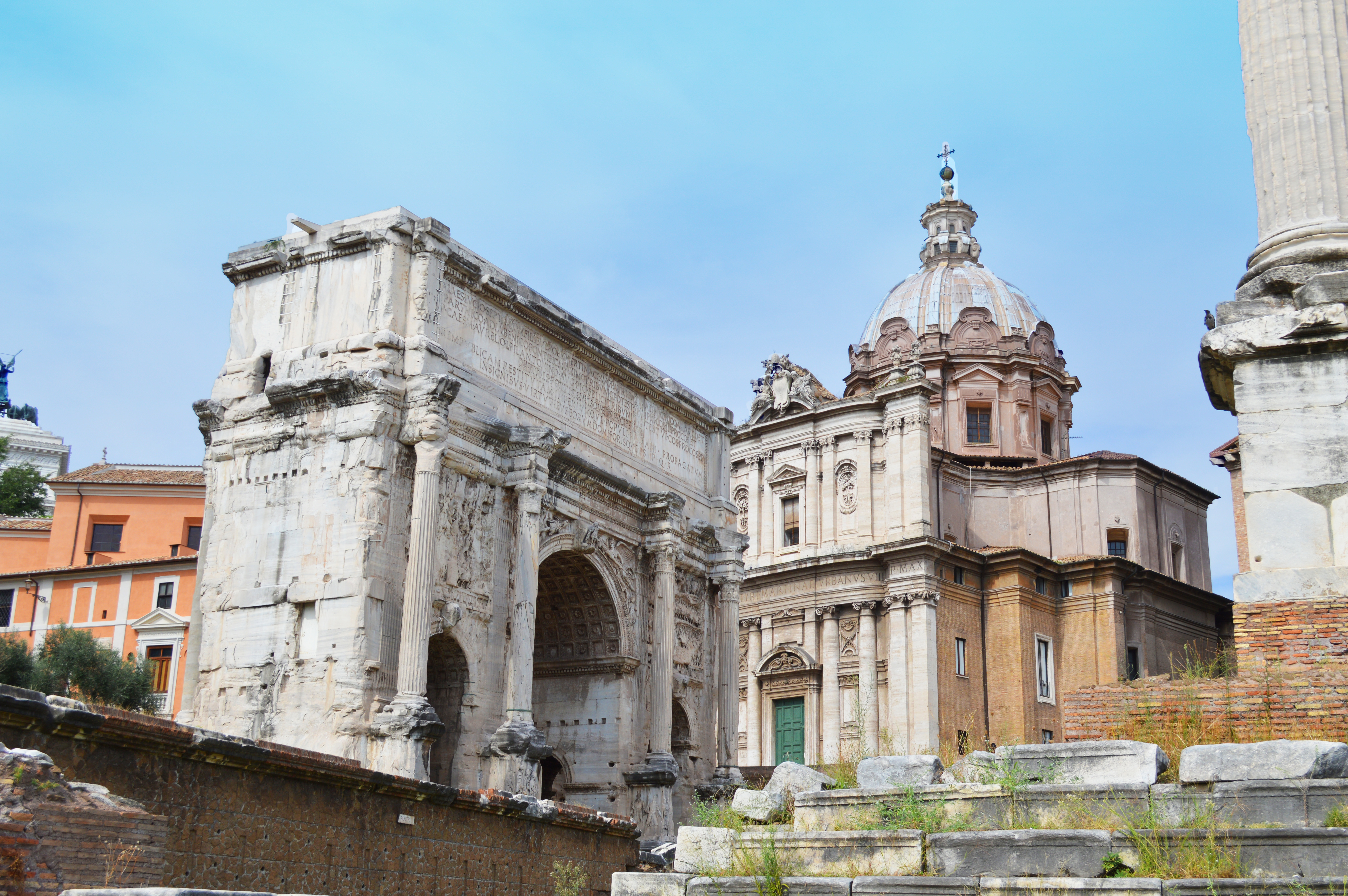
Photo by author
The magnificent Arch of Septimius Severus stands in front of the Temple of Saturn. This triumphal arch is the best preserved of the three arches in the Forum. Built by the Roman Senate in 203 AD, it honors Emperor Septimius Severus and his sons Caracalla and Geta on their victories over the Parthians in what is now Romania. You can still read the inscription on the arch that says, “Dedicated to Septimius Severus and his sons.”
The Arch of Septimius Severus stands an impressive 75 feet in height and 82 feet wide. It’s unique to most triumphal arches because it has three arched passages. The more significant center passage is slightly over 39 feet in height, with the two side passages at around 23 feet. When it was first constructed, a flight of stairs was going up through its central passage.
The arch is constructed of marble and features four deep reliefs representing scenes of the Parthian war. At the top of the arch, in the center, there’s a large relief of Mars, the god of war. It’s believed that there were also two statues of winged Victory on each side, which are now lost. As with the Arch of Titus, it was topped with a bronze quadriga with statues of Septimius Severus and his two sons. After Emperor Severus’ death, his son Caracalla, who didn’t want to share the power, had his brother Geta killed and his name and image removed.
The arch is in very good condition because it was incorporated into a Christian church in the Middle Ages. Even after the church relocated, the congregation continued to protect the arch from being stripped of its stone and marble.
The Arch of Septimius Severus stands at the foot of Capitoline Hill on the Via Sacra. The Via Sacra was the main route for the triumphal parades of the victorious generals and emperors, which started at the Forum’s southern end and ended near the Arch of Septimius Severus.
10. The Rostra
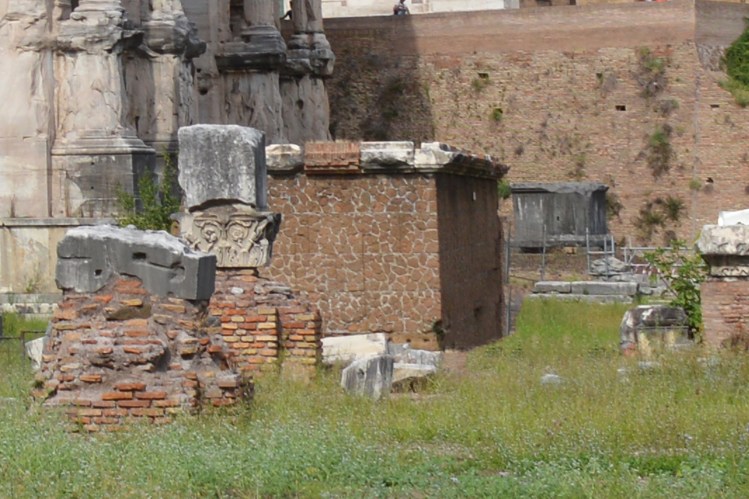
This is the enlargement I made from my photo of the Arch of Septimius Severus, where I finally found the Rostra.
Photo by author
With all of the wondrous ruined temples and buildings that spread throughout the Roman Forum, it’s easy to miss one that’s rather plain-looking. However, this often overlooked structure was one of the most important places for the people of ancient Rome. It was called the Rostra, and it was upon this platform that the average Roman citizen could speak their mind.
Originally, this speaker’s platform was known as the “tribunal.” The first tribunal in the Forum was located near the Curia building. The circular open area in front of the tribunal, where listeners stood, was the Comitium.
The name changed from the tribunal to the rostra after the naval battle of Antium in 338 BC. Six bronze ramming prows taken from the enemy ships were part of the spoils from that battle. These captured prows were attached to the front of the tribunal platform as trophies. So, what does the name change have to do with ships’ prows? The Latin word for prow is rostra. Because of the attached prows, the platform began being referred to as the rostra, and the name stuck.
When fire destroyed the Curia in 52 BC, Julius Caesar began a major restructuring of the Forum. As part of this project, Caesar planned to relocate the Rostra and Comitium to the west side of the Via Sarca, across from their original location.
The Rostra that Julius Caesar began constructing, referred to as the Rostra Vetera, is said to have had a curved design. Across its back was a staircase, which allowed speakers to mount the platform. This rostrum wasn’t finished when Caesar was assassinated in 44 BC but was finally completed by Emperor Augustus in 42 BC.
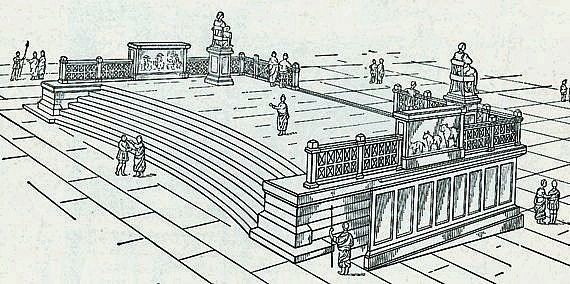
Art from goldstone
Augustus encased the original Rostra Vetera inside a much larger, rectangular design. This new Rostra was a little over 78 feet long, constructed of tufa blocks with a marble facing and a curved staircase on its north side. It was adorned with ship prows and reliefs, topped with a marble railing, and had statues and columns sitting on its platform. This structure is known as the Rostra Augusti, and its remains are what you see in the Forum today.
Many famous speeches in Roman history have been delivered from this rostrum; one of the most well-known is Marc Antony’s at Julius Caesar’s funeral in 44 BC. I go into more detail on this in my post, The Roman Forum: Searching For Caesar’s Grave, Part 2: The Funeral Of Julius Caesar.
As I wrote earlier, missing the Rostra when visiting the Forum is easy. I know this because I missed it myself during our visit in 2015. It wasn’t until we got home and I was researching our trip that I learned how close we must have been. I began looking through all my photos to see if I might have caught it unknowingly. Finally, there it was, hidden in plain sight; it appeared in one of the photos I had taken of the Arch of Septimius Severus.
11. The Curia Julia
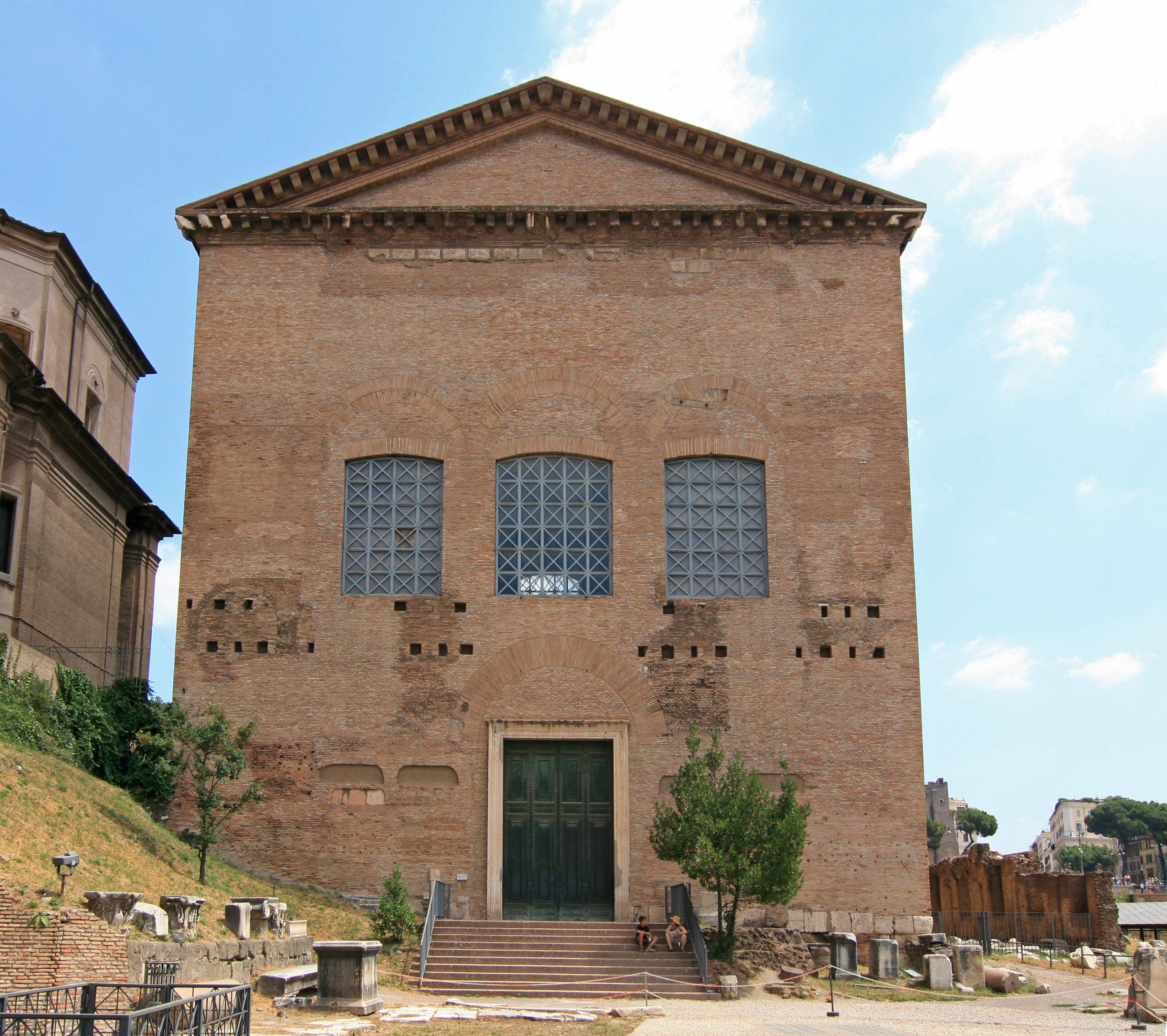
Photo from Wikipedia
Across the Via Sacra from the Rostra is a building that looks out of place among all the other ruins of the Forum; in fact, it almost looks contemporary in its design. Yet this building dates back to Julius Caesar and the Roman Republic and is considered one of the best-preserved structures in the Forum. This is the ancient government building known as the Curia Julia.
The place where the Roman Senate met during its Republic and Imperial periods was called the Curiae. The first Curiae buildings on the Forum were located on the east side of the Forum’s main street, the Via Sacra. Three Curiae were built at that location: the Curia Hostillia, followed by the second and larger Curia Cornelia. The third, begun by Julius Caesar, is the Curia Julia.
When a fire destroyed the Curia Cornelia in 52 BC, Julius Caesar began a significant redesigning of the Forum. In 44 BC, Caesar started relocating and rebuilding the Forum’s governmental area. As I wrote in the last segment, one component of Caesar’s plan was the relocation of the Comitium and Rostra across the Via Sacra.
Art by Lasha Tskhondia
As with the Rostra and Comitium, construction on Caesar’s curia wasn’t finished when he was assassinated on March 15, 44 BC. In fact, it was because the Curia Julia was still under construction that the Roman Senate moved their meeting place to the Theatre of Pompey, where the assassination occurred. I go into greater detail on Caesar’s assassination in my post, “Searching for the site of Julius Caesar’s Assassination.” As with the new Rostra, Comitium, and other projects started by Caesar, the Curia Julia was completed by his successor, Emperor Augustus, in 29 BC.
Emperor Domitian was the first to restore the Curia Julia between 81 and 96 AD. After a fire heavily damaged the building in 283 AD, Emperor Diocletian rebuilt the entire structure between 284 and 305 AD; it’s this building that you see today.
Once again, a Christian church saved another historic building in the Forum from destruction. In 630 AD, the Curia Julia was converted into a church. The church left the building mostly unchanged, preserving the structure.
Once again, I missed the Curia Julia during my visit to the Forum. I saw the building but had no idea what I was looking at.
12. The Temple of Vesta
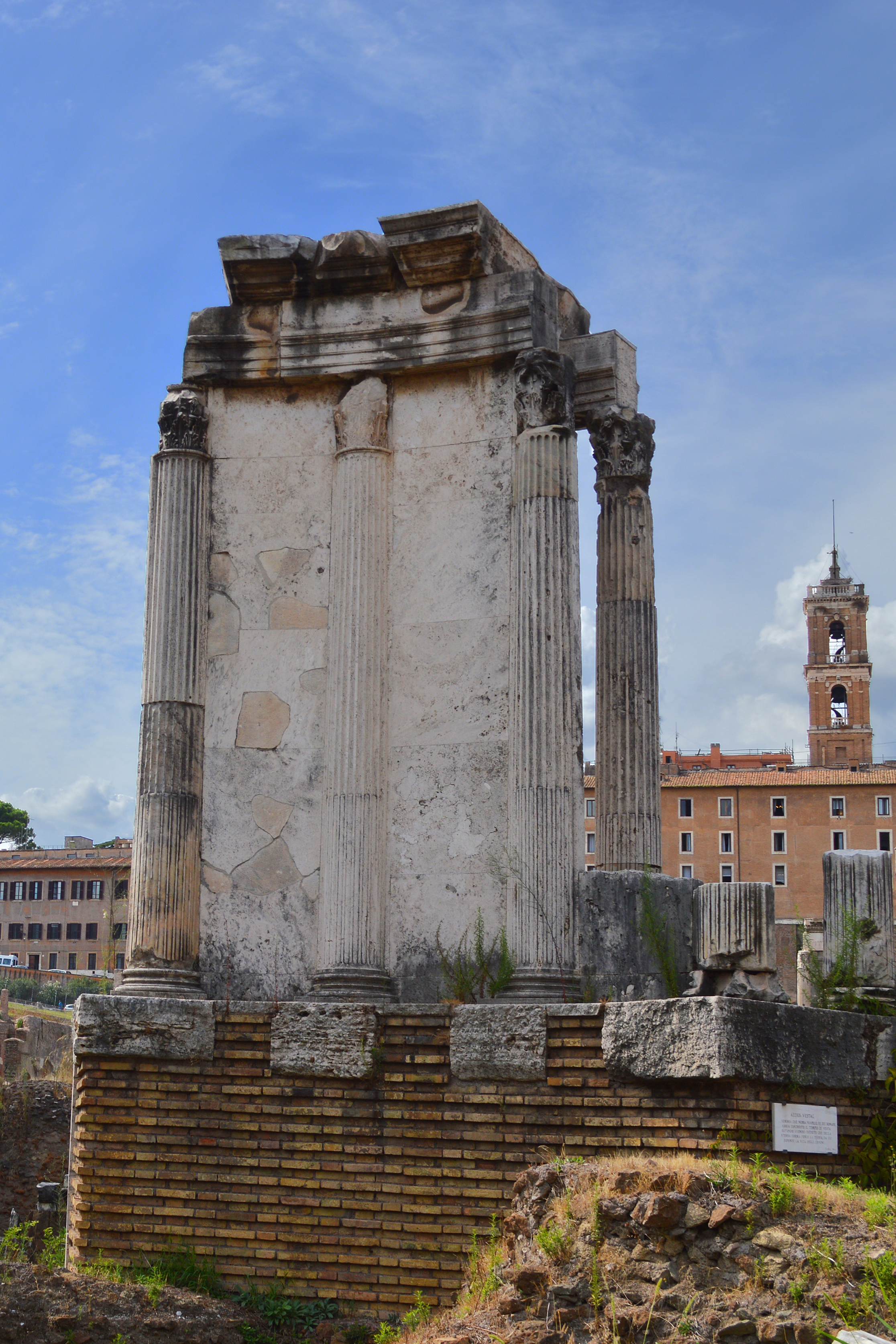
Photo by author
As we leave the northern end of the Forum, walking along the Via Sacra back toward the Arch of Titus, you’ll see a set of columns on what was once a semicircle temple. Of all the many temples in the Forum and in Rome, this was by far the most sacred to its people. It was the Temple of Vesta.
The Temple of Vesta housed the eternal Sacred Fire of Rome. The belief was that the mythical Aeneas, a Trojan hero and demi-god, carried this flame to Rome from Troy without it burning out. This eternal flame represented the timelessness of Rome. On the first day of the New Year, Romans would extinguish their home fires. They’d then come to this temple and relight their hearth fires from its sacred flame. This eternal flame was kept by the six Vestals. These Vestals were selected from the most prominent Roman families when they were children.
The Temple of Vesta is one of the oldest temples on the Forum; the original is believed to have been built during Rome’s kingdom period. Its unique circular design is thought to represent a primitive hut or home. Even though this temple was dedicated to Vesta, the goddess of the household hearth, there were no statues of her in its cella. Instead, that place was occupied by the sacred flame. Due to the constantly burning flame, the temple roof had a smoke vent hole at its center, just like the Pantheon.
The Emperor Septimius Severus rebuilt the temple sometime between 193 and 211 AD. It remains in the Forum now. The temple was partially restored in the 1930s, most likely by the dictator Benito Mussolini.
Historians think that the Temple of Vesta served the people of Rome in their yearly pilgrimage well into the 13th century AD. It may have had the most extended use of any of the temples in the Forum. However, the Temple of Vesta finally succumbed to the same fate as its neighbors, having its marble and stone quarried off for other buildings.
13. The House of the Vestal Virgins
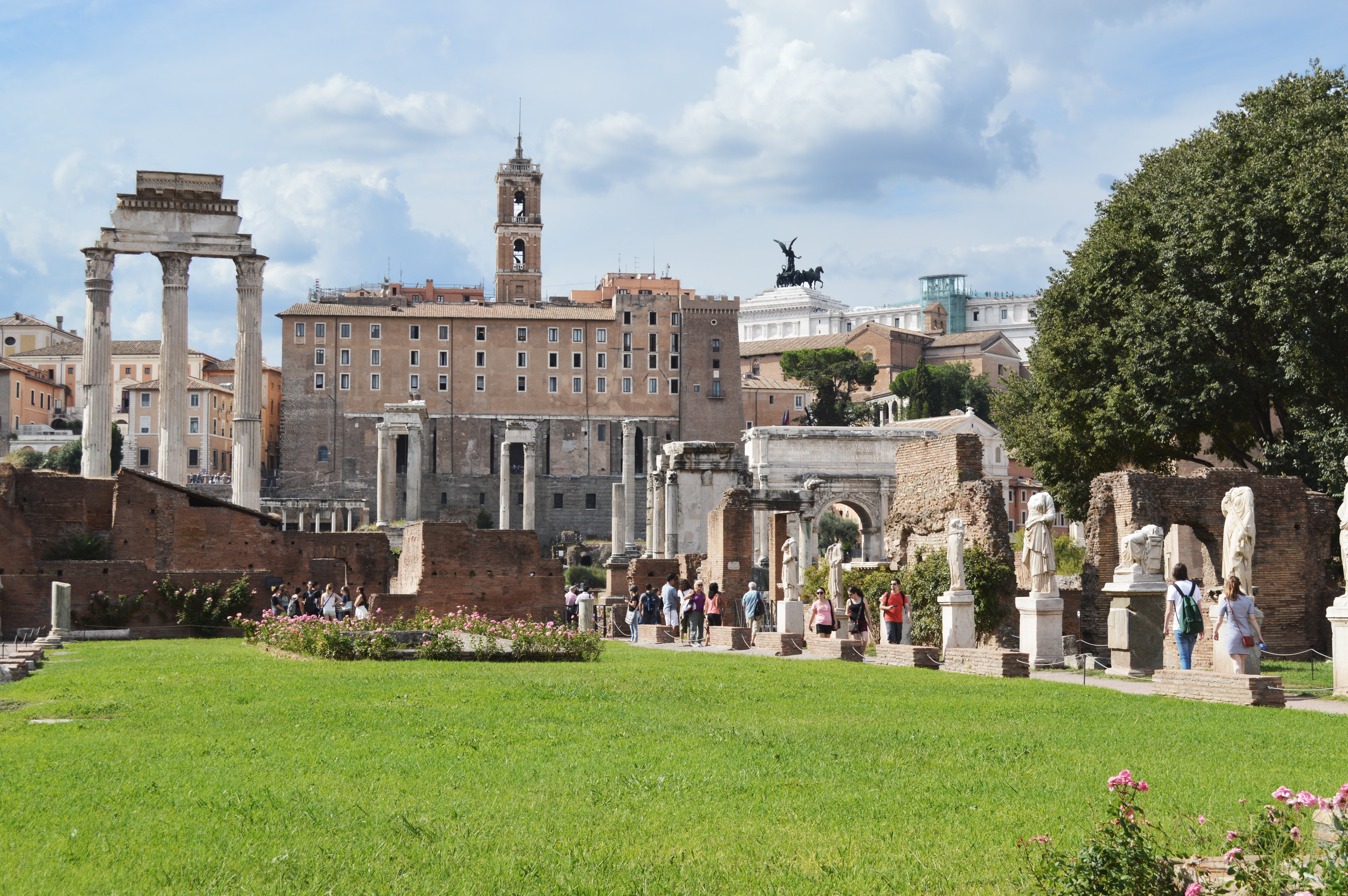
All that was left of the massive complex where the Vestal Virgins lived.
Photo by author
Next to the Temple of Vesta, toward the foot of Palatine Hill, is the garden of the House of the Vestal Virgins. This beautiful and well-kept garden is all that remains of the House of the Vestal Virgins, the servants who maintained the sacred flame of Rome in the Temple of Vesta. Today, only the building foundations and the courtyard garden have survived.
Emperor Septimius Severus built the main building with two floors and a columned portico that completely surrounded the courtyard garden. The private apartments of the Vestal Virgins were on the second floor. The kitchen, flour mill, ovens, and servant’s quarters were on the bottom floor. Some think that Severus’s design was the concept used for the modern convent.
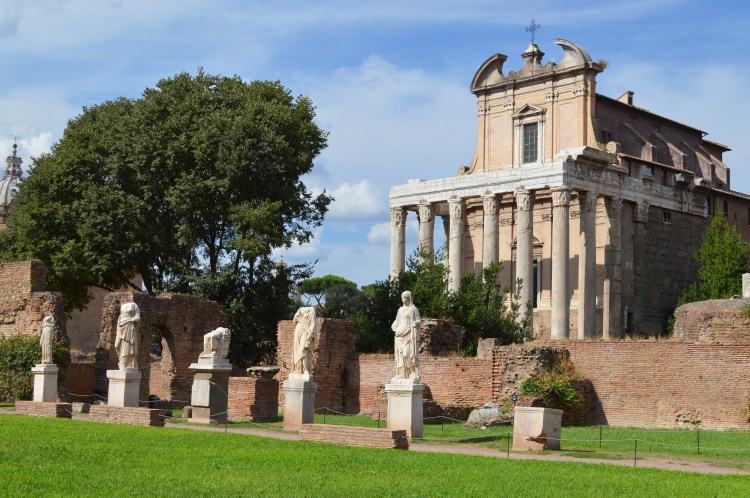
with the Temple of Antoninus, Pius, and Faustina can be seen
Photo by author
As you walk around the garden, check out the statues on each side of the grassy area. These statues are of the temple’s head vestals. You can still read the inscriptions that state the virtues each Vestal had.
14. The Tullianum, or the Mamertine Prison
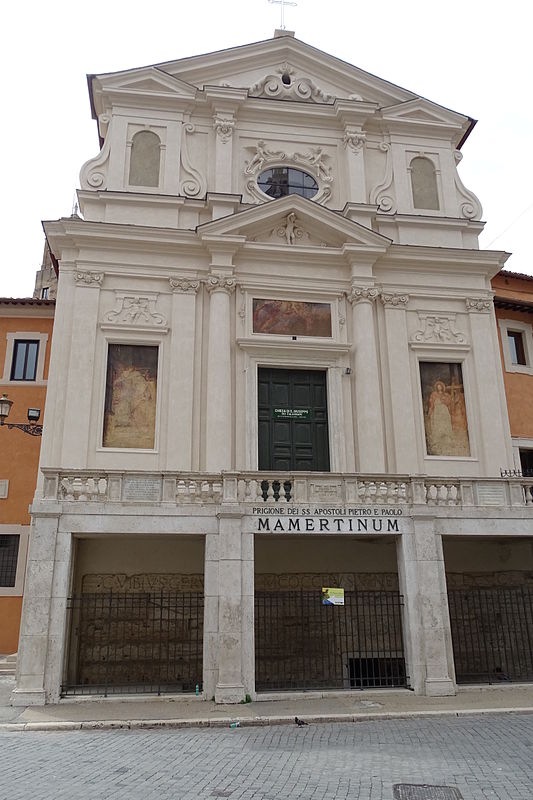
Photo from Wikipedia
Before we leave the Roman Forum, there’s one more site that I’d like to tell you about. This place has a historical and deep Christian connection: the Mamertine Prison. And it goes without saying that we missed it while in Rome. So, what’s the Mamertine Prison, where is it located, and why did we miss it?
After we got back from our trip, our pastor asked if we had visited the Mamertine Prison while in Rome. My wife and I looked at each other with a blank face. We had no idea what the Mamertine Prison was. We knew how Saint Peter and Saint Paul were imprisoned in Rome before being martyred, but we had no idea it was at Mamertine Prison. Also, with all the walking we did around the city and all the tours we took, we never heard of or saw any reference to the Mamertine Prison while in Rome. Now I was curious; where was this Mamertine Prison, and had we walked past it without knowing? The search was on.
What I found was that the place was initially called the Tullianum. Sources say it was first constructed as a cistern to collect water from a spring on the northeast side of Capitoline Hill in the 7th century BC. This cistern also had two levels, an upper and lower. Because it wasn’t designed as a cell to hold criminals, prisoners were lowered by rope through an opening to the dungeons below.
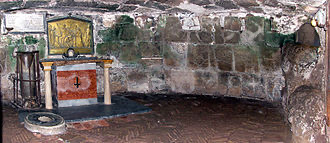
Photo from Wikipedia
Although it’s referred to as a prison, it really wasn’t. Roman law in the Republic and Imperial periods did not call for long-term imprisonment. What it did allow, however, was for short-term detention. This would apply to those awaiting trial or execution. Some of the executions were conducted within the Tullianum itself.
As I stated above, some Christian denominations believe this was the location of the imprisonment of Saints Peter and Paul. Historically, the exact location of their imprisonment is not mentioned. However, because it was so near the center of the Roman government, it’s very likely that high-level political prisoners, like Saint Paul and Saint Peter, could have been held there.
On the subject of the two saints, even the Bible is unclear where Paul had spent his last days. In the Book of Acts, Paul is guarded for two years in his apartment. Historically, that length of time is much too long for how the Mamertine Prison was used. As for Saint Peter, there’s debate about whether he was even in Rome. I cover this in “Was Saint Peter Ever in Rome?”
There’s no record of when the Tullianum stopped being used as a jail, but we know it has been used for Christian worship since the medieval period. Also, the location’s name changed from the Tullianum to Mamertine during that period.
Today, the Mamertine Prison is used by two churches: San Giuseppe dei Falegnami, which holds worship in its upper chamber, and San Pietro in Carcere, which holds worship in its lower cell.
So, when in Rome, where do you find the Mamertine Prison? Mamertine Prison is on the side of the Capitoline Hill, at the northeast end of the Forum, on the Via del Tullinano. The Via del Tullinano is only a few yards past the Arch of Septimius Severus.
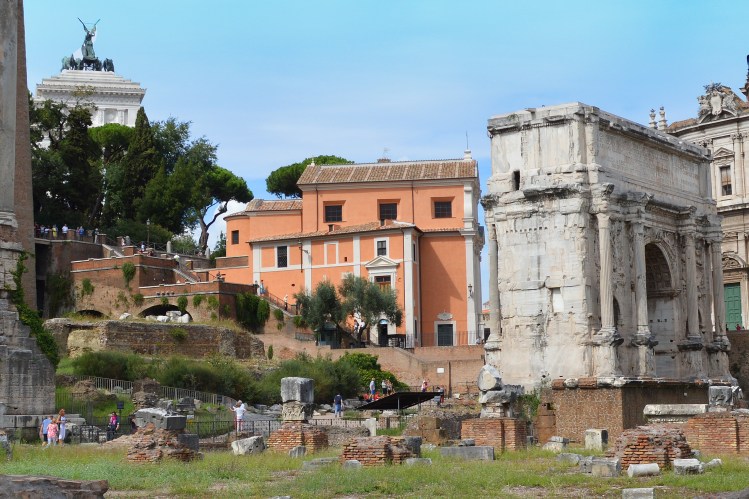
The Tullianum/Mamertine Prison is the peach-colored building in the background.
Photo by author
Interestingly, I was just about twenty feet away from its location when I stopped to take a few photos of the Forum of Caesar from the Via dei Fori Imperiali. Also, it’s not hard to recognize where it’s at from the Forum because the church is painted a bright peach color.
The cells are beneath the Church of San Giuseppe dei Falegnami, and I understand that you can reach them through the church. You can also take the stairs down to the cells instead of being lowered on a rope.
I still haven’t figured out why this site isn’t included on most general tours. However, I later learned that it is available with some church group tours.
This post was updated on August 19, 2024
There are other Forums in Rome
Most tourists, myself included, think that the only Roman Forum is the one that runs from the Colosseum, along the Via Sacra, to the Capitoline Hill. And although this was the first of the Forums of Rome, it’s by no means the only one.
The Forum was expanded outward starting with Julius Caesar, followed by other emperors. These new Forums were constructed to self-aggrandize the emperors who built them. These are known as the Imperial Forums.
In my next series, “The Imperial Fora of Rome,” I’ll give the history and location of five of these Imperial Forums.
 Still Current
Very informative! Thanks for compiling this info and sharing!
LikeLiked by 1 person