
In an ancient and historic city like Rome, there is always something right under your nose that you could miss if you don’t keep your eyes open and listen to others. As tourists, we sometimes only focus on the main sites and literally walk past others of equal or greater historical value.
As I mentioned in an earlier post, our hotel in Rome was the Grand Hotel Palatino, located on the Via Cavour. The Palatino is just a few blocks from the Roman Forum and Colosseum. Many times, my wife and I would leave the hotel and walk down to those famous ancient sites, ignorant of what we were passing. At breakfast one morning, another guest at our table asked, “Have you been to the St. Peter in Chains Church?” “The what?” I asked. She explained that it had Michelangelo’s famous statue of Moses. We told her we had not and asked where it was located. Her answer makes my point: “Across the street from the hotel and up a few steps.”
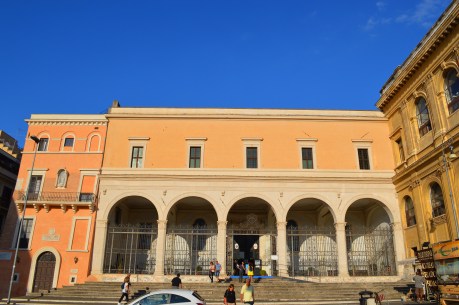
And she was absolutely correct in her directions. Across the Via Cavour was the narrow Via di San Francesco di Paola, which was more of a walkway in that location than a street. And she was also correct about the short set of steps to the top. At the top is the Via Eudossianna, and there, as our tablemate had said, was San Pietro in Vicoli, Saint Peter in Chains.
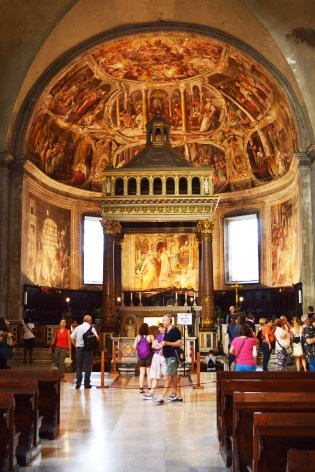
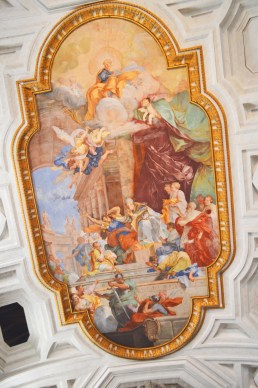
Built in the fifth century, this minor basilica is rather unassuming on the outside when compared to Saint Peter’s, Sant’Agnese in Agone, or the other majestic churches of Rome. But once you enter, you’ll be surrounded by the colorful beauty of its many frescos. But it’s not the frescos or even the holy relic that this basilica is named for that brings the tourists here; it’s the statue of Moses.
Michelangelo’s statue of Moses
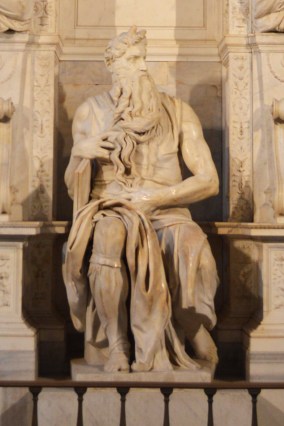
There is a wonderful history behind this work of art, but first of all, it wasn’t sculpted as a standalone. Michelangelo was first commissioned by Pope Julius II to create a funeral monument and tomb for him. The original design was to be massive, with 40 statues. However, Pope Julius II had a big ego. In his drive to immortalize himself with giant projects, he kept pulling Michelangelo away from working on the tomb to undertake other projects, such as painting the ceiling of the Sistine Chapel. Michelangelo did not consider himself a painter, but rather a sculptor, which caused deep friction between them. Because Julius kept veering off to other projects, his tomb and monument were not finished at the time of his death in 1513, and so the complete monument was never finished. Julius’ well-to-do family had the finished portion of the monument, with the statue of Moses, moved to Saint Peter in Chains because of the Pope’s love for this small basilica.
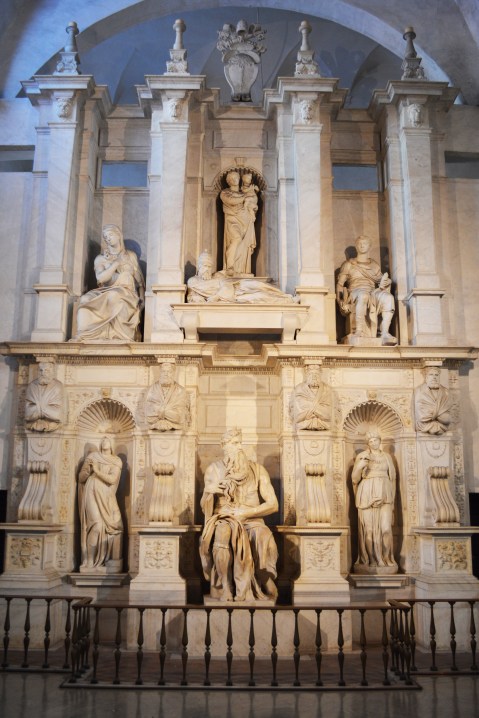
Michelangelo considered his statue of Moses to be his best work. The statue’s surface appears to have been brushed rather than chiseled. It was said that Michelangelo saw this statue as so lifelike that he asked it to talk when he had finished it. There is also a controversy about the statue’s horns. Moses seems to have two horns coming out of his forehead. Some scholars believe that the reason for these horns could be due to a mistranslation in the book of Exodus. The most common translation of the Exodus account states that Moses came down from Sinai with two rays on his forehead. This is the translation of the Hebrew word “Karan” or “Karnaim,” meaning “rays.” However, the confusion by Michelangelo could have been because he thought the Hebrew word was “keren,” which means “horns.” No one really knows what Michelangelo’s intentions were. It is also said that Michelangelo hid his profile and those of his patrons in Moses’ beard as a joke.
The Chains of St. Peter

The statue of Moses overshadows what I think is an equally interesting and historically significant artifact housed in this church, which is what this basilica is named after and was constructed to house. That would be the relic of the chains that supposedly bound St. Peter when he was imprisoned in Jerusalem and Rome.
The story is that Empress Eudoxia, wife of Roman Emperor Valentinian II, had gotten the chains that held St. Peter while imprisoned in Jerusalem from her mother, who had gotten them from the Bishop of Jerusalem. Eudoxia then gave those chains to Pope Leo I, who already had the chains that bound Peter while he was imprisoned in the Mamertine Prison in Rome before he was martyred. Legend says that as Pope Leo was comparing the two chains, they miraculously fused together.
This relic is kept in a reliquary under the main altar. To get a closer look, go down a few steps at the front of the altar. At peak tourist times, it may be easier to view the statue of Moses.
So, as you travel to historic cities and countries, don’t forget to look across the street and up a few steps. You may be surprised by what you’ll find.
 Still Current
Thank you for sharing this interesting piece of history! In so many countries, like Italy, we often forget just how old everything is and how even the most unassuming buildings have stories to tell.
LikeLiked by 1 person