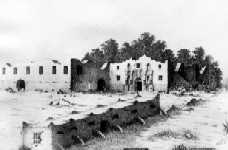

In this post, I’ll continue the story of how the almost forgotten Alamo battlefield was slowly erased by the City of San Antonio as it grew and expanded. Sadly, one of the main contributors to this urban sprawl was a man who had a direct connection with the Alamo and its fallen defenders.
I’ll also explain how the Alamo’s main buildings survived and how the ruined Alamo church came to look the way it does today.
First, I’ll start with the Alamo defender who, for his personal gain, almost single handed destroyed the hallowed grounds.
Samuel A. Maverick (July 23, 1803- September 2, 1870)
In Texas history, Samuel Maverick is best known as a mayor, land speculator, and developer of San Antonio in the mid-1800s, and it’s also said that his name was the source for the term “being a maverick, “ a person of independent thinking. But beyond this, Samuel Maverick also had a direct connection to the Texas Revolution, the Battle of the Alamo, and was a significant influence on what became of the Alamo battlefield.
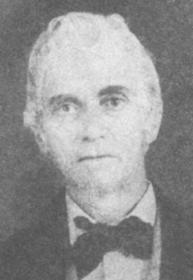
Samuel A. Maverick came to San Antonio from South Carolina in 1835, at the very start of the Texas Revolution. He took part in the Siege of Bexar and afterwards became a member of the Texan garrison at the Alamo. During the Alamo’s siege, Maverick left the fort on March 2, as a courier for Travis and also as a representative for the garrison at the convention for Texas Independence, thus escaping the final battle.
In 1838, Maverick began buying up land grants around San Antonio, believing that the city would explode with new settlers from the United States now that Texas was a republic. That same year, he moved his family into one of the remaining houses that had been part of the forts’ west wall. While living there, he continued purchasing the remaining lands on and around the Alamo compound, including the rest of the old west wall. In his development of that area, he demolished what traces of the west wall that remained.
Maverick claimed a deep attachment to the Alamo and wanted to live close to where his friends had fallen. He built himself a grand two-story home, which sat where the Alamo’s west and north walls had met. This area would have been the location of one of the Alamo’s cannon platforms, and most likely where Travis had met his death.
Ten years later, Maverick subdivided the lands on the west, north, and northeast sides of the Alamo battlefield, including where the main body of the Mexican army had attacked the north wall. Maverick’s “Alamo Village” would cover the north wall of the battlefield entirely.
Maverick laid out all the lots, streets, and the Alamo Plaza itself, giving it the look we see today. Maverick may have felt close to his fallen hero friends, but his developments were one of the main contributors to the demise of the Alamo battlefield.
Thanks to Maverick, what had been the Alamo’s west wall was now a row of commercial buildings, and its north wall would be taken over by a massive Federal building. By the 1840s, all that remained of the Alamo fort was its three large buildings: the Long Barracks (the old Convento), the Low Barracks (what had been the fort’s main gate), and its Church.
These historic buildings were in an advanced stage of deterioration: the roofs of the Long Barracks and Low Barracks had collapsed, weeds were growing out of the building’s walls, and animals, bats, and birds made their homes there. What remained of the Alamo sat vandalized, slowly decaying, and mostly forgotten.
The Alamo under the Army (1847-1878)
In 1847, during the Mexican-American War, a 29-year-old American soldier named Edward Everett, who was unable to join his command in Mexico because of an injury, was assigned by his commander, Col. John Hardin, to collect information on the local history and customs of San Antonio. Everett, who was also an accomplished artist, began sketching the different sites and missions around the town, including the Alamo ruins. Many of the images we have today of the Alamo during this period come from Everett’s work.
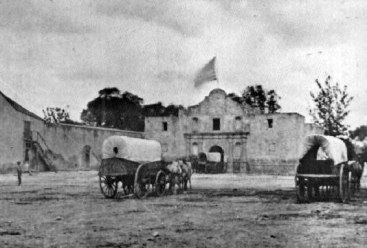
In 1849, the U.S. Army leased the church and Long Barracks from the Catholic Church to be used as a quartermaster depot. To save cost, Captain James Ralston proposed using the Alamo’s buildings as foundations. However, Everett, who had become the Captain’s clerk, convinced Ralston to use only the Long Barracks and Low Barracks, leaving the church as a historic relic. It’s interesting to note that Everett considered the Alamo’s church as a historic relic, but not its other two buildings. It could have been a lack of the locals not knowing the true history of the Alamo battle, or was it again the allure of the church’s façade that drew Everett away from the historical fact that it was in the Long Barracks where so many defenders and Mexican soldiers had fought to the death, and the Low Barracks where Jim Bowie had died.
Ralston put Everett in charge of turning the Alamo’s two buildings into offices, living quarters, workshops, and storage rooms. Under Everett’s direction, the Low Barracks was re-plastered and a new roof added. However, his reconstruction of the Long Barracks was the most drastic to the original building. Most of the Long Barrack’s interior and some of its walls were removed. The second floor was in poor condition, but Everett utilized what he could and extended its length by adding new walls. Further changes were made by cutting additional windows and doors into the building’s thick stone walls.
Although Everett left the ruined church intact, he ordered that the rubble that littered its interior be cleaned out. It was reported that during this time, a few skeletons and artifacts, attributed to the 1836 battle, were found in the church.
Although Everett and Ralston wished to keep the church as it was, the new assistant quartermaster had a different idea, not only for the Alamo’s church but its other two buildings as well.
Major Edwin Babbitt was placed in charge of making the site ready as an Army depot. Babbitt wanted to tear down all of the Alamo’s buildings, even those that had been rebuilt by Everett, and construct all new structures on the site. If Babbitt had gotten his way, it would have been the complete loss of the Alamo.
But General Thomas Jesup strongly disagreed with Babbitt. Gen. Jesup saw that the reconstructed Long and Low barracks were more than adequate, and that the church’s thick, high walls would make a strong foundation for a third building. Although Gen. Jesup overruled Babbitt, he also had over ruled Everett’s vision of keeping the Alamo church as it was. Jesup’s order would bring about the way the Alamo church looks today.
The reconstruction of the Alamo church was a major undertaking. The first thing that the engineers needed to do to make it usable was to add a roof. But before they could do that, they needed to raise the walls of the church with new stone and make it even. Once that was done, they were able to add a wooden gabled roof that ran from the front to the back of the building, using a hip design on its eastern end. However, the roof’s western peak couldn’t be finished that same way, it would make it look unsightly. That problem was solved by architect and stonemason John Fries.
It was Fries who came up with the design for the Alamo’s now-famous “hump.” Where Fries actually got this idea is lost to time. Although we can’t picture the Alamo today without its hump, it wasn’t much appreciated at the time.
Initially, the church had windows on each side of its main door and one above it. However, when the army added the roof, they also added a second floor. To let more sunlight into the room, they needed to add more windows. Those two windows you now see near the top on both sides are what were cut into the building by the army, and if you look closely, you’ll see they don’t line up.
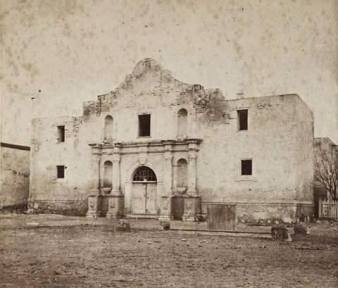
The United States Army continued to use the Alamo buildings up until the Civil War. After Texas seceded from the Union, the Confederate Army used the buildings from 1861 until the war’s end. After the Civil War, the U.S. Army again occupied the Alamo until its depot was moved to Fort Sam Houston in 1878. After the Army left, the three Alamo buildings once again came under the control of the Catholic Church.
By that time, the Catholic Church had little use or need for the buildings. It was then that a local merchant approached the Church, making them an offer they couldn’t refuse. An offer that would once again change the look and history of the Alamo, and not for the better.
Some of the resources used:
Thompson, Frank. “From Army Headquarters to Department Store.” The Alamo, A Cultural History, Taylor Publishing , 2001.
Nelson, George. The Alamo, An Illustrated History. Cenveo Printing, 2009.
“Samuel Maverick .” Wikipedia, Wikipedia, May 2018, en.m.wikipedia.org/wiki/Samuel_Maverick.
“Alamo Mission in San Antonio.” Wikipedia, Wikipedia, 2 July 2018, en.m.wikipedia/wiki/Alamo_Mission_in_San_Antonio.
Selcraig, Bruce. “Remembering the Alamo.” Smithsonian.com, Smithsonian.com, 1 Apr. 2004, http://www.smithsonianmag.com/history/remembering_the_alamo-101880149/.
 Still Current
Great post. Texas history is rich, isn’t it?
LikeLike
Thank you, and yes it is. It has been quite an experience for me in studying the the Texas story. Over the 60+ years of my research I’ve seen what we thought was fact being corrected. If you liked this post check out the others on this subject.
LikeLiked by 1 person
I will. Thanks.
LikeLike
As a descendant of John M Fries who was the architect of the renovation. You said in the article that where Fries got the idea for the arched parapet was lost to time. Perhaps I can be of assistance then, he and his parents and other siblings immigrated to the US from Germany. The arched parapet was a common architectural design from their area of Germany.
LikeLike
Thank you for the information Mr. Malloy, and I’m honored to meet a descendant of the man who created the iconic image we know today as the Alamo. I would like to use this piece of information you’ve provided in a future post. For clarification, what area of Germany was this designed used?
LikeLike