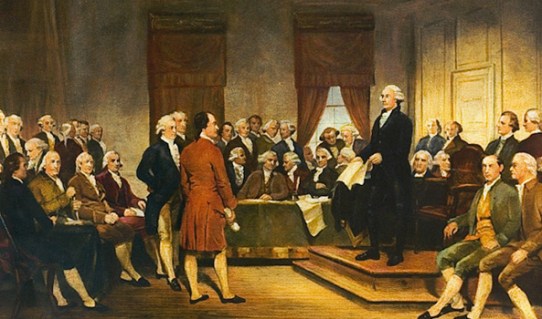

We’ve been on an incredible journey toward the birth of a nation. Its beginnings were rooted in the words of the Declaration of Independence, which projected a vision of a nation for its people. This vision, however, wasn’t reflected in the first two documents of governance, the Articles of Confederation and the Federal Constitution that followed.
This is best described by B.J. Lossing in his 1848 book, Lives of the Signers of the Declaration of Independence, when comparing the differences, “The former (the Declaration of Independence) was based upon declared right; the foundation of the latter (Articles of Confederation) was asserted power.” Lossing goes on to explain, “The former was based upon a superintending Providence and the inalienable rights of man; the latter rested upon…,” Lossing then uses this 1839 writing by John Quincy Adams, “… sovereignty of declared power – one ascending for the foundation of human government, to the laws of nature and of nature’s God, written upon the hearts of man – the other resting upon the basis of human institutions, and prescriptive law, and colonial charters.”
What Lossing and Adams were saying was that, in their quest to form a new government, the framers lost sight of the grand vision laid out in the Declaration of Independence and instead focused too much on the rules of order and the laws of government.
Thankfully, this was about to change as the 1st Congress of the United States began crafting a Bill of Rights.
updated on July 5, 2025
The 1st. Congress of the United States of America begins fulfilling its promise.
With the Constitution finally ratified on June 21st, 1788, the 1st Congress of the United States met for the first time in New York City, then the country’s capital, at Federal Hall on March 4th, 1789.
The Federalists had fared pretty well with representation in the new Congress, having gained the majority of the seats in both the House of Representatives and the Senate. However, they now needed to begin working with the Anti-Federalists to fulfill the promise of gaining ratification, which was to amend the new Constitution to include a Bill of Rights.
As the first Congress convened to begin debating the Bill of Rights, the big question was: How do you amend the document? Article V allowed Congress to amend the Constitution, but it should not have been done in the manner it was.
Enter, again, James Madison
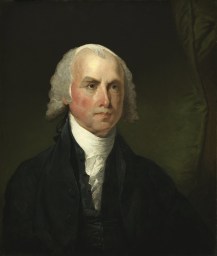
As I presented in Part I, James Madison was one of the most vocal participants at the Constitutional Convention in arguing against the need for a bill of rights in the Constitution. However, as the debate continued during the convention and after Washington and Jefferson had written to him, he began to see the concerns that the anti-Federalists and the States had. He was now willing to work on amending the Constitution with a bill of rights.
Madison, now a congressman, feared that a contentious argument over the form the amendments should take and what those amendments should be could drive Congress into calling for a second constitutional convention, and in doing so, bring the entire Constitution into question. Still a Federalist, he was determined to preserve what he had worked so hard on, and the only way he saw to avoid a Constitution/Bill of Rights issue was to take the lead in writing those amendments himself.
The Virginia Declaration of Rights
In writing his proposed amendments, James Madison again consulted the sources he’d used for the Constitution: the Magna Carta (Great Charter) of 1215, the English Bill of Rights of 1689, and other existing state constitutions. But he mostly consulted his own state’s Virginia Declaration of Rights of 1776, which pre-dated the Declaration of Independence by almost a month.

The Virginia Declaration of Rights is one of the most pivotal documents in the early formation of our government and our national vision. Initially drafted by George Mason, who had also proposed adding a Bill of Rights to the Constitution at the Constitutional Convention, the Virginia Declaration of Rights served as seed material not only for Madison in the Constitution and Bill of Rights but also for Thomas Jefferson when writing the Declaration of Independence.
Here’s an example of what I mean: Article I of the Virginia Declaration of Rights states, “That all men are by nature equally free and have certain inherent rights… they cannot, by any compact, derive or divest their posterity; namely, the enjoyment of life and liberty…and pursuing and obtaining happiness and safety.” Jefferson wrote in the Declaration of Independence: “We hold these truths to be self-evident, that all men are created equal, that they are endowed by their Creator with certain unalienable Rights, among these are Life, Liberty and the pursuit of Happiness.”
The influence of the Virginia Declaration of Rights is found throughout the Declaration of Independence and the Constitution. Still, Madison’s most obvious usage is in the Bill of Rights. This is evident in the Virginia Declaration of Rights, Articles 12 and 16, which would later become part of the First Amendment, Article 13 in the Second Amendment, and Article 9 in the Eighth Amendment.
Madison’s first proposed amendments
On June 8, 1789, James Madison presented his nine proposed amendments to the House of Representatives. Two of these proposals read as follows:
“First. That there be a prefixed to the constitution a declaration that all power is originally vested in, and consequently derived from the people.”
And another was his fourth proposed change:
“Fourthly. That article 2nd, section 9, between clauses 3 and 4, be inserted these clauses, to wit, ”The civil rights of none shall be abridged on account of religious belief or worship, nor shall a national religion be established, nor shall the full and equal rights of conscience be in any manner, or in any pretext be infringed…”
As you can see from these two examples, Madison’s original idea was to make the amended changes directly to the main body of the exciting Constitution itself, rewriting articles and sections themselves. The House and the Senate were concerned with amending the Constitution in that manner. They feared that the public would perceive making significant changes to the document so soon after ratification as a sign of instability. Congressman Fisher Ames of Massachusetts said that a “dissection of the Constitution” so soon after implementation could cause a loss of confidence in the new Constitution and its government.

Congressman Roger Sherman of Connecticut proposed to the House that the amendments not be made to the existing ratified document, as Madison had proposed, but rather be placed separately at the bottom, keeping the original document intact to “remain inviolate.” The House also voted to add a preamble to the beginning of the amendments. As I stated in Part Two, the preamble was added to explain why and to what end these changes were being made. Again, in hopes of keeping the public’s confidence in their new government (please read my Part Two post on the preamble).
The House debated Madison’s nine amendments for eleven days, during which time they took his original nine and rewrote them into twenty-one-sentence paragraphs. They continued to revise and combine those amendments until they finally agreed on seventeen. Additionally, the House removed most of Madison’s preamble, feeling that it was too similar to the wording of the Declaration of Independence, and added the phrases “freedom of speech, and of the press,” which would ultimately be incorporated into the First Amendment.
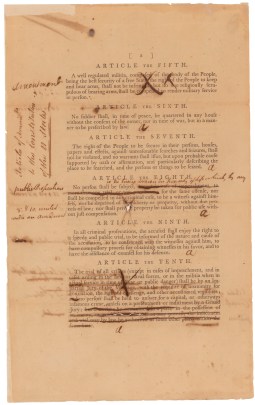
On August 24, 1789, the House sent its seventeen proposed amendments to the Senate for review and revision. The Senate then made twenty-six additional changes of its own, including eliminating the rest of Madison’s preamble and removing the extension of parts of the Bill of Rights to the states and the Federal government. In their process, they condensed the House’s seventeen amendments to twelve. These changes were approved by the Senate on September 9, 1789.
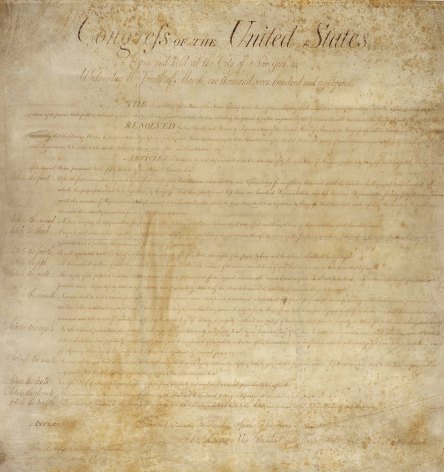
The two versions were discussed on September 21, 1789, by the House-Senate Conference Committee, which resolved the differences between them. The committee presented twelve Constitutional Amendments to Congress, which were then approved in a joint resolution of Congress and sent to the States for ratification on September 28, 1789.
The Process of Ratifying the Bill of Rights
For the twelve articles approved by Congress, under Article V, to become part of the Constitution, they had to be ratified by each State’s legislature, according to Article VII of the Constitution. Each one of the twelve had to be separately voted on and ratified by at least three-fourths of the fourteen States (Vermont had been added to the Union during the ratification process).
Only ten of the twelve amendments sent to the states gained the support of the eleven states needed for ratification. Articles 3 through 12 received the minimum needed. These became what we now call the Bill of Rights.
One interesting fact is that there’s no time limit for the ratification process to be accomplished, as the 1st Congress failed to set one. So, the original Articles 1 and 2, which didn’t make the original state ratification, are still considered pending and open for ratification. So, what’s the status of those two amendments?
Article 2, which dealt with the pay of Senators and Representatives, was initially approved by only seven states. However, in the 1970s, concerns about congressional pay raises sparked a national protest, which in turn led to a movement to secure the additional states needed for ratification. This was finally accomplished in 1992, becoming the 27 Amendment, 202 years after being first presented.
As for the original Article 1, which deals with the number of Representatives in the House, it missed ratification by only one state. However, that article is still pending, needing twenty-seven states’ approval to become another amendment to the Constitution.
Madison’s legacy
James Madison fathered the two foundational documents that created our United States government: the Constitution and the Bill of Rights. But he was more influential on one than on the other. It’s been stated that without Madison, there would still have been a Constitution, but without Madison, there would not have been a Bill of Rights.
With the Bill of Rights added to the Constitution, the vision outlined in the Declaration of Independence was realized. The government of the United States of America was now more than just laws and procedures; it had guarantees for the personal freedoms of its people.
Please read my other posts on We the People:
Part One: “… To form a more perfect Union.”
Part Two: “… to prevent misconstruction or abuse of its powers…”
Some of the resources used:
Bill of Rights Institute . “James Madison.” Bill of Rights Institute, Bill of Rights Institute, billofrightsinstitue.org.
Wikipedia. “United States Bill of Rights.” United States Bill of Rights, Wikipedia, 2 July 2018, en.m.wikidia.org/wiki/United_States_Bill_of_Rights.
“The Bill of Rights becomes law.” This Day in History, History, http://www.history.com/this-day-in-history/the-bill-of-rights-becomes-law.
National Archives. “Why a Bill of Rights?” National Archives, Archives.gov, 15 Aug. 2016, http://www.archives.gov/amending-america/explore/why-bill-of-rights-transcript.html.
Greenslade, Bob. “A Re-Write of the Bill of Rights through the Preamble.” Tenth Amendment Center, Tenth Amendment Center, 14 Dec. 2010, tenthamendmentcenter.com/2010/12/14/a-rewrite-of-the-bill-of rights-through-the-preamble.
“Virginia Declaration of Rights.” Wikipedia, Wikipedia, en.m.wikipedia.org/wiki/Virginia_Declaration_of_Rights.
“Anti-Federalism.” Wikipedia, Wikipedia, en.m.wikipedia.org/wiki/Anti-Federalism.
“Bill of Rights.” Bill of Rights Institute, Bill of Rights Institute, http://www.billofrightsinstitute.org/founding-documents/bill-of-rights/.
Lossing, B. J. Lives of the Signers of the Declartion of Independence. WallBuilder Press, 2010.
 Still Current