The Preamble to the Bill of Rights

One of the thrills I get when writing and researching for these posts is finding those little pieces of history that aren’t always presented in the regular telling. When added to the narrative, these pieces give the stories much more depth and a clearer understanding. However, they also completely change the direction of my original idea.
So it was when I was doing research for these posts on the Bill of Rights. I discovered a little piece of its history that hasn’t always been included in the writings on the first ten amendments. Knowing about and understanding these often left-out pieces of the Bill of Rights goes to the very essence of the framers’ purpose and intent when they crafted the Bill of Rights. To better present this, I felt it needed an entire post.
I’d now like to address the preamble to the Bill of Rights, which went before the listing of the amendments.
Preambles
Having a preamble added to their documents was extremely important to our framers: the Declaration of Independence, the Constitution, and the Bill of Rights all have one.
So what’s a preamble? Dictionary.com defines a preamble as: “an introductory part of a statute, deed, or the like, stating the reasons and intent of what follows.” The preamble was the beginning statement that set the document’s purpose and what it was set up to do.
The preambles we know also paint a vast vision with inspiring words, such as these from the preamble of the Declaration of Independence: “We hold these truths to be self-evident, that all men are created equal…” and “That to secure these rights, Governments are instituted among Men, deriving their just powers from the consent of the governed…” And from the Constitution: “We the People of the United States, in Order to form a more perfect Union… do ordain and establish this Constitution for the United States of America.”
The framers did not release an essential document without a Preamble. However, it’s interesting to note that the preamble to the Bill of Rights has been left off most printing, even those published by the government.
One of the books I’ve been using in writing these posts is “Lives of the Signers of the Declaration of Independence” by B.J. Lossing. Written in 1848, Lossing included the Declaration of Independence, the Articles of Confederation, the Constitution, and the Bill of Rights. Each of them includes their preambles, except for the Bill of Rights. Lossing only included the introductory paragraph to the Bill of Rights, leaving out the important following three paragraphs, especially the second paragraph that explains why these amendments were added.
So why has the Bill of Rights preamble been so often left off? I haven’t been able to find that answer yet. However, I’m sure that after you read the preamble, you’ll see the Bill of Rights in a different light.
So here’s the preamble to the Bill of Rights in
its entirety:
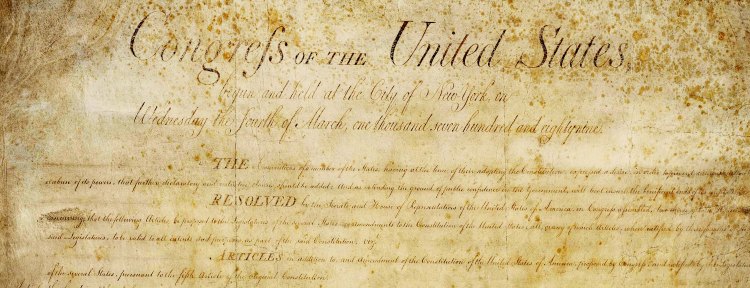
CONGRESS OF THE UNITED STATES
begun and held at the City of New York, on Wednesday the fourth of March, one thousand seven hundred and eighty-nine.
THE Conventions of a number of the States, having at the time of their adopting the Constitution expressed a desire in order to prevent misconstruction or abuse of its powers, that further declaratory and restrictive clauses should be added: And as extending the ground of public confidence in the Government will best ensure the beneficent ends of its institution.
RESOLVED by the Senate and House of Representatives of the United States of America in Congress assembled, two thirds of both the Houses concurring that the following Articles be proposed to the Legislatures of several states as Amendments to the Constitution of the United States, all or any of which articles, when ratified by three fourths of the said Legislatures to be valid to all intents and purposes as part of said Constitution; viz.:
ARTICLES in addition to, and Amendment of the Constitution of the United States of America proposed by Congress, and ratified by the Legislatures of the several States, pursuant to the fifth Article of the original Constitution.
Armchair Analyzing the Preamble
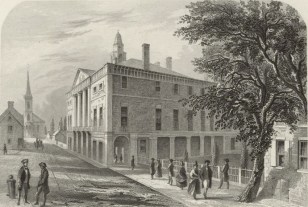
The first paragraph of this preamble states that the First Congress under the new United States Constitution acted upon these articles while it was in session in the City of New York.
The third paragraph states that two-thirds of both the Senate and the House of Representatives are presenting these articles (twelve at that time) to the states for consideration and ratification and how that is to be done.
The fourth paragraph introduces the following amendments as ratified under Article V of the United States Constitution.
The second paragraph of the preamble is the real meat of these amendments’ purpose and intent. It clearly addresses why these amendments were needed to the Constitution.
The second paragraph begins with: “THE Conventions of a number of the States, having at the time of their adopting the Constitution expressed a desire…” This clearly explains why Congress created these amendments. Because several states and groups within those states had issues with the Constitution as it was presented for the ratification process.
Their issue was that they felt the Constitution, as presented for ratification, lacked significant protections for citizens’ rights. This issue actually threatened the Constitution’s very ratification. I’ll dive deeper into this in my next post.
The preamble then states what these amendments are supposed to accomplish: “…in order to prevent misconstruction or abuse of its powers…” The “it” in this line is the Federal Government. These amendments are to keep the Federal government from overstepping its bounds by taking away certain States and the people’s rights and then becoming a monarchy or tyranny.
It then explains how these amendments will prevent that possible abuse of power: “… that further declaratory and restrictive clauses should be added…” This line says that the governmental restrictions guaranteed by these amendments will stop government infringement on certain people’s civil liberties as outlined in these amendments.
The paragraph ends with:“…And as extending the ground of public confidence in the Government will best ensure the beneficent ends of its institution…” This says that with and through these amendments, the people will trust the government more, which will benefit both.
So you see, the Bill of Rights amendments are not to protect the people from foreign governments but from the government of the United States of America.
Now that you’ve read the Bill of Rights preamble and my own humble analysis, we’re ready to dive into the history of how these ten amendments came about, how James Madison, the Federalist, came to be the one who spearheads the writing of these amendments. And what did I mean by “twelve” Bill of Rights amendments?
Stay tuned; my next post will be about crafting the Bill of Rights.
Please read my post, “We the People: A Brief History of the United States Constitution and Its First Ten Amendments, Part One,” to form a more perfect union.
Sources used:
Lossing, B. J. Lives of the Signers of the Declaration of Independence. WallBuilder Press, 2010.
“The Preamble to the Bill of Rights.” Revolutionary War and Beyond, Revolutionary War and Beyond, revolutionary-war-and-beyond.com/preamble-bill-of-rights.html.
Martin. “Preamble to the Bill of Rights.” What Would The Founders Think?, What Would The Founders Think?, whatwouldthefoundersthink.com/preamble-to-the-bill-of-rights.
“Preamble to the Bill of Rights.” Office of Government and Community Relations, Drexel University, drexel.edu/ogcr/resources/constitution/amendments/preamble/.
“Preamble to the “Bill of Rights”.” Adask’s Law The Profit of Injustice, Adask’s Law The Profit of Injustice, 17 Apr. 2011, adask.wordpress.com/2011/04/17/preamble-to-th-bill-of-rights/.
National Archives. “The Bill of Rights: A Transcription.” America’s Founding Documents, The U.S. National Archives and Records Administration, http://www.archives.gov/founding-docs/bill-of-rights-transcript.
 Still Current