
As my wife and I walked north along the Via dei Fori Imperiali, past the ruins of the Forums of Augustus and Nerva, toward the Piazza Venezia, we noticed an area much larger than the other forum sites. This space was also littered with broken and fallen columns. But on the end of this field was an impressive, tall, curved wall, and at its north end stood a tall Imperial Column. This is all that remains of the Forum of the Emperor Trajan. Our last and most impressive of the Imperial Forums.
The history of this site and the forum that would fill it goes back before Emperor Trajan. It started with his predecessor, Emperor Domitian.
As Rome grew out from the area of the Forum, a new city center began to form to its north at Campus Marius. Emperor Domitian envisioned a forum connecting the old Forum and Campus Marius.
The most logical site for this Forum was the still vacant land between the Capitoline and Quirinal hills. However, there was a significant issue with this site. A small saddleback hill sat between the two hills that needed to be leveled.
To accomplish this project, more earth was required to be moved than for the building of the Forum for Julius Caesar. So extensive was this leveling that it hadn’t been completed before Domitian was murdered in 96 AD. His successor, the Emperor Nerva, completed this task.
Nerva discovered that the project was so enormous that he abandoned the site, selecting the already level street between the forums of Augustus and Vespasian to build his Forum (see my post on the Forum of Neva). The more ambitious Emperor Trajan would complete the building of a forum at the northern site.
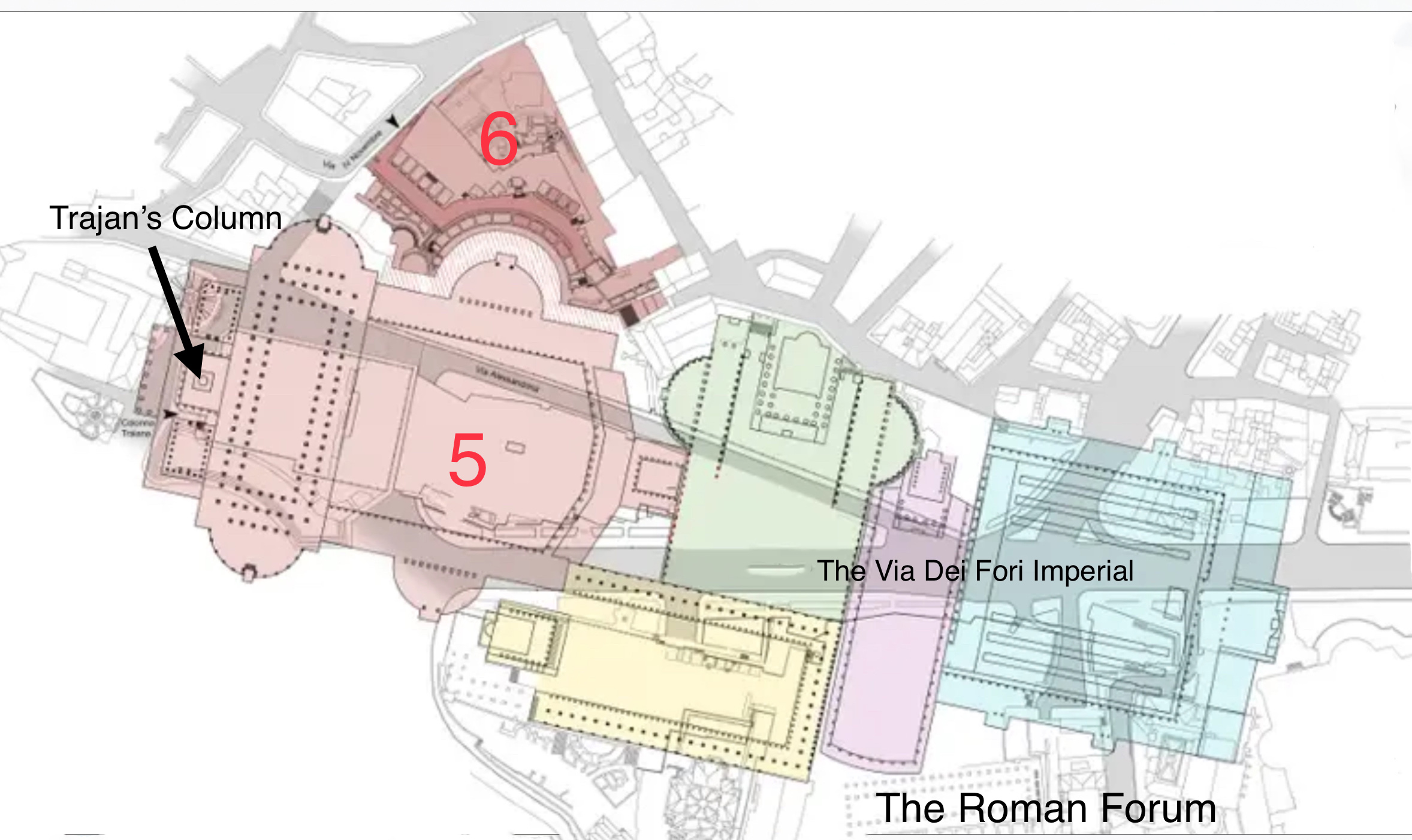
5. The Forum of Trajan
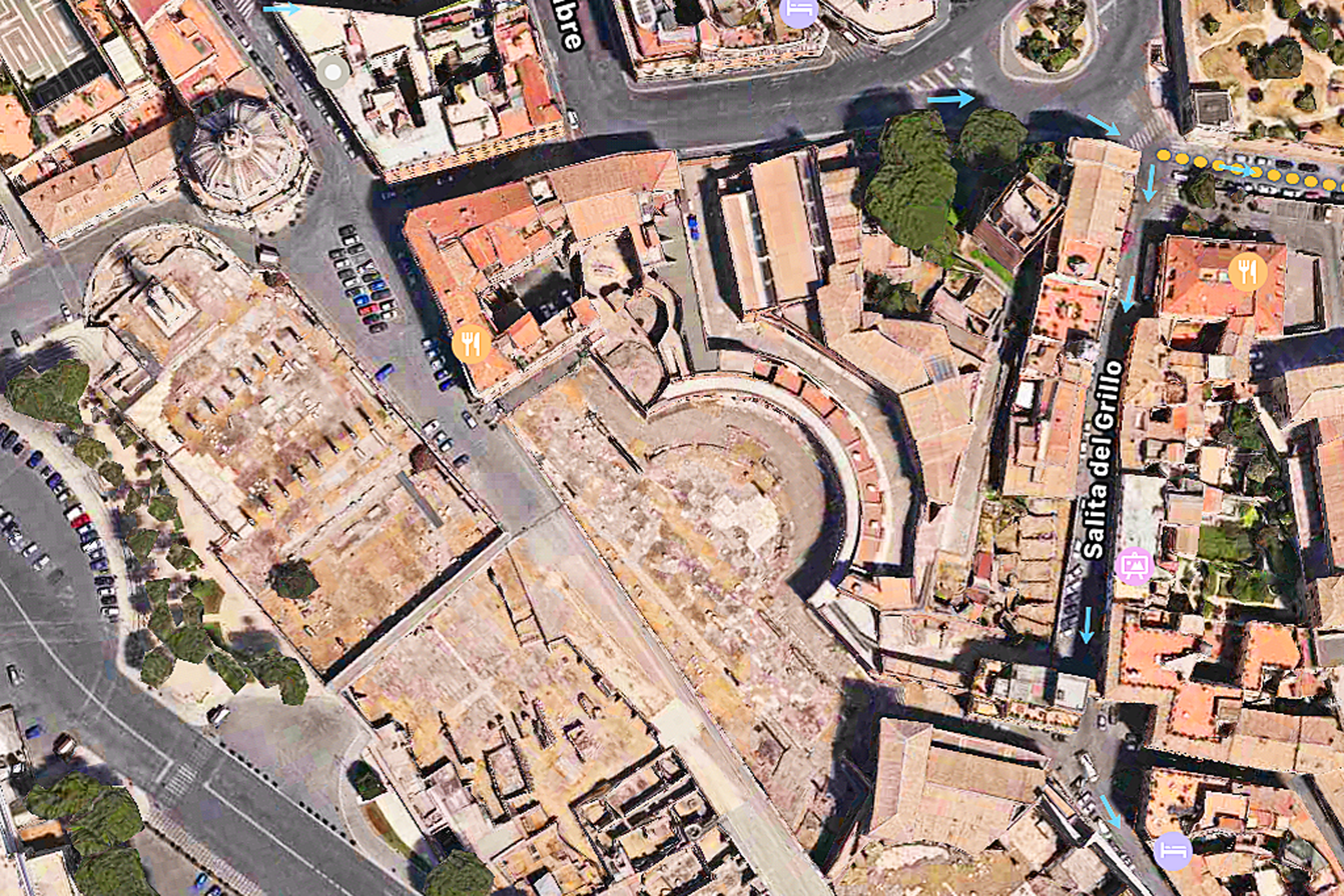
Trajan began constructing his forum at the unfinished site of Emperor Domitian’s forum at around 112 AD. Trajan used the spoils he had acquired from his conquest of Dacia (today’s Romania) to finance his forum. To oversee its construction, Trajan commissioned his favored architect, Apollodorus of Damascus, to design and build his forum. Apollodorus had also built two triumphal arches for Trajan and is credited with finishing the Pantheon.
As with all Roman forum designs, the central area of Trajan’s Forum consisted of an enormous open interior square at its center, which held a giant equestrian statue of the Emperor. This square was surrounded by columned porticoes, with the western and eastern sides curved. The porticos on the long side featured statues and reliefs of Trajan’s conquests, as well as portraits of previous emperors and Trajan’s family.
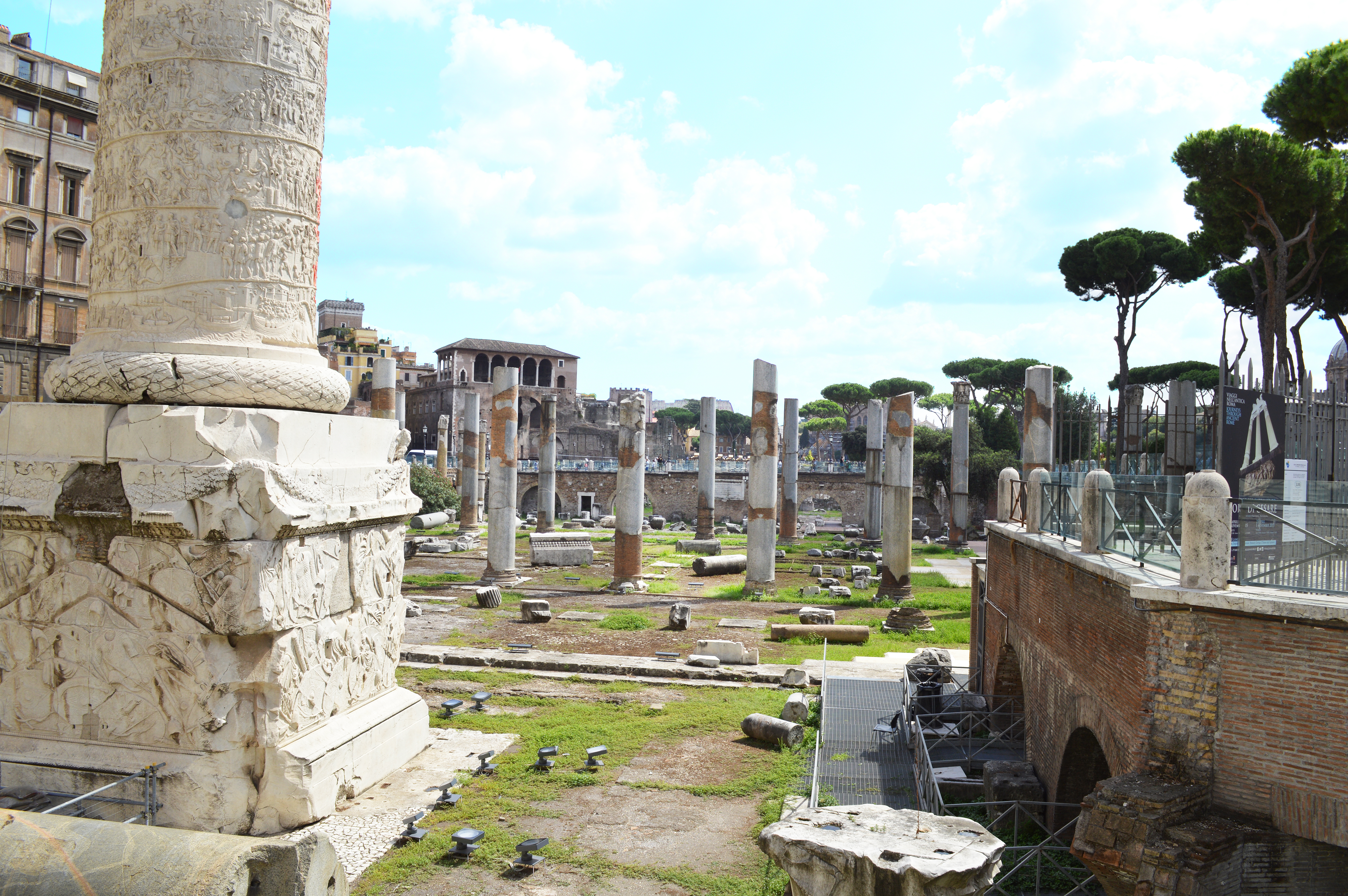
On the north side of the square stood the Basilica Ulpia. Ancient Roman basilicas were not used for religious purposes, as later Christian basilicas were. Roman basilicas housed the offices for the administration of justice and commerce and were also where the Emperors conducted their business.
Trajan’s basilica was the largest ever built in ancient Roman, measuring 385 feet by 182 feet. Its columns and walls were marble and measured 164 feet high, and its roof was made of gilded bronze tiles. As you entered the basilica from the forum’s grand square, you’d come into its center great nave surrounded by four columned aisles. On each of the basilica’s sides were libraries, one in Greek and the other in Latin. Those entering or leaving the forum by its main entrance on the north side would have been greeted by the magnificent Column of Trajan.
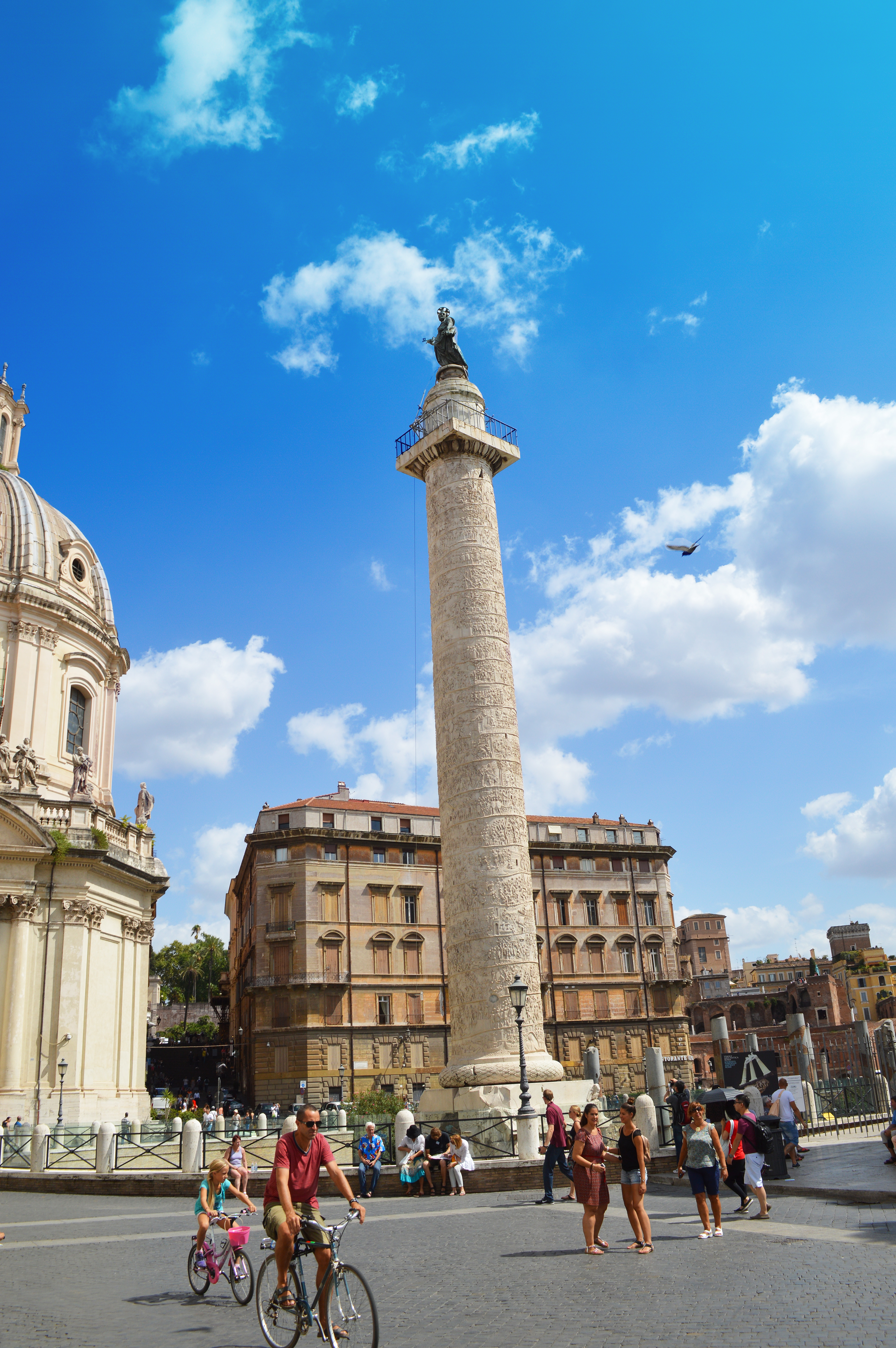
Trajan’s Column is the best preserved of the ancient Roman victory columns. It was inaugurated at the same time as Trajan’s Forum in 113 AD. Including its base, the Column stands 115 feet high. The Column is constructed by a series of twenty Carrara marble drums 12.1 feet in diameter and weighing 32 tons. The Column’s famous frieze, depicting the Roman’s battle with the Dacians, wraps up and around the total height of the Column; it would measure 620 feet long if stretched out. The Column’s capital block weighed 53.3 tons and had to be lifted 112 feet to its top, no simple feat for the ancient Roman builders. When it was inaugurated, the Column was crowned with a statue of Trajan, but this statue vanished sometime in the Middle Ages. Today, a statue of St. Peter sits atop the Column, which was placed there by Pope Sixtus V in 1587.
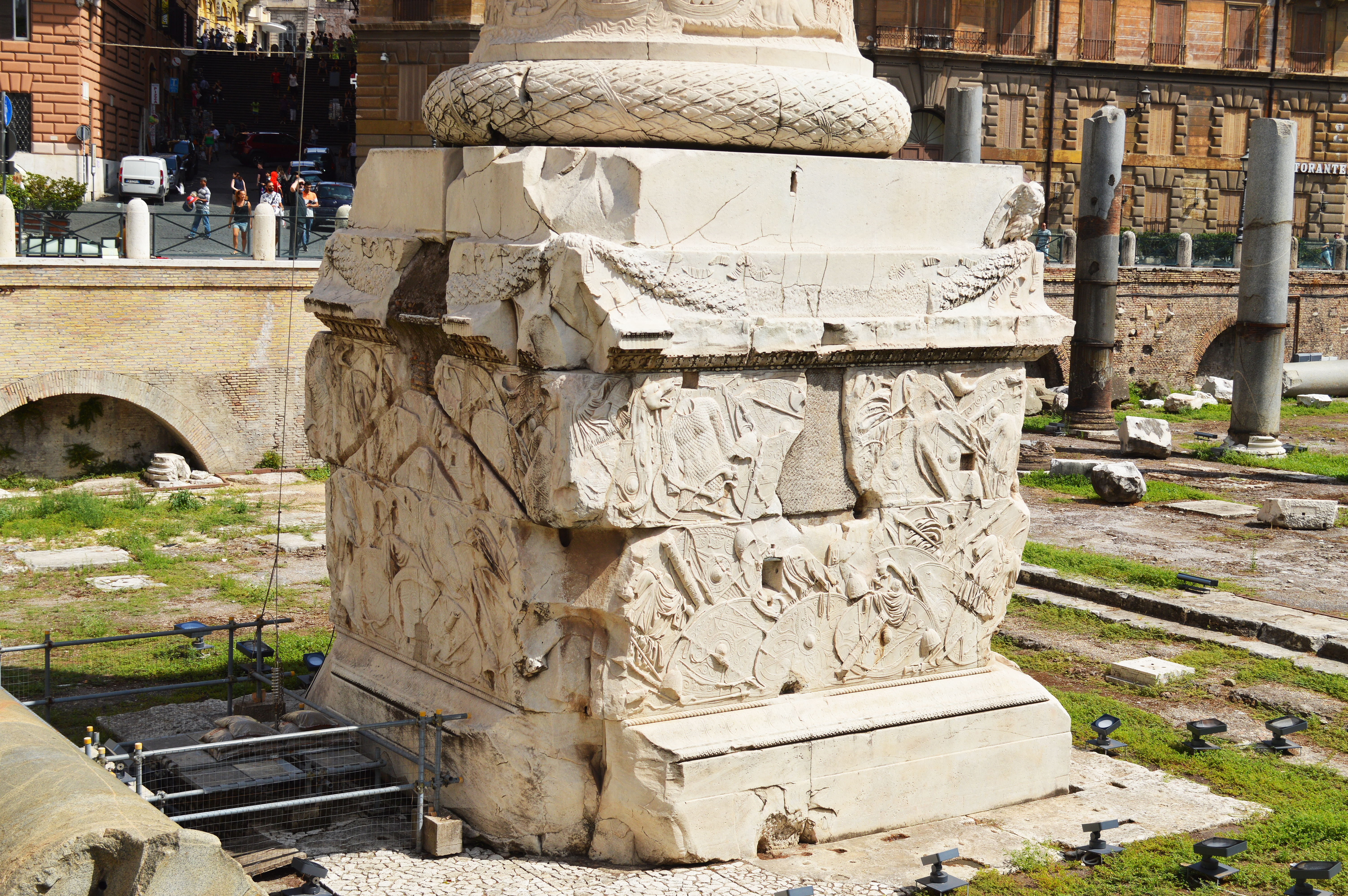
Here are a few interesting facts about Trajan’s Column: the Column is hollow and features an 182-step spiral staircase to a viewing platform at the top. Ancient Romans could get a tremendous view of the city and its forums from there. Access to the stairs was through a door in its base. The climb was illuminated by forty window slits along its height that provided sunlight for those climbing up. Also, Trajan’s Column was the first ever to record the usage of a spiral staircase. This was a fact that I didn’t know when I visited. I have a passion for these staircases, so I was looking at the first spiral staircase in the world without knowing.
Also, after Trajan died and was deified by the Roman Senate, his ashes were placed in a gold urn and entombed in the Column’s base.
6. Trajan’s Market
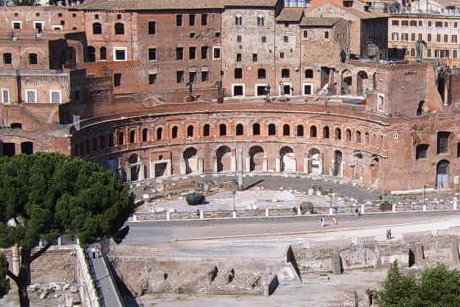
While removing the saddleback hill, Apollodorus saw that the forum’s eastern side ran up to the high rock face created when they cut into the Quirinal Hill. The architect found that this three-story rock face was unstable and needed reinforcement. To accomplish this, he constructed an enormous hemicycle brick-faced complex that he built up against the cliff’s side. This structure wholly covered and supported the hill from collapsing.
This structure held offices, halls, and other commercial uses. Two wide hallways ran between the complex against the cliff and the main forum buildings. Today, this wall complex is referred to as Trajan’s Market. However, archaeological evidence does not support that it was ever used as a traditional marketplace.
A Fight to Preserve the Past
Besides most of it being covered by the Via dei Fori Imperiali, the Imperial Forums also suffer from the vibrations and exhaust fumes from the heavy traffic on this busy four-lane road, threatening what is left of what was the glory of ancient Rome.
However, groups of citizens, archeologists, and scientists are working to convince the city government to undo Mussolini’s actions and remove the Via dei Fori Imperiali. Although nothing of significance has happened yet, in 2013, the city closed the southern end of the road by the Colosseum to motor vehicles.
Sources used:
Bileta, Vedran. “Trajan’s Column: The Ancient Roman movie Carved In Marble.” The Collector, The Collector, 24 July 2021, http://www.thecollector/trajans-column.
“Imperial Forums.” a view on cities, a view on cities, http://www.aviewoncities.com/rome/imperialforums.htm. Accessed 11 Apr. 2020.
“Imperial fora .” Khan Academy, Khan Academy, www.khanacademy.org/humanities/ap-art-history/ancient-mediterranean-ap/ap-ancient-rome/a/imperial-fora. Accessed 11 Apr.2020.
Staccioli, Romolo Augusto . “The Imperial Fora.” Rome: Past & Present, 2015, Vision Roma, 2015, pp. 54-57.
“Trajan’s Forum.” Wikipedia, Wikipedia, en.m.wikipedia.org/wiki/trajan%27_Forum. Mar. 2017.
Wikipedia. “Imperial fora.” Wikipedia, Wikipedia , en.m.wikipedia.org/wiki/Imperial_fora. Accessed 6 Apr. 2020.
Wikipedia . “Forum of Augustus .” Wikipedia, Wikipedia, 6 Apr. 2020, en.m.wikipedia.org/wiki/Forum_of_Augustus.
Wikipedia. “Forum of Caesar.” Wikipedia, Wikipedia, Dec. 2019, en.m.wikipedia.org/wiki/Forum_of_Caesar.
 Still Current
One thought on “THE IMPERIAL FORA OF ROME, PART III: THE FORUM OF TRAJAN”