When my wife and I visited Rome, we were surprised to learn that there were forums other than the one we knew. These forums were separate from the main forum, each having its own unique history; they are the Imperial Fora. These forums were built during Rome’s imperial period by five of ancient Rome’s most famous emperors between 46 BC and 113 AD. These forums are almost hidden from the casual tourist, much of them buried beneath the Via dei Fori Imperial, between the Piazza Venezia and the Colosseum.

After the fall of Rome, the Imperial Fora, like the Roman Forum, fell into disuse. The marble and stone from its temples and buildings were stripped off and used elsewhere. During the Middle Ages, the forums were built over, eventually being buried under the medieval and modern city of Rome. Over the centuries, the forum’s grand structures slowly faded from view, lost and forgotten.
Many of the sources I used for this post are very critical of the fascist dictator Benito Mussolini for his building of the broad avenue Via dei Fori Imperial, which covers almost 84% of the forums of the emperors Nerva and Trajan, and severely divided the others. However, one of my followers, David McCarthy, pointed out other sources that credit Mussolini for conducting a massive archaeological excavation of the forums in the 1930s, returning large sections to the public. Excavations continue today, and there is a discussion on what to do about the Via dei Fori Imperial.
So, what is the history of these forums? What did they look like? Why were they built? What remains of them today? I’ll try to answer these questions in this post and the next two.
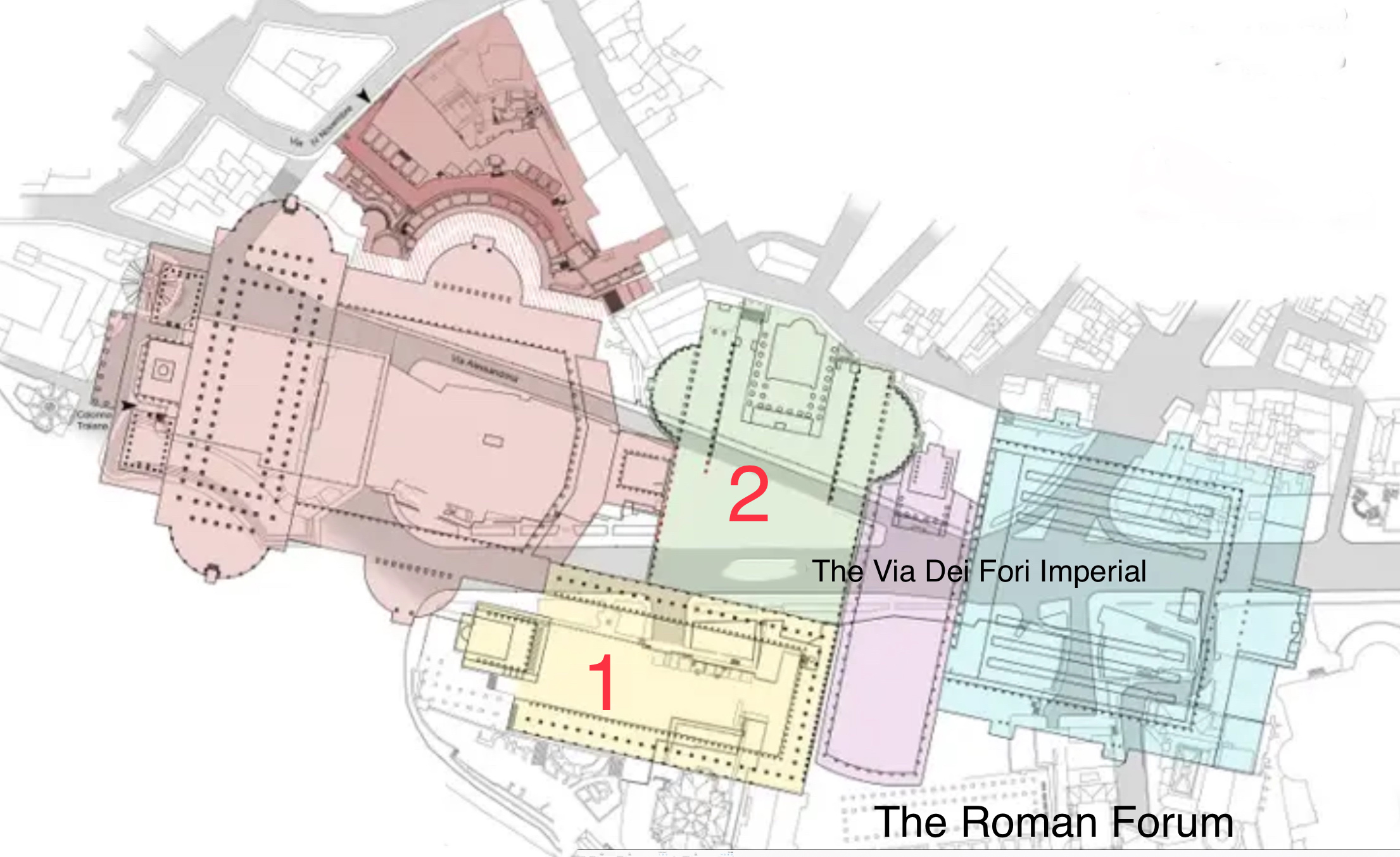
1. The Forum of Caesar
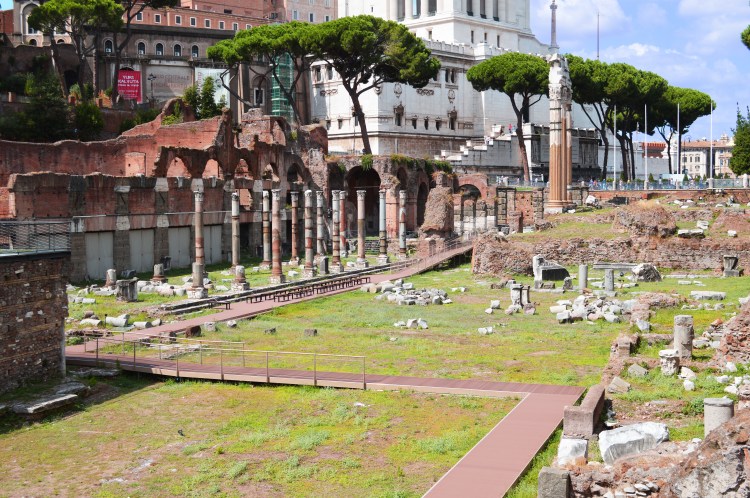
The Forum’s open plaza is in the foreground, and the row of columns to the left is all that remains of the colonnade that surrounded its plaza. The mound of ruin in the background, along with the tall columns, are all that’s left of the Temple of Venus Genetrix.
Photo by author
On the west side of the Via dei Fori Imperial, just south of the Via di San Pietro in Carcera, and behind the Curia Julia, there’s an open space with a row of small columns along one side and three taller columns with a capital on top. At first, you may think this is still part of the central Roman Forum, but it’s not. This is all that remains of the separate and the first Imperial Fora; the Forum of Julius Caesar.
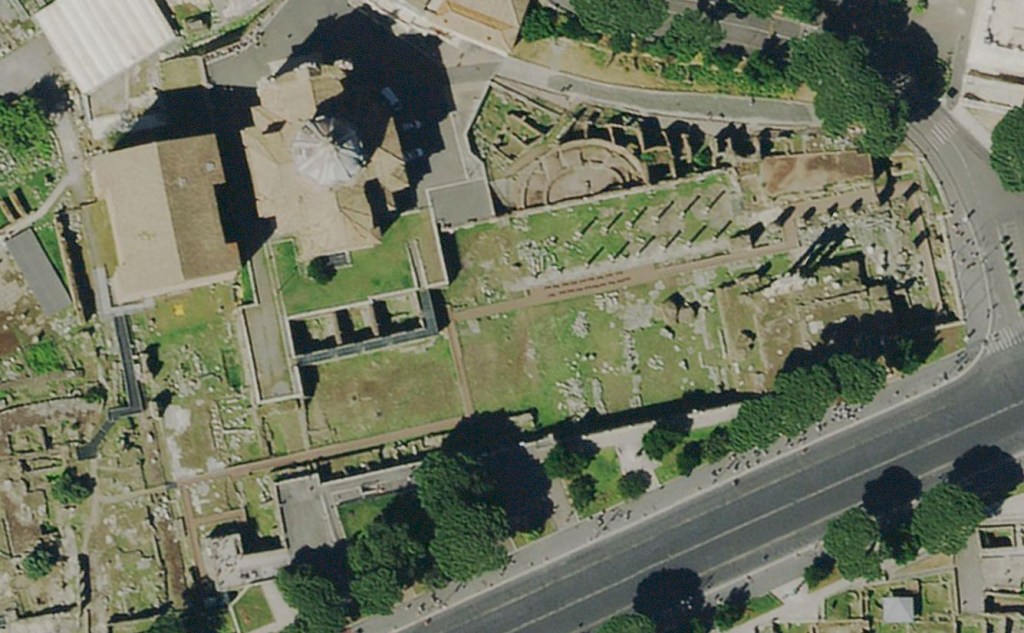
Screenshot from Google Maps.
As Rome grew, its original forum became overcrowded with government buildings and temples. Soon, the forum’s purpose as a marketplace and gathering plaza for its citizens was lost. Seeing this, Julius Caesar decided to build a more significant forum bearing his name next to the existing forum.
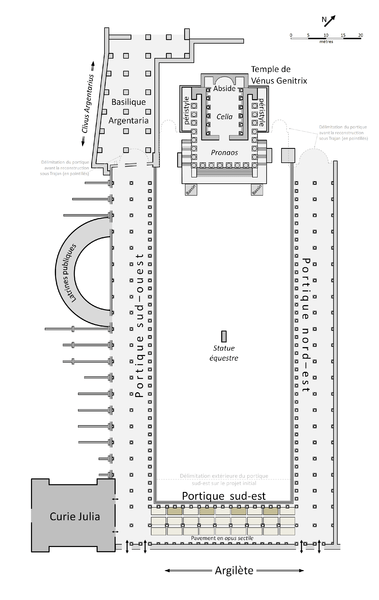
Art by Cassius Ahenobarbus
Caesar wanted his forum to be an extension of the original Roman Forum. To accomplish this, he selected a site behind his Curia Julia at the base of the Capitoline Hill. The place he chose was already occupied by many houses, so Caesar had to purchase those. In addition, the area for the plaza and temple was too low, and vast amounts of earth were brought in to raise and level the site. This was all paid for by the spoils from the Galli Wars.
Caesar designed his forum in two parts: an open gathering plaza and a Temple to Venus Genetrix. The large rectangle plaza was flanked by paired colonnades on three sides: east, south, and west. The three smaller columns that can still be seen today are all that remains of this colonnade.
At the plaza’s north end sat the crown jewel of Caesar’s forum, the Temple to Venus Genetrix. Caesar dedicated his temple to the Roman goddess Venus because his family believed they were descended from her. Besides a statue of Venus, there were statues of Julius Caesar and his mistress, Queen Cleopatra of Egypt. All that’s left of this magnificent temple are the three taller columns with the capital on top.
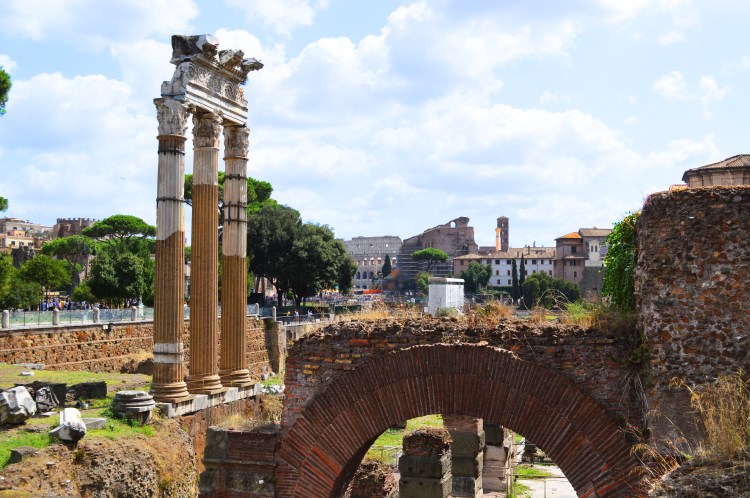
Photo by author
Construction on the Forum of Caesar began around 46 BC, two years before he was assassinated. This forum and many of Julius Caesar’s other projects had to be completed by his adopted son, Augustus Caesar.
But Augustus wasn’t satisfied just finishing Julius Caesar’s forum; he wanted one of his own. To find the Forum of Augustus, look across the Via dei Fori Imperial from the Forum of Caesar. Where the main road meets the Via Cavour, you’ll find what remains of the Forum of Augustus, the second of the Imperial Fora.
The Forum of Augustus
Art from Wikipedia
The assassination of Julius Caesar caused a major power struggle for control of Rome. After the battles of Philippi and Actium, Augustus consolidated his power and was eventually named the first emperor of the Roman Empire.
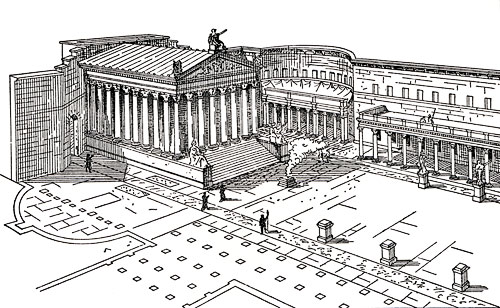
Before the Battle of Philippi, Augustus vowed to the Roman god Mars that if he was victorious, he’d build a grand temple to honor him. Augustus would make this temple to Mars the centerpiece of his forum.
Art by Cassius Ahenobarbus
Due to the politics of the Roman government, the building of his forum was postponed many times. In fact, it would take over forty years before the Forum of Augustus was completed. The still unfinished forum and the temple were inaugurated in 2 BC.
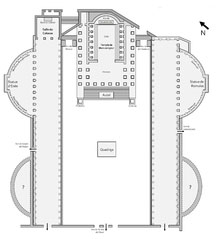
The location Augustus chose for his forum was adjacent to and at a right angle of Caesar’s. Augustus followed the traditional rectangular design for the plaza of his forum. This plaza was surrounded by a colonnade, as that of Caesar’s. However, his colonnade had a unique feature. On each side were two large double-columned, covered hemicycle porticos with niches on their back walls. It’s believed that these niches held the busts of some of Rome’s most famous leaders, who were also members of Augustus’s family. It’s thought that there were around 108 busts displayed in these porticos. Today, some of the inscriptions below the niches can still be read.
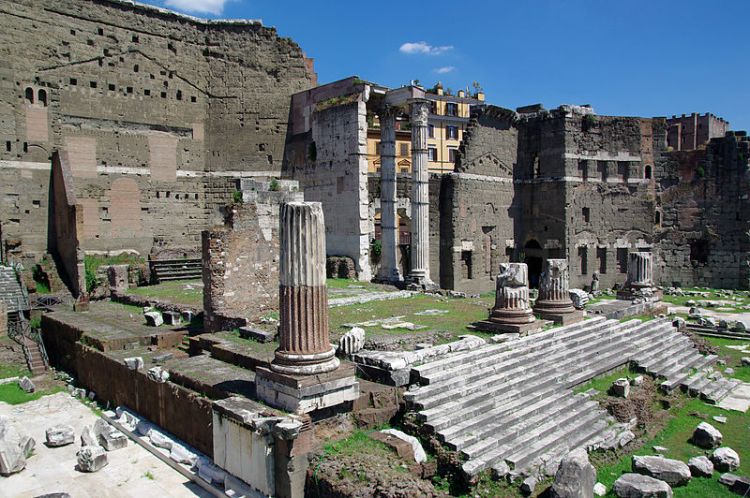
Photo from Wikipedia
One of ancient Rome’s most undesirable districts was just behind the forum, the Suburra. A high wall was built to separate the forum from this district, which is still standing today. This wall also acted as a firebreak, helping protect the forum from the all-too-frequent fires that broke out in the Suburra.
In front of this wall was the Temple to Mars Ultor (Mars the Avenger), which featured eight columns along its front and sides. One of the treasures said to have been stored there was Julius Caesar’s sword and his legion’s standards, which Augustus had recovered from the Parthians.
In the plaza’s center was a statue of Augustus standing in a triumphal chariot. To the temple’s left was another statue of the emperor in a hall at the end of the portico. This statue stood forty-five feet tall.
The construction materials used in the temple and forum were also fascinating. While the enclosing walls of the forum were made of local stone, the temple and colonnade were composed of a mixture of finely dressed Peperino volcanic tufa, Carrara marble, Giallo Antico granite, Africano, and Pavonazzette. All these materials came from all over the empire, symbolizing that the Roman Empire was made up of many nations, but all governed by Rome.
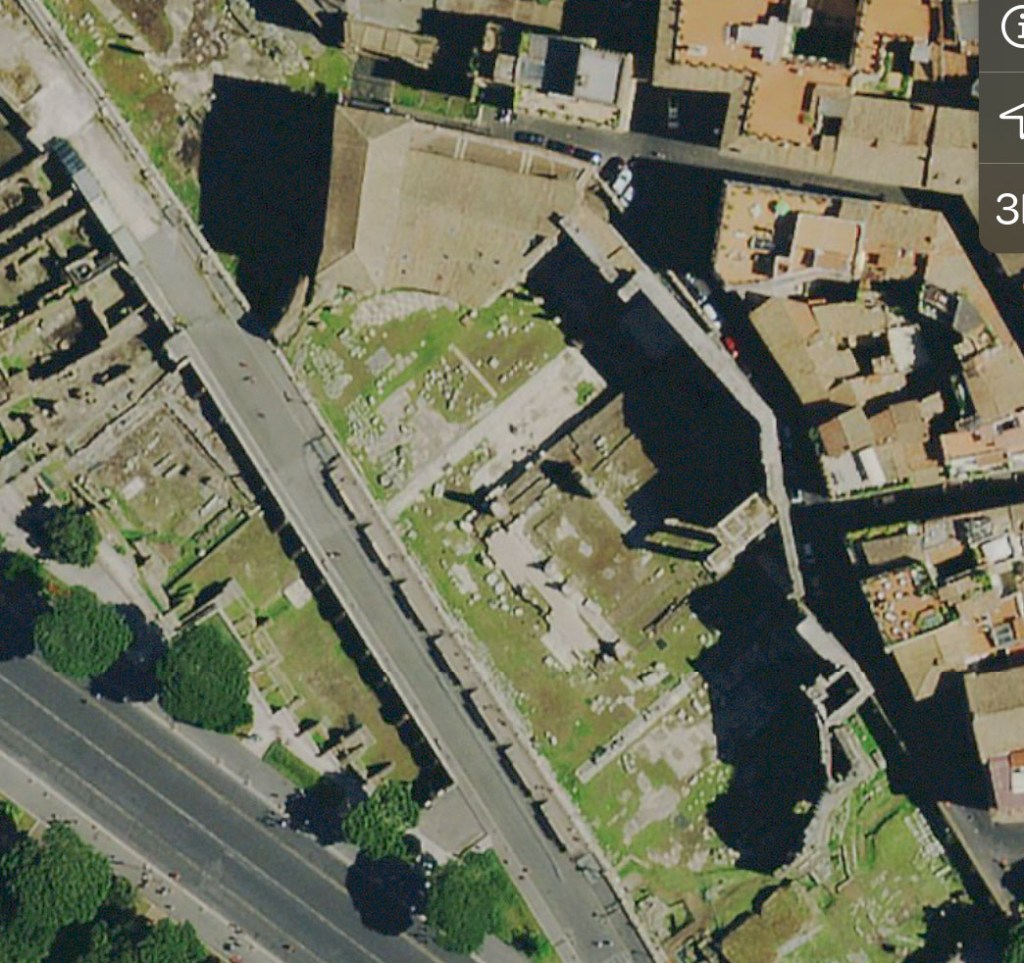
as seen from above.
Screenshot from Google Maps
In 19 AD, Augustus’s successor, Emperor Tiberius, added two triumphal arches on either side of the temple. These were to honor Drusus the Younger and Germanicus for their victories in Germania (Germany).
Today, all that remains of the Forum of Augustus is the steps leading up to the temple, the temple’s floor, a set of temple columns, the walls of two hemicycle porticos, and the large wall at the back. Sadly, most of the forum is lost beneath the Via Alessandrina and Via dei Fori Imperial.
To see what remains of the Forum of Augustus, simply cross over the Via dei Fori from the Roman Forum side and walk a few yards up the Via Alessandrina.
While we’re still in the area, my next post will explore the Forums of the Emperors Vespasian and Nerva.
Sources used:
“Imperial Forums.” a view on cities, a view on cities, http://www.aviewoncities.com/rome/imperialforums.htm. Accessed 11 Apr. 2020.
Staccioli, Romolo Augusto . “The Imperial Fora.” Rome: Past & Present, 2015, Vision Roma, 2015, pp. 54-57.
Wikipedia. “Imperial fora.” Wikipedia, Wikipedia , en.m.wikipedia.org/wiki/Imperial_fora. Accessed 6 Apr. 2020.
.Wikipedia . “Forum of Augustus .” Wikipedia, Wikipedia, 6 Apr. 2020, en.m.wikipedia.org/wiki/Forum_of_Augustus.
Wikipedia. “Forum of Caesar.” Wikipedia, Wikipedia, Dec. 2019, en.m.wikipedia.org/wiki/Forum_of_Caesar.
“Imperial fora .” Khan Academy, Khan Academy, http://www.khanacademy.org/humanities/ap-art-history/ancient-mediterranean-ap/ap-ancient-rome/a/imperial-fora. Accessed 11 Apr. 2020.
 Still Current
One thought on “THE IMPERIAL FORA OF ROME, PART I: THE FORUMS OF JULIUS AND AUGUSTUS CAESAR”