
My wife and I love traveling through history, seeing all the famous sites, and learning their history. We then share them with you, hoping that when you, too, visit, you’ll have a deeper appreciation of what you’re seeing.

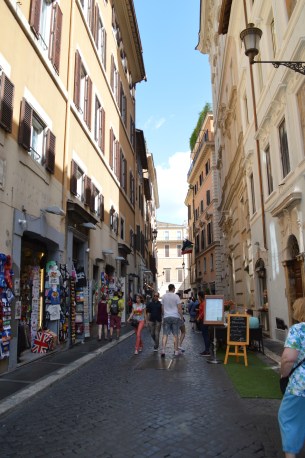
With so much restoration going on in Rome, it’s hard to view some of the historic sites among the construction. And so it was with the Trevi Fountain. As my wife and I walked down the Via delle Muratte toward the Piazza di Tervi, we were told you could hear the fountain’s gushing water getting more intense as you drew near it. When we visited, all we could hear was the sound of the crowds in the piazza. When we reached the piazza, we found that the fountain was dry, scaffolding had been erected among the statues, and a plexiglass wall surrounded it.
This was due to a significant twenty-month restoration of the fountain in 2014, which was made possible by a 2.2 million euro sponsorship from the Fendi fashion company. Completion of what was to be the most thorough restoration of the fountain ever done wasn’t until November of 2015, and our visit was in September of that year. But even with the fountain being dry, and the protective wall that surrounds it, the fountain’s sheer size (161 feet wide by 86 feet high) and its classic grouping of statues make this magnificent work of art awe-inspiring.
The location of the Trevi Fountain is at the end of one of Rome’s ancient aqueducts, the Aqua Virgo. This aqueduct was built by Emperor Augustus to supply the hot baths of Agrippa and to provide water to Rome, a service it maintained for over 400 years.
Even after the fall of Rome, the aqueduct, accompanied by a simple fountain, continued to supply water to the area. It was with Pope Clement XII in 1730 that the fountain we know today came into being. The fountain was part of Pope Clement’s project to rebuild the Tervi district. He knew of plans for a magnificent fountain, designed by Gian Lorenzo Bernini, to be built there, but that project had never gotten started. After a heated contest between Roman architects, the Pope commissioned Nicola Salvi. Salvi began his construction in 1732, incorporating some of Bernini’s original concepts into his final design. When Salvi was constructing his fountain, he was bothered by an unsightly sign that a barber refused to remove, so he hid it behind a large sculpted vase. Today, Romans call this vase asso di coppe, “the Ace of Cups.” Salvi didn’t live to see his fountain completed; he died in 1751. The fountain was completed by Giuseppe Pannini in 1762, when Pietro Bracci’s large statue, “Oceanus,” was placed in the fountain’s central niche. The Trevi Fountain remains one of the most spectacular works of Baroque art in the city today.
The Trevi Fountain has been made famous by being featured in the movies “La Dolce Vita” and “Three Coins in the Fountain.” I was in this last film that began the tradition of throwing coins into the fountain. The proper way is to use your right hand and throw the coins over your left shoulder, with your back to the fountain. It is estimated that over € 3,000 is removed from the fountain each day. That is why they included a recessed section of the plexiglass wall, allowing visitors to still toss coins into the dry fountain during the restoration.
Tradition holds that when you throw a coin into the Trevi Fountain, you will return to Rome. However, since the fountain was not working when we visited, we did not return to see it in all its glory.
 Still Current