
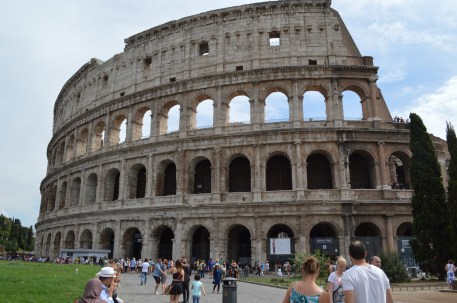
As you walk toward the Colosseum along the Via del Colosseo, with the crowds of sightseers and street vendors surrounding her, you can’t help but marvel at this ruined giant from a time long lost in history. Few ancient structures can identify a city and its founding people. However, when you see these structures, you immediately know where you are and who built them. The Parthenon identifies Athens and the ancient Greeks, just as the Colosseum identifies Rome and the ancient Romans. However, the Parthenon doesn’t have the same mystique of historical correctness or incorrectness as the Colosseum. Even its name, the Colosseum, isn’t what the ancient Romans knew it as.
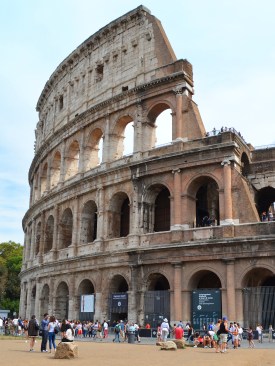
To understand what is correct about this famous and inspiring amphitheater, we need to look back to its origins before it was built. We start during the time of one of ancient Rome’s most decadent emperors, Nero. His reign was marked by misrule, murder, and the construction of lavish palaces. Even after the great fire of 64 AD, when much of the city was destroyed, he built on the very ashes of his people. In the valley next to Nero’s large “Domus Aurea” (garden house), located on Esquiline Hill, the largest of Rome’s seven famous hills, he extended his gardens and constructed a large lake in the middle. On this lake, he orchestrated sea battles with full-size ships for his entertainment and that of his privileged guests. This would later become the site of the Colosseum. At the entrance to his gardens, across from the Roman Forum, Nero erected a 100-foot-tall bronze statue of himself as the Roman sun god Apollo. This statue was known as the Colossus of Nero.
Nero was the last direct descendant of Julius Caesar, and without an apparent heir, his suicide in 68 AD triggered a series of civil wars over who would succeed him as emperor.
It wasn’t until General Vespasian seized the throne in 69 AD that the Roman Empire would finally become stable. Vespasian is best known for his military feats, particularly for suppressing the Jewish rebellion and capturing Jerusalem in 70 AD. Vespasian was the first of the Flavian emperors. Vespasian toned down the excesses of the former emperors and restored power to the Roman courts and Senate. The Emperor also promised to build the most incredible public amphitheater in the world for the people. As I wrote above, the site Vespasian chose was Nero’s Lake. Construction on his amphitheater began around 70 AD. Work was finally completed by Vespasian’s son Titus in 80 AD. It was opened with the emperor’s family name, the Flavian Amphitheater.
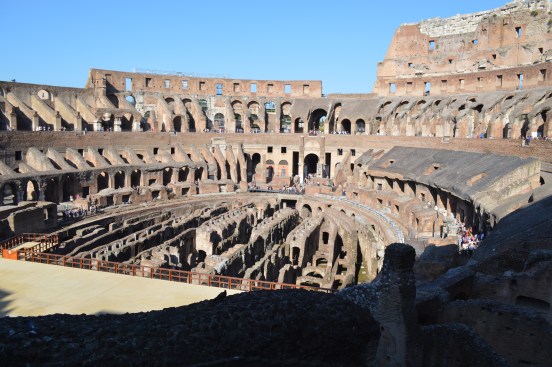
Although it took ten years to complete, the construction progressed quite quickly for such a massive undertaking. The Flavian Amphitheater was constructed with stone, marble, and concrete. When it was finished, its elliptical measurements were 620 feet long by 513 feet wide, and its outer walls were over 164 feet high. Over 3,531,466 cubic feet of travertine were used in its building, and the metal pins used to hold the blocks together weighed more than 300 tons. The arena floor measured 287 feet by 180 feet and was surrounded by a 15-foot-high wall that separated spectators from the action on the floor. Below the floor level were two levels: one for the animals and one for the gladiators. Tunnels, trapdoors, and elevators allowed combatants and wild animals to enter the arena from below.
Seating was arranged by ancient Roman social order, with the upper classes positioned nearer the amphitheater’s arena floor and the lower classes seated higher up. However, there was little worry about not getting a seat because the amphitheater could hold 70,000 spectators. The amphitheater also featured many visionary elements ahead of their time, designed to comfort both its audiences and performers. To protect people from the sun, enormous awnings rolled out around the top. Additionally, to protect the audience from one of the wild animals escaping from the arena, it was surrounded by a metal mesh screen. The 2000 movie “Gladiator” provides a reasonably accurate portrayal of what the Flavian Amphitheater would have looked like, but it was still more spectacular.
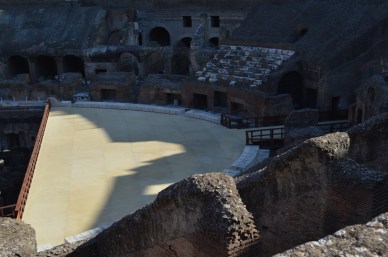
For many hunting presentations, hills, forests, and small lakes were constructed on the arena floor. It was written that at one hunting performance, over a hundred lions were released through the trap doors into the arena, and so loud were their roars that the crowd was frightened into instant silence. There is also an account that stated that over 9,000 animals were killed during the amphitheater’s inaugural games.
Today, when we think of the Colosseum, we think mainly of the gladiator battles. However, unlike what has been popularized in movies, these fighters weren’t necessarily slaves, but rather freemen seeking fame and fortune, much like today’s professional athletes. Some were criminals who fought to earn their freedom.
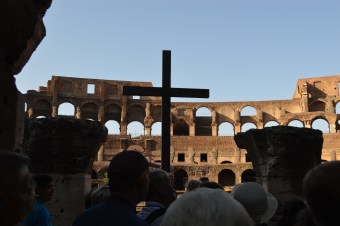
Another misconception of the Colosseum is that Christians were martyred there. Pope Benedict XIV started this story in 1749. No historical evidence suggests that Christians were ever martyred in the Colosseum. Christians were indeed martyred in Rome, but at a time before the Colosseum was built. I give the location of where Christians were actually martyred in my post, ‘The Circus of Roman Emperor Nero: Where Saint Peter was Martyred.‘
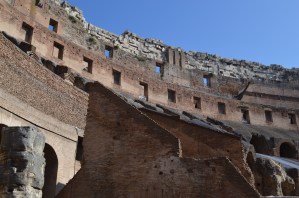
So when did the Flavian amphitheater start being called the Colosseum, and how? There are two theories regarding the origin of this name change. One reason is the structure’s “colossal” size. Another, which I think is more accurate, is due to the giant bronze statue, “The Colossus of Nero.” Vespasian added sun rays to the crown of the statue’s head and, wanting to erase any trace of the Julian family, renamed it “the Colossus of Solis.” Later, in 128 AD, Emperor Hadrian moved the statue closer to the amphitheater when he began building the Temple of Venus and Roma. Now, being so close to each other, people would refer to it as the Colosseum. No one is sure when the statue vanished into history, but the Colosseum still stood for them to see, keeping the name Colosseum.
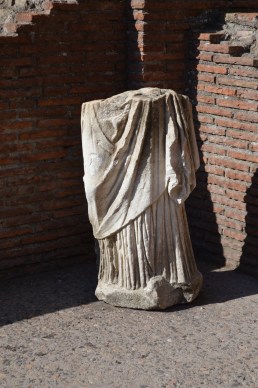
As the Western Roman Empire declined and public tastes changed, the Colosseum became increasingly less used until all performances ceased around the 6th century. By then, the arena had suffered much damage from earthquakes, fires, and other natural disasters. After it was abandoned entirely, it was vandalized, and its marble and stone were used as a quarry for other building projects in the city, including St. Peter and St. John Lateran. By the beginning of the 20th century, more than two-thirds of the original structure had been destroyed. The Colosseum’s marble seats and most of its decorative trimmings are lost. The 1990 restoration began in earnest to save Rome’s most popular tourist attraction.
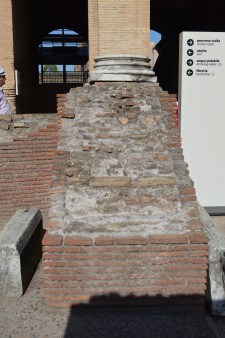
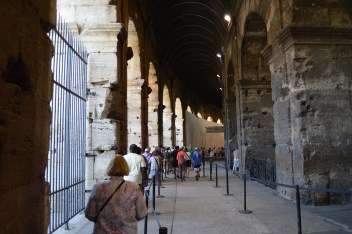
Today, as you walk inside this excellent example of the glorious architecture of ancient Rome’s last imperial period, you can envision the masses walking along its corridors and up the stairs to their seats. As you go out and see the remains of the arena floor and the cubicles below, you can almost hear the tens of thousands of Roman citizens cheering for their champions.
 Still Current
I visited a lot of website but I think this one has something extra in it in it
LikeLike