
Now, many of you may not have heard of Hampton Court Palace, it being overshadowed by the more well know Buckingham Place and the close by Windsor Castle. But for a history nut like me, it means a lot. It was at Hampton Court Palace that many of the historic events of the Tudor period in English history took place, mainly because it was the principal palace for King Henry VIII and later his daughter, Elisabeth I. Additionally, of the many areas and castles owned by Henry VIII, Hampton Court is one of only two that still exist.
The history of Hampton Court dates back to before the time of Henry VIII. The Knights Hospitallers of St. John of Jerusalem purchased the site for their farm estate in 1236. Because Hampton sat between the royal places of Sheen and Byfleet, the Knights built guest houses for the passing royal visitors as they went from one palace to the other.

In 1494, the Knights leased Hampton Court to a rising member of King Henry VII’s court, Giles Daubeney. During the time Daubeney held Hampton Court, the king and his queen often stayed there. It was during this time that Hampton Court also grew in value. However, it wasn’t until after Daubeney died in 1508 that its next owner, Thomas Wolsey, would make significant expansions to the estate.
Thomas Wolsey was an ambitious member of the next King, Henry VIII, court. Thomas Wolsey rose from a cardinal of the Roman Catholic Church to the Archbishop of York, and to Henry VIII’s Chief Minister and favorite. In 1514, he claimed the estate from the Knights and began its extravagant expansion. Wolsey wanted Hampton to be the largest and most lavish palace in England. Over the next seven years, he spent over 200,000 gold crowns adding new buildings and expanding the entire palace. However, in 1528, seeing that his enemies were turning the King against him, he decided to give Hampton Court to the King as a gift, in the hopes of saving his head. Two years later, in 1530, Wolsey died.
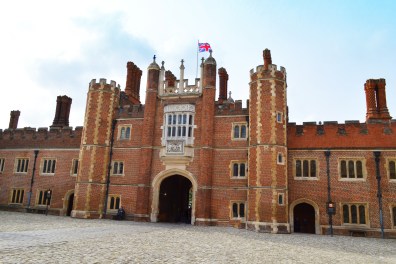
Henry VIII realized that Hampton Court was the only one of his many houses and palaces that was large enough to accommodate his ever-growing court of over a thousand. In addition, six of Henry’s wives would stay at Hampton, as well as his children. Henry VIII continued to expand and build onto the palace until 1540. Hampton Court Palace was by then 36,000 square feet, and featured tennis courts, bowling alleys, a “Great Hall” and a chapel. The palace also had a lavatory that could sit 28 people. In 1546, Henry entertained the French ambassador, with his entourage of two hundred, as well as Henry’s own court of 1,300. At the time of his death in 1547, Hampton was the favorite of Henry, over his other sixty houses.

Some of the major events in Tudor history that took place at Hampton were: The birth of King Henry VIII’s only male heir, Edward VI, by Jane Seymour. It was while attending mass in the palace’s chapel that the King learned of Queen Catherine Howard’s adultery, his fifth wife. Catherine was then confined to her apartments there until she was sent to the Tower of London, where she was executed.

Henry VIII died at Hampton Court Palace, and his eldest daughter, Queen (Bloody Mary), spent her honeymoon with King Philip there. Queen Elizabeth I, Mary’s half-sister, continued the expansion of the palace and also used it as her principal residence during her reign. When Elizabeth died in 1603, the crown passed to her first cousin, twice removed, the Scottish King James VI (son of Mary, Queen of Scots, whom Elizabeth had executed). He took the title of King James I of England, which ended the reign of the House of Tudor and marked the beginning of the House of Stuart.
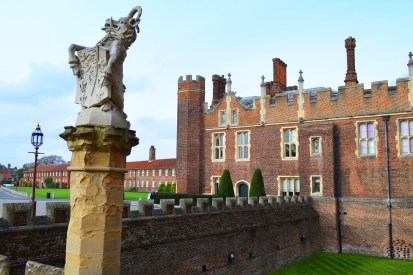
Many other historical events took place at Hampton Court Palace, but one other stands out as particularly noteworthy. In 1604, James I convened a meeting of representatives from the English Puritan Church and the Church of England at Hampton Court, aiming to resolve their differences; this meeting is known as the Hampton Court Conference. While no agreement was reached between the King, the Church of England, and the Puritans, it did prompt the King to commission the translation of the Bible into English; this led to the creation of the King James Version.

The royal families stopped using Hampton Court for themselves in 1737, but starting in 1760, the palace was used, rent-free, by those so honored by the crown. In 1838, the young Queen Victoria ordered that Hampton Court Palace should be thrown open to all her subjects without restrictions.”
Today, Hampton Court is open to all visitors, who can walk in the rooms and hallways once trod by England’s most famous and infamous rulers.
 Still Current