
Oxford University is considered to be the oldest university in the English speaking world. Although there is no written record of when teaching actually began, it is believed to have started around 1096. What the records do show is that the school began to grow rapidly at around 1167; this was after King Henry II banned English students from attending the University of Paris. In 1209, after disputes with the townspeople of Oxford, some of the professors moved to the town of Cambridge, where they founded the University of Cambridge, the second-oldest university. Together with Oxford, they are referred to as the “ancient universities.” Because of their histories, they are often referred to jointly as “Oxbridge.”
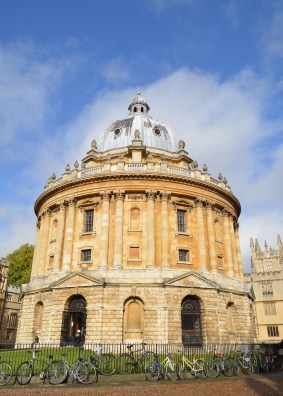
Oxford is a “city” university, which means it doesn’t have a main campus of its own; instead, the school’s buildings are intermixed with homes and businesses throughout the town. Oxford University comprises 38 colleges, as well as a range of other academic institutions. It is also home to one of the oldest and most prestigious scholarships, the Rhodes Scholarship. The school also has the oldest university museum and the largest university press in the world, the Oxford Press.
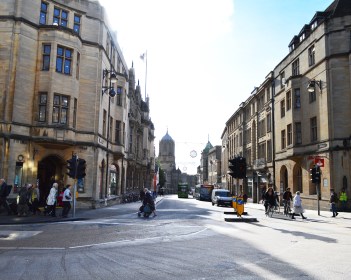
Its alumni include 27 Nobel laureates, 26 Prime Ministers of the United Kingdom, and numerous foreign heads of state. Additionally, many renowned authors and artists attended school there. The apartment where author Lewis Carroll, of Alice’s Adventures in Wonderland, stayed when he attended the university was pointed out to us.
The buildings of Oxford and those of the town have an accumulation of traditions and history that spans the centuries and will continually thrill you as you walk around this ancient city.
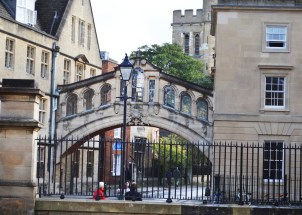
One of the most interesting structures is the Hertford Bridge. This bridge was built in 1911 as a skyway to connect the two parts of Hertford College. I was told that its design is of the Bridge of Sighs in Venice, Italy. However, this seems to be a legend; the Hertford Bridge was never designed after that famous Venetian bridge. In fact, after seeing the Bridge of Sighs in Venice, the one at Oxford looks more like Venice’s Rialto Bridge.
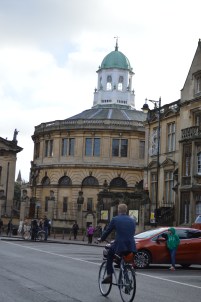
Other notable buildings at Oxford include the Radcliffe Camera, constructed between 1737 and 1749, which houses the Radcliffe Science Library, and the Sheldonian Theater, built in 1664, where concerts, lectures, and ceremonies are still held today.
 Still Current