
Stratford-upon-Avon sits one hundred miles northeast of London and was founded by the Anglo-Saxons as a market town in around 1196 AD. It most likely would have remained a simple English village if it weren’t for its famous son, William Shakespeare.
Shakespeare was baptized on April 26th, 1564, in Stratford’s Holy Trinity Church. He was the son of John Shakespeare, a respected Stratford alderman and a successful glove maker. As of now, no records have been found giving Shakespeare’s actual birthdate. When Shakespeare was 18 years old, he married local 26-year-old Anne Hathaway, taking out a marriage license on November 27, 1582. William and Anne had three children: a girl and twin boys. One of their sons, Hamnet, died of an unknown cause at the age of eleven in 1596.
Shakespeare didn’t make a name for himself in Stratford; he knew that London was better suited for a playwright. Sometime between 1585 and 1592, he moved to London, where he became the successful actor and writer that we know today. In London, he was part-owner of the playing group known as King Chamberlain’s Men and founded the famous Globe Theater, which he built on the banks of the River Thames. Shakespeare’s first works were comedies; he then wrote his famous tragedies, which continued until around 1608. After that, at the end of his career, he wrote the tragicomedies, also known as his romances, and began collaborating with other writers. In his lifetime, Shakespeare wrote and collaborated on thirty-eight plays, one hundred and fifty-four sonnets, and two long sonnets.
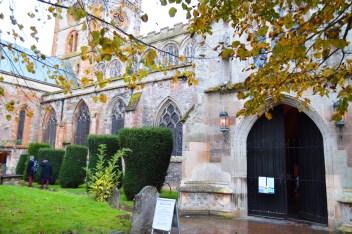
Although London was the base for his success, he traveled between there and his hometown of Stratford-upon-Avon throughout his career. In approximately 1613, Shakespeare retired to Stratford, and three years later, on April 23, 1616, he passed away at the age of 52. William Shakespeare was buried in the chancel of Holy Trinity Church, the same church where he was baptized.
Stratford-upon-Avon today capitalizes on its association with Shakespeare, attracting an estimated 4.9 million visitors each year to this small medieval town. 2016 should draw even more visitors, as it marks the 400th anniversary of his death. The first Shakespeare Jubilee, honoring him, was held in 1769, organized by the famous actor David Garrick, and lasted over three days.
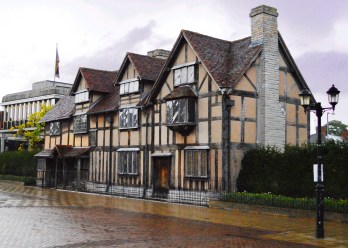
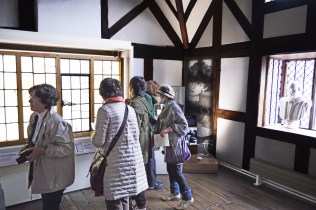
In Stratford, you can tour Shakespeare’s birthplace, house, and gardens. The interior of the house is set up as a museum of 15th-century English life. The last room you visit is where legend says that Shakespeare was born.
Since Shakespeare traveled frequently between London and Stratford, he and Anne had a house in the town, which no longer exists. Today, where the house once stood is a vacant lot. The story of why the house is no longer there is said to be because the last owner didn’t like all the tourists peeking in the windows, so he tore it down. You can visit Anne Hathaway’s house, Holy Trinity Church, and visit Shakespeare’s grave.
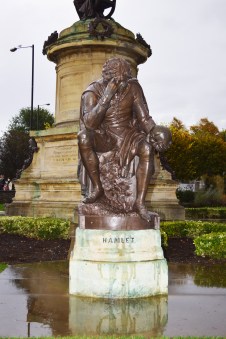
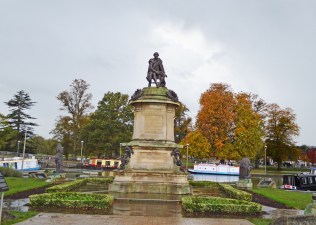
Another thing to do while in Stratford-upon-Avon is to walk along the Avon River, seeing the colorful houseboats moored along its banks. Visit the statue of William Shakespeare, surrounded by statues of some of his most famous characters, including my favorite, Hamlet. Take in a play by the Royal Shakespeare Company, or dine in one of the many historic pubs and restaurants throughout the town.
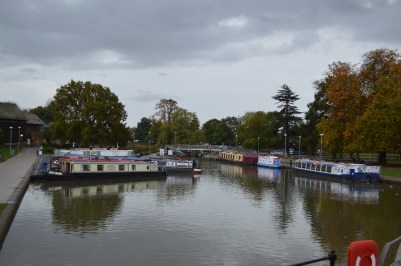
All in all, Stratford-Upon-Avon is where tourist pleasantly meets history, as long as you don’t peek in any windows.
 Still Current
One thought on “Stratford-Upon-Avon, England: Shakespeare’s hometown”