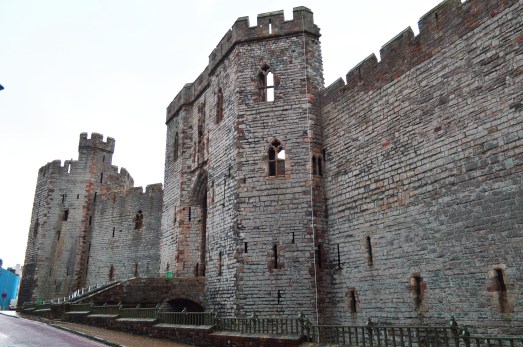

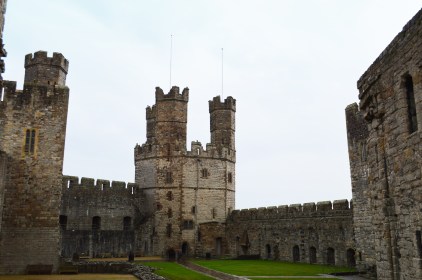
Britain is known for its castles, and one of the most impressive and massive is on the northern coast of Wales in the town of Caernarfon. Caernarfon Castle is also one of the best preserved 13th-century medieval fortresses in Britain. But even before this current castle was built, the city had a long history of being fortified. Each of the many invaders of Wales, from the Romans through William the Conqueror, has built walls and forts at this site. The current castle was built by King Edward I of England in 1283. Also, with the construction of the castle, Edward extended its walls to enclose the entire town. There is a famous legend that developed into a royal tradition associated with Caernarfon Castle, the investiture of the Prince of Wales.
The legend connecting the Prince of Wales to Caernarfon Castle dates back to Edward I. The King needed something to unite the Welsh people with England. While staying at Caernarfon Castle on 25 April 1284, Edward II, his son, was born. Edward I promised the Welsh people that they would have their own prince who didn’t speak English. Since Edward II was a baby, and therefore spoke no English.
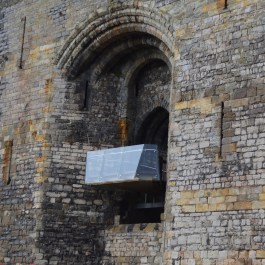
From a balcony on the castle wall, Edward I presented his son as the first Prince of Wales. History tells a different story. There were many Welsh noblemen before Edward II who claimed the title Prince of Wales. And records show that it wasn’t until Edward III that the title was attached to the heir apparent to the British Throne. Not until 1911, with the investiture of Prince Edward, the son of King George V, did the tradition begin by having the investiture ceremony take place at Caernarfon Castle. The next was Prince Charles, on July 1, 1969, by his mother, Queen Elizabeth II, from the same castle balcony as legend had it.

The Castle is owned by the Walsh government, but in theory it belongs to the Earl of Caernarvon. The Caernarvon family has a notable history in archaeology, extending beyond their castle. It was George Herbert, the 5th Earl of Carnarvon, who funded Howard Carter’s discovery of the tomb of Tutankhamun. And it was Herbert’s death that led to the story of the “Mummy’s Curse” when he died from a severe mosquito bite infection while in Cairo, Egypt, soon after the tomb was discovered. The Caernarvon family has also made their mark in popular television culture. The home of the current Earl of Caernarvon is Highclere Castle, which is the setting for Downton Abbey.

The Town of Conwy
While visiting Caernarfon, take a short side trip to the small seaside town of Conwy, a medieval walled market town. Conwy is known for two of its buildings: its own massive and picturesque castle and the smallest house in Great Britain. Conwy Castle and the city walls were also built by Edward I between 1283 and 1289. The castle’s builder was James of St. George, who constructed both the castle and the city’s walls. Conwy Castle is regarded as one of the finest examples of late 13th-century and early 14th-century military architecture. Its massive walls can be seen throughout the old town.

At the foot of one of the city’s walls, by its docks, sits a building that is at the extreme opposite end of the scale in size from the castle; it’s the smallest house in Britain. This house is also known as the Quay House, as it is situated on the quay (Docks) of Conwy. The floor area measures only 10 feet by 5.9 feet, and the height to the eaves is 10 feet 2 inches. The Quay House has been inhabited from the 16th century until the 1900s, when it was declared unfit for human habitation.
The last person to live in the house was a fisherman named Robert Jones. Mr. Jones was 6-foot-3-inches, and he couldn’t stand up fully in the house. This Quay house is still owned by the Jones family and is used as a tourist attraction. For a small fee, you can look inside.
 Still Current
One thought on “Wales’ Castle Caernarfon, and the City of Conwy”