
In 360 BCE, approximately 1,300 years after the massive eruption of the island Thera, the Greek philosopher Plato wrote in his Timaeus of a great sea power that had attacked ancient Athens. He wrote that this sea power was the most incredible power that the world had ever seen. These invaders, he wrote, came from a giant island beyond “the Pillars of Hercules,” which he called Atlantis. In his story, Athens repelled the attack, ending with Atlantis falling out of favor with the Gods and sinking beneath the sea after a great calamity.
Although the Atlantis story was of minor importance in Plato’s work, believed to have been used as a metaphor, the tale of Atlantis has grown to legendary status. Present-day philologists and historians agree that the story presented by Plato is fictional in character. Still, there is much debate about what might have inspired his tale and where this mythical island may have existed. After reading many of these theories, I lean toward those that place Santorini/Thera as ancient Atlantis, or at least part of it. I also think that Plato was not just using the one island in his tale, but was referring to an entire advanced civilization that had occupied the Greek Isles for his Atlanteans. I also believe that the eruption of Thera led to the destruction of that civilization and was used by Plato to support his account of Atlantis.
In presenting my thoughts, I will examine two aspects of the Atlantis tale: first, its probable location, and second, who the Atlanteans could have been if they actually existed.
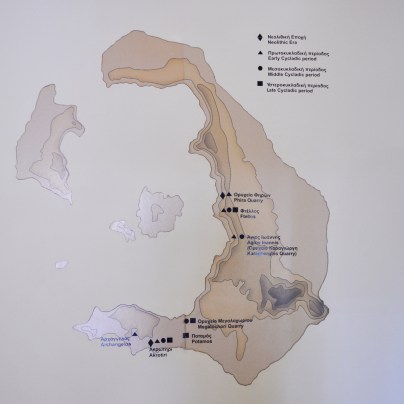
First, what would the probable location of Plato’s Atlantis have been? In his Timaeus, Plato puts Atlantis “beyond the pillars of Heracles (or the Roman spelling, Hercules).” Today, the most commonly referred to landmass known as the Pillars of Heracles is the Straits of Gibraltar. This has led most theorists to consider Atlantis’ location in the Atlantic Ocean. However, the ancient Greeks referred to many locations as “the Pillars of Heracles.” The mythical stories of the hero Heracles and the other Greek gods and heroes were oral tales told before the Aegean Bronze Age, which started around 3000 BCE. These early settlers, who would later become the Greeks, migrated to the Greek peninsula from Eastern Europe after the last great Ice Age. Their worldview was limited to the region around the northeastern Mediterranean. They would not have known about the Straits of Gibraltar. Two landmasses in the world of the ancient Greeks were also known as the Pillars of Heracles during that period. These are the two southward-pointing headlands on each side of the Gulf of Laconia in Greece’s Peloponnese. Using the Peloponnesian Pillars of Heracles would put the island of Thera (Santorini) beyond them.
It has also been theorized that Plato may have referred to Atlantis as a group of people on multiple islands, rather than just one giant island. This brings me to my second thought about who the Atlanteans could have been. There must have been an advanced Bronze Age Mediterranean civilization that Plato could have drawn upon for his description of the Atlanteans. There was a civilization that was more advanced than the early Greeks of the mainland in the early Bronze Age. We know them today as the Minoans. The Minoan civilization originated on the island of Crete and subsequently spread throughout the eastern Mediterranean, including the island of Thera. Historians agree that the Minoans and the early mainland Greeks had conflicts. Greek mythology is full of tales of these conflicts. One of the most famous is of the Greek hero Theseus killing the Minotaur in the Labyrinth on Crete. This myth tells of King Minos of Crete demanding that, every nine years, King Aegeus of Athens send seven boys and seven girls to Crete as an offering to the Minotaur, a monster with the body of a man and the head of a bull. This story depicted the power of the Cretan King over mainland Athens at that time. Plato’s description of the conflict between the Atlanteans and the Athenians, although a different tale, is similar to what was going on between these two people.
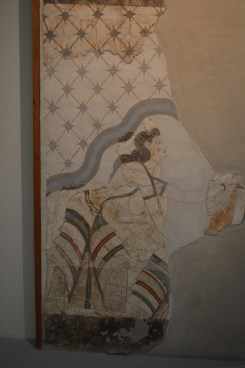
No records tell us the name of this Bronze Age island civilization in ancient times. Twenty-century archaeologist Arthur Evans gave this civilization the name Minoan, taken from the mythical Cretan king Minos. So, could the people we call today the Minoans have been Plato’s Atlanteans?
So, what does history say happened to the Minoans? And how does it compare to what Plato says happened to the Atlanteans? Plato writes about the battle between the Athenians and the Atlanteans, in which the Athenians won. History says that as the mainland Mycenaean and Athenian civilizations grew and expanded, they pushed back on the Minoans, and I’m sure there would have been battles. Plato then writes that Atlantis angered the gods, and they caused a great calamity to fall on Atlantis, sinking it beneath the sea. We know that the Minoan civilization flourished, beginning in approximately 3650 BCE. Then, around 1615 BCE, Thera exploded, raising havoc throughout the Minoan islands and civilization. Following the Thera eruption, the Minoan civilization began to decline, and by approximately 1540 BCE, the Minoans had disappeared.
In my opinion, the Minoans served as the model for Plato’s Atlanteans, and the Thera eruption was the calamity that not only destroyed the Minoan civilization but also contributed to the creation of the legend of Atlantis.
When you visit the island of Santorini and stand on the crater’s edge, looking down at the sea in the caldera, you can feel that you have indeed found the lost Atlantis.
 Still Current
One thought on “Atlantis; maybe not so lost?”