
One of Greece’s most exciting and unique archaeological sites is the Bronze Age city of Akrotiri on the island of Santorini (Thera).
Human habitation on Thera can be traced back to the fifth millennium. However, the Minoan period of Akrotiri, at the time of the eruption, is the most interesting. The Minoan civilization originated on the island of Crete and spanned from approximately 3650 BCE to around 1400 BCE. The Minoans are regarded as one of the most advanced civilizations of the Bronze Age. They were sea people, spreading out from Crete to the islands in the Cyclades group. They traded with other Mediterranean civilizations, such as Egypt and Turkey. Akrotiri is believed to have been one of the main Minoan trade centers.
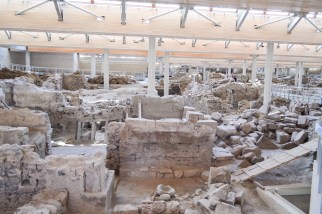
Between 1642 and 1540 BC, Thera exploded in one of the most massive eruptions in history. The eruption buried Akrotiri under tons of volcanic ash, freezing it in time. The city lay hidden for over three millennia until locals, quarrying pumice, began finding ancient artifacts. In 1867, the first organized excavations of the site began under the direction of the French geologist F. Fouque. Although other excavations were conducted in the later part of the 19th and early 20th centuries, it wasn’t until Greek archaeologist Spyridon Marinatos began working that the site revealed its true meaning. Within just a few hours, Marinatos uncovered the remains of a completely buried city. Today, Akrotiri is one of the most significant archaeological sites in the Aegean region and is often referred to as the Pompeii of Greece.
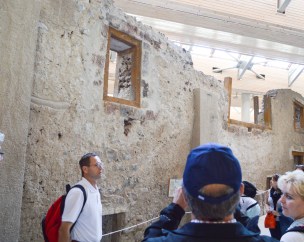
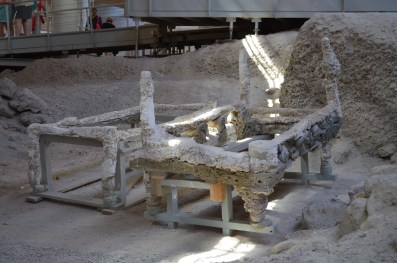
Unlike Pompeii, there are no signs of human deaths caused by the eruption that buried Akrotiri. Although there are pieces of furnishings that molds have been made of, no bodies have been found so far. In fact, the city is void of even articles of value. This suggests that the population of Akrotiri, and the entire island as well, may have had sufficient time to evacuate before the final blast occurred.
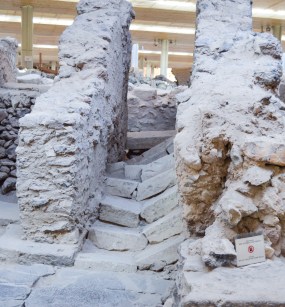
Another unique difference between Pompeii and Akrotiri is that the entire excavation is inside a covered building, protecting it from the elements. You view the ruins from an elevated walkway, which provides a bird’s-eye view of the streets and rooms. On the tour, you can go down onto one of the ancient streets, a street where people walked almost seventeen hundred years before Pompeii.
 Still Current
One thought on “Thera’s prehistoric city of Akrotiri [akro’tiri]: the Pompeii of Greece”