
The last stop on our tour was the island, known by most as Santorini. This Greek island was one of the most anticipated stops for me because of its geological formation and history, both real and mythical. Santorini has another name, perhaps even a third, that’s mythical and even more famous.
The name Santorini comes from when the island was part of the Latin Empire in the thirteenth century. Today, Greece has officially restored the island to its classical Greek name, Thira, also spelled Thera. The island is also connected to an even older, mythical name, Atlantis. I’ll cover this theory in a future post.
It is part of a small archipelago of islands at the far southern end of the Cyclades Island group. The Thera archipelago group comprises five islands, the largest of which is Thera. The others in the archipelago are the inhabited island of Therasia and three uninhabited islands: Nea Kameni, Palaia Kameni, and Aspronisi. Nea Kameni and Palaia Kameni are the newest islands in the archipelago, having been created when the supervolcano exploded in around 1627 or 1600 BCE.
When you sail into Thera’s harbor, you are actually sailing into the caldera of that supervolcano. The sight of the island’s sheer cliffs, rising more than nine hundred feet above the harbor, with its famous white stucco buildings and colorful blue roofs virtually hanging onto the very edge of those cliffs, is truly fantastic.
There are three ways to get to the crest of the crater: one is to walk up. It’s not a good idea; remember, it’s over nine hundred feet straight up. You can take a donkey and ride to the top. Although this is a touristy thing to do, most people say how uncomfortable it is. And lastly, by a motor vehicle. Our method was by a 60-passing travel coach, which was an experience in its own right. My hats off to our Greek driver and his expertise on the steep, winding, one-lane road.
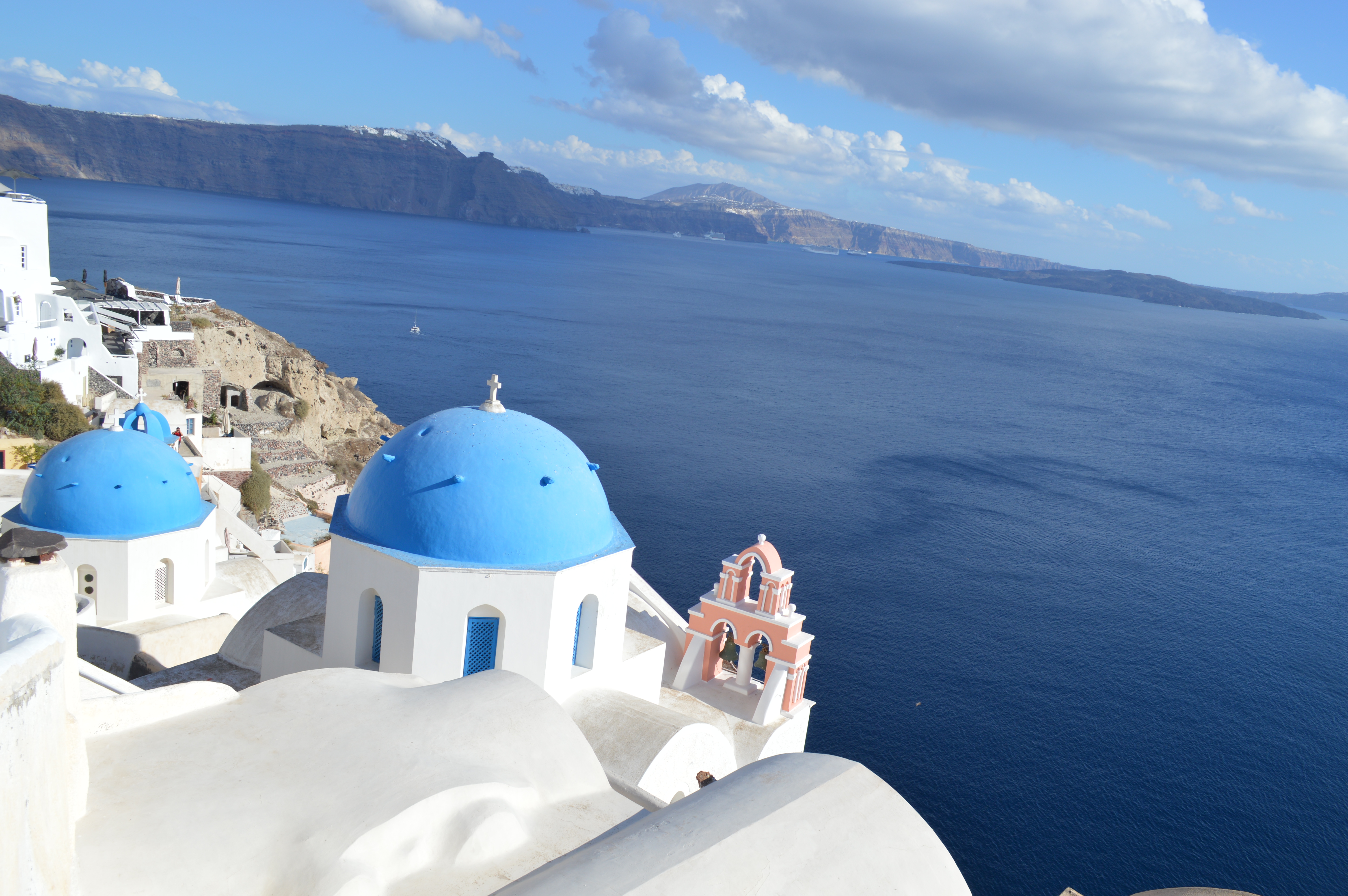 As I mentioned, Thera is a supervolcano. Its two major cities sit on the western rim of the crater, while the east side of the island slopes gently down to the sea.
Like all of Greece, Thera has beautiful churches to visit. There are big ones and small ones all over the island. The number of churches reflects the Greeks’ devotion to their religion. 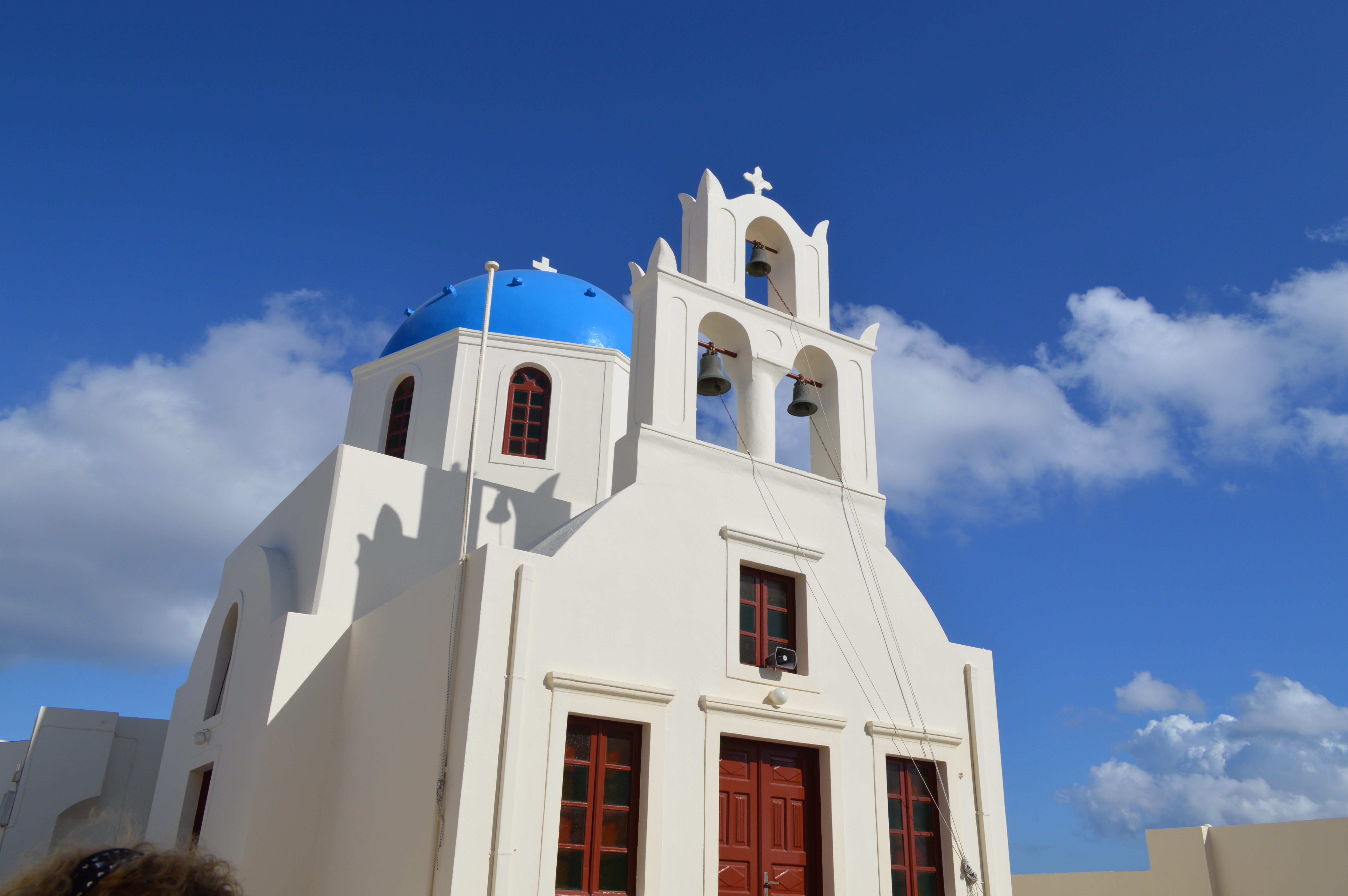
Greece and its islands have a national religion—Christian Greek Orthodox. Over 90% of all Greeks passionately practice this religion. The Greek Orthodox is a branch of the Eastern Orthodox Church, which makes up the second-largest Christian church group. It is also one of the oldest religious institutions in the world, claiming that its practice dates back to the original faith passed down from the Apostles.
In future posts, I will explore the volcanic, archaeological, and mythical history of this beautiful Greek island, Thera.
 Still Current
One thought on “Santorini? Thera? Or is it Atlantis?”