Leaving the Old North Church follow Hull Street toward Charlestown. About a block from the church, you will be at Copp’s Hill Burying Ground.
Copp’s Hill Burying Ground
Founded in 1659, it was the largest cemetery in the Colonies at that time. Copp’s Hill is the final resting place for two Puritan ministers who were involved with the Salem Witch trials. Also buried here is Robert Newman, the Sexton of the Old North Church, who is believed to have been the one who hung the lanterns for Paul Revere in the church’s steeple. Edmund Hartt, the builder of the USS Constitution, also lies at rest here. In Copp’s Hill Burying Ground, it is believed that close to 1,000 free African-Americans are buried there, one of whom is Prince Hall, who formed the country’s first Black Masonic Lodge and was instrumental in ending slavery in the Bay State. During the Battle of Bunker Hill, because of its height, Copp’s Hill was used by the Red Coats to train their cannon on Charlestown.
Continue on Hull Street to Commercial Street, turn left, and head over to and across the Charlestown Bridge. Once you are across, turn right along Constitution Road toward the tall ship docked at the Boston Navy Shipyard- The USS Constitution, “Old Ironsides.”
Old Ironsides
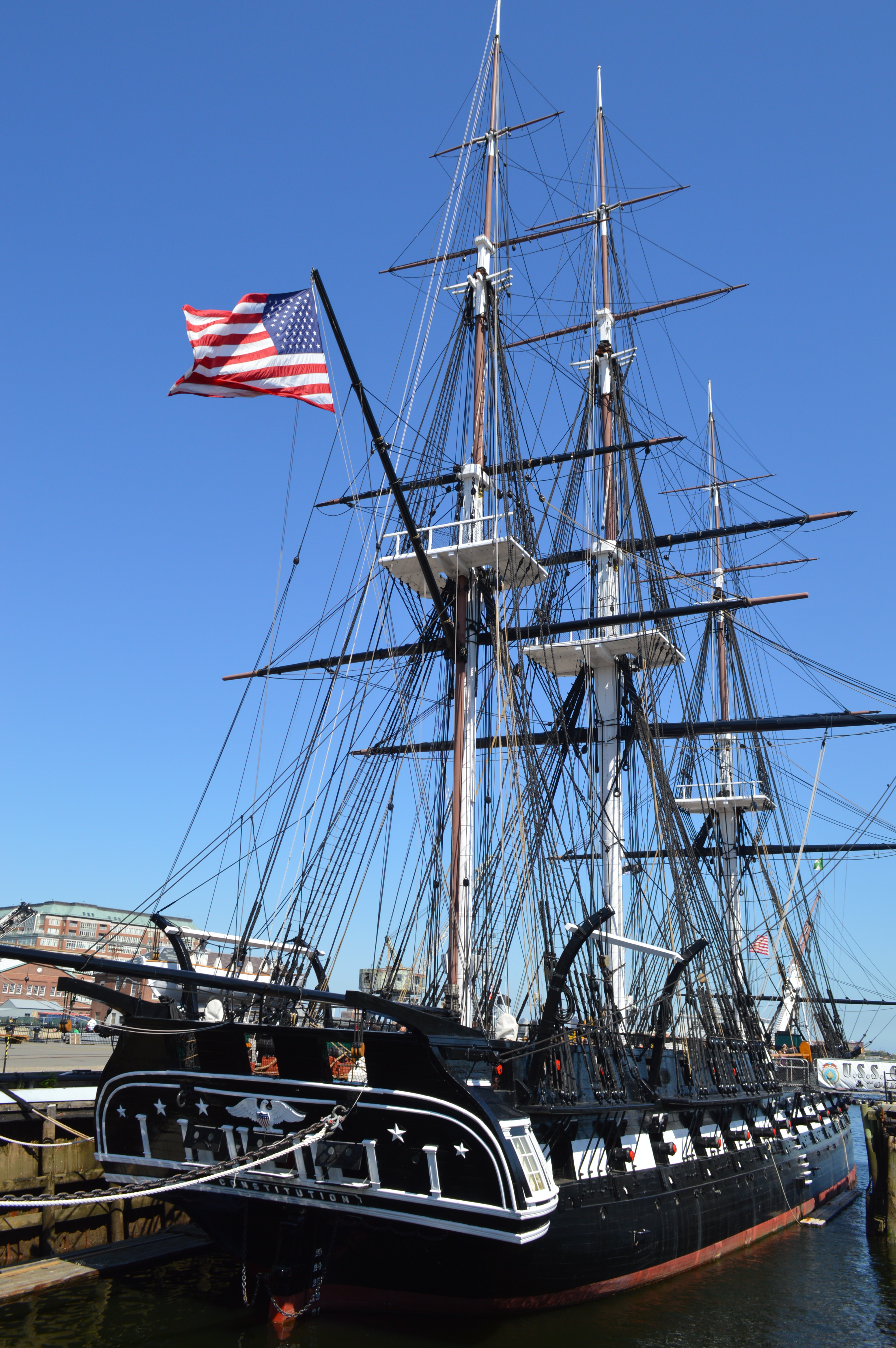
The USS Constitution is the oldest commissioned ship in the US Navy. She was launched in 1798 and became famous while helping to defend our nation during the War of 1812. It was during the naval battle with the HMS Guerriere that a British sailor, seeing their cannonballs bouncing off her sides, gave her the famous nickname “Old Ironsides”. Her unique construction, a three-layer wood sandwich of American hardwoods, gave Old Ironsides its strength. The copper fastenings for the ship were made by Paul Revere. When she was in service, the USS Constitution had a crew of 500; Today, she is manned by a crew of about 70.

After you leave the USS Constitution, your next stop will be the Bunker Hill Monument. It’s not hard to find this site because of its 221-foot granite obelisk, which towers over Charlestown. We crossed over Chelsea Street, under the Tobin Memorial Bridge, and climbed up Tremont Street to the monument.
The Bunker Hill Monument
After the battles of Lexington and Concord, the Colonial Militia chased the Redcoats back to Boston and then laid siege to the city of Boston. On the evening of June 16, 1775, Col. William Prescott ordered the militia to fortify the high ground of Bunker’s Hill. However, they chose the next hill over, Breed’s Hill, instead. The Red Coats awoke the next day to find cannon and rifles manned by 1,000 militia pointing down on them from the hilltop. To protect their position on June 17, the British crossed over to Charlestown with 2,200 troops to attack the hill. Only after three charges were the British troops able to dislodge the defenders from the hill.

The reason given for the militia’s pullback was a lack of ammunition. In the end, the colonists lost between 400 and 600, who were either killed or wounded. The British casualties amounted to 1,034 killed or wounded, almost half of the British attacking force. This was the first major conflict of the American Revolution, and although the British technically won the battle, it served as a morale booster for the untrained colonists. The mistake in the name of the hill used in the battle was due to a British Lieutenant Page, who reversed the names of the two hills on the battle map.
The cornerstone for the monument was laid in 1825 by Revolutionary War hero the Marquis De Lafayette, and the structure was completed in 1842. Climb up the 294 steps to the top if you can. There is a museum of the battle across from the monument at the corner of Monument Square and Monument Avenue.
 Still Current